
THREE British tourists are among at least 16 people killed in the horror Lisbon tram crash.
More than 20 people were also injured after the terrifying collision which left passengers trapped under the wreckage of the iconic Gloria Funicular.
GettyA Brit tourist is among 16 dead in the Lisbon tram crash[/caption]
GettyA woman lays flowers near the scene of the crash[/caption]
Portugal is now observing a day of national mourning after the deadly disaster which was reportedly caused by a cable coming loose.
Holidaymakers from a range of different countries are among the dead, including two German and two Spanish nationals.
A three-year-old boy from Germany who escaped death begged a cop to hold him after the crash killed his dad and seriously injured his mum.
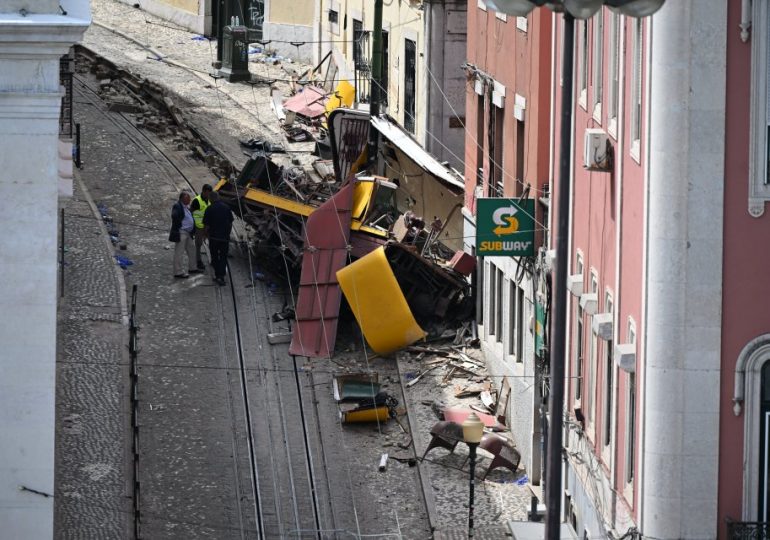
Witnesses told how the carriage sped down the before smashing into a building and crumpling “like a cardboard box”.
Chilling footage showed rescuers running over to the wreckage, with distressed onlookers heard screaming: “There’s kids under there.”
The first victim of the tram disaster was named as brakeman André Marques.
At least 21 people, including the German three-year-old’s mum, were left injured following the harrowing disaster.
The list of victims is understood to include eight women, seven men and two unidentified victims.
Among the dead and injured are Portuguese nationals, Germans, Spaniards, as well as people from South Korea, Canada, Italy, France, Switzerland, Morocco and Cape Verde, authorities say.
Investigators in Lisbon are still trying to piece together the tragedy which occurred when the cable car was making its usual 2,441ft journey just after 6pm local time.
It was reportedly full with at least 38 people inside, made up of locals and tourists, due to it being rush hour in the busy city.
Disturbing footage showed dozens of bystanders sprinting up the steep road to find the car flipped on its side and torn apart into splintered metal.
Clouds of dust and smoke had engulfed the narrow lane as a crowd of concerned onlookers gathered at the bottom of the hill.
Fire crews and paramedics arrived shortly after as they swarmed the wreckage.
The brake guard in charge of the funicular, André Marques, would have started the descent by pulling a lever to make the cart move along the cables above it.
The Glória line’s two cars are attached to opposite ends of a haulage cable with traction provided by electric motors on the cars that counterbalance each other.
As the journey down the hill started – a trip which should have taken two minutes and 12 seconds – the other tram started to come up like usual.
Expert analysis: What went wrong?
Prof Dave Cooper, Chair the British Standards committee for Cableways in the UK, told The Sun about what may have caused the tragedy.
He said: “From an engineering design perspective what we know is that the system opened in 1885 and is therefore unlikely to have complied with modern standards expected of a new cableway system.
“It can be described as a heritage system. It had two cars each rated at 43 persons and travelled a distance of some 265metres.
“From description seen it is understood that the system had just set off with the lower car ascending and inversely the upper car descending.
“Passengers from the lower car describe it that the car had just left the bottom station and travelled a short distance and then suddenly reversed and relaxed to its stopping position.
“Given that the bottom car is still intact in that position and the top car that was descending is now down the track and has derailed it can be said that the relationship between the two cars has been lost.
“It is possible that the ropes that connected the two have broken. It is understood that there were bends in the track and that if the top car was descending uncontrollably the geometry of the track may have allowed the car to derail given the speed that it would have achieved.
“What is not understood is why the emergency brake (if there was one) on the uncontrollably descending car did not apply.
“It maybe that it did but was unable to overcome a combination of the mass of the car and its passengers and the speed at which it was travelling.”
It is believed that a cable holding the lower streetcar snapped with witnesses hearing a “metallic thud” on the line.
Bruno Pereira told CNN Portugal: “I noticed that the tram below didn’t stop exactly where it was supposed to.
“There was a metallic thud, a loud noise, and the tram jumped off the track and moved about two feet onto the sidewalk.
“That was the first strange thing that happened.”
Due to the two trams needing each other to work properly the initial error caused the second carriage to lose control.
André Marques, the brake guard in charge of the funicular when it derailed, has been named and pictured as the first victim
Shutterstock EditorialOver 20 people were injured[/caption]
GettyAuthorities are still probing the crash[/caption]
Rescue teams hauling stretchers had to use specialised cutting equipment to get inside the mangled carriage.
Civil protection officials said 62 rescue workers and 22 vehicles were deployed to the site for the two hour rescue and recovery mission.
Portugal’s National Institute of Medical Emergencies confirmed that some of the victims were foreign nationals.
A pregnant German woman is in a critical condition, according to Observador.
An Italian woman also broke her arm, Corriere della Sera reports citing the Italian embassy in Lisbon.
APIt was reported that a cable came loose before the crash[/caption]
APThe horrifying ordeal killed tourists, including one German dad[/caption]
Leave a comment