
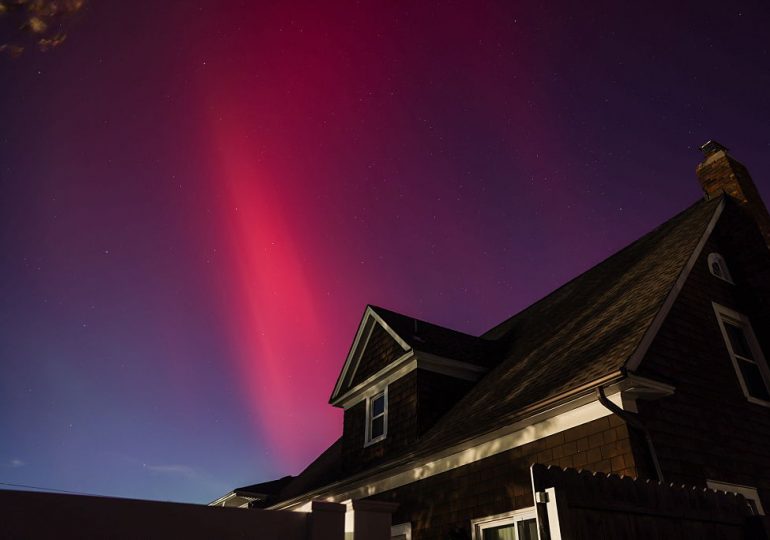
The Northern Lights could illuminate skies in over a dozen states on Monday and Tuesday..
Large expulsions of plasma from the sun, known as coronal mass ejection, are forecast to reach the Earth overnight Monday or by midday on Tuesday, according to The National Oceanic and Atmospheric Administration’s Space Weather Prediction Center and the U.K.’s national meteorological service, which could cause a strong geomagnetic storm and make the Northern Lights visible further south than usual.
[time-brightcove not-tgx=”true”]
The beautiful phenomenon, also known as the aurora borealis, occurs when such plasma and the Earth’s magnetic field interact, producing colorful light displays.
Geomagnetic activity will likely reach a G1 on the geomagnetic storm scale, ranking as a minor event, on Monday, before intensifying into a stronger G3 geomagnetic storm on Tuesday, NOAA predicted.
Portions of 15 states could have a full or partial view of the aurora Monday and Tuesday, per the agency’s forecast, including Alaska, Idaho, Iowa, Maine, Michigan, Minnesota, Montana, New Hampshire, New York, North Dakota, South Dakota, Vermont, Wyoming, Washington, Wisconsin.
A forecast from Geophysical Institute at the University of Alaska predicts that, with clear skies, the lights could be visible Monday evening from Utqiaġvik to Anchorage and Juneau in Alaska, as well as in Maine, Idaho, Indiana, and Wyoming. On Tuesday evening, the University is slightly more optimistic than NOAA, showing potential for the lights to be seen in cities like Indianapolis, Chicago, Cleveland and Boston, as well.
And the lights don’t have to be directly overhead for you to potentially see them: According to NOAA, it can be observed from as much as over 500 miles away when the aurora is bright and if conditions are right.
To get the best view the phenomenon, the agency recommends finding space away from city lights and viewing the sky in the late evening or very early morning (within two hours of midnight).
Less than one month ago, the aurora borealis was seen not only in northern states like Minnesota and Montana, but as far south as states like Florida, Alabama, and New Mexico.
Its expected appearance in the skies this week comes just days before another much-anticipated celestial event is set to occur: the peak of the Geminids meteor shower. The meteor shower, considered one of the best and most reliable to take place each year, occurs every December as the Earth orbits through a patch of debris left behind by a mass known as 3200 Phaethon. This year it began on Dec. 4 and will end on Dec. 17, with the peak expected to occur on Dec. 12 and 13.