A “megaquake” could occur along Japan’s main island north coast in the coming week, authorities said in a rare warning after a 7.5-magnitude tremor shook the same region on Monday.
Officials at the Japan Meteorological Agency (JMA) said that the Monday quake, which struck at 11:15 p.m. off the Pacific coast of Aomori prefecture at a depth of 54 km, increases the chance of a quake of a similar or higher magnitude in the same region within the coming week.
[time-brightcove not-tgx=”true”]
It’s the first time the agency has issued a megaquake (8.0 magnitude or higher) warning for the coastal regions of Hokkaido and Sanriku since the system was introduced in December 2022, according to local paper Asahi.
Tsukasa Morikubo, a Cabinet official for disaster management, said in a press conference Tuesday that a megaquake could occur along the Japan Trench and the Kuril Trench off Hokkaido as a follow-up to the Monday tremor.
“It is unclear whether a large-scale earthquake will occur,” Morikubo said. “But everyone should heed the call to take precautions to protect their own lives.”
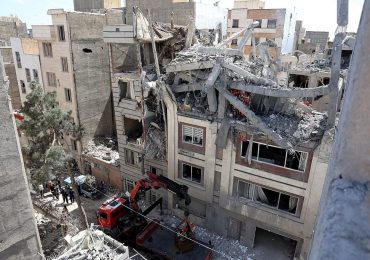
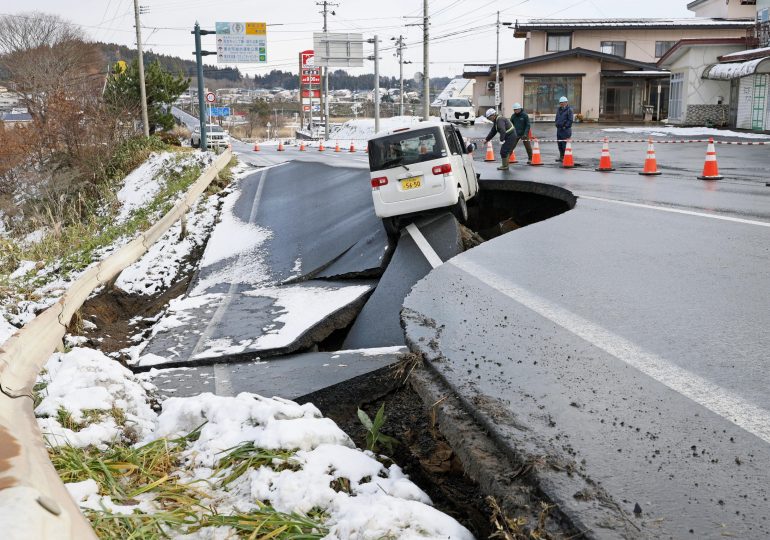
The Monday quake was powerful enough to trigger 2-ft-high tsunamis, injure at least 30 people, and prompt evacuation orders for some 90,000 residents. Videos on social media show the shaking prevented people from standing up. Photos of the aftermath showed cracks on roads and damage to some buildings in Aomori, and even some residents in Tokyo more than 350 mi. away said they felt the tremor.
With the strength of the latest quake, Prime Minister Sanae Takaichi warned residents to “pay close attention to updates” from JMA and local authorities, given the increased likelihood of a much stronger follow-up. “In addition to reviewing your regular earthquake preparedness—such as securing furniture—please ensure that you are ready to evacuate immediately if you feel any shaking,” Takaichi said Tuesday.
A “megaquake” warning is not new: in response to a 7.1-magnitude quake in the country’s south in August 2024, Japan issued its first-ever alert for a megaquake originating from the nearest undersea trench called the Nankai Trough. No related earthquake happened after that, and citizens were able to return to their daily lives a week later.
But despite Japan’s constant exposure to such tremors—its location on the circum-Pacific “Ring of Fire” means that earthquakes, both felt and unnoticed, occur about every three minutes—earthquake panic, particularly for megaquakes and the so-called “Big One,” remains high because of the risk of scores of casualties.
Here’s what to know about megaquakes in Japan.
What is a “megaquake”?
According to Japan’s Headquarters for Earthquake Research Promotion, quakes that record a magnitude 8.0 or higher are considered megaquakes. These often occur when one of two converging tectonic plates slides underneath the other, creating subduction zones. Japan is surrounded by many of these zones, which are known for increased volcanic and earthquake activity.
Such quakes can cause strong shaking across wide areas, with epicenters extending as far as 100 to 200 km.
Japan has a history of strong earthquakes—such as the 1923 Kanto earthquake (magnitude 7.9), the 1944 Tonankai earthquake (magnitude 7.9), the 1946 Nankai earthquake (magnitude 8.0), and the 2003 Tokachi-oki earthquake (magnitude 8.0). Strong quakes can also occur on inland active faults, such as the 1891 Nobi earthquake (magnitude 8.0).
One of the most prominent megaquakes in the country, however, was the 2011 Great East Japan Earthquake. The magnitude-9.0 quake was so strong it caused 23-ft high tsunamis, killed more than 20,000 people, and famously damaged a major nuclear reactor in Fukushima.
Earlier this year, a government panel report stated that a megaquake in the Nankai Trough region down south has an 80% chance of happening in the next 30 years. As many as 298,000 people could die under that quake’s worst-case scenario.
As for a mega-quake in the Japan Trench and the Kuril Trench to the country’s east, previous government estimates show that as many as 199,000 people could die if a magnitude-9.0 quake strikes the country’s east coast.
Why did the latest quake trigger megaquake concerns?
The JMA stated that based on past global large-scale earthquake statistical data, the probability of a magnitude-8.0 or higher earthquake occurring in the area within a week after a magnitude-7.0 or higher quake is about 1 in 100, which is “higher than usual.”
A megaquake in the region could trigger tsunamis along Japan’s Pacific coast from Hokkaido to Chiba Prefecture, according to NHK.
The Headquarters for Earthquake Research Promotion reports that the northern Sanriku coast has a 4% to 20% probability of experiencing a magnitude-8.0 or higher quake within 30 years. The last such recorded instance was the 1968 Tokachi quake, which had a magnitude of 8.3.
Given the region’s history of strong earthquakes, Yoshihiro Hiramatsu, a professor at Kanazawa University and an expert in earthquake studies, told Kyodo News that the Monday temblor may have shifted the ground’s balance, possibly setting up factors for a larger earthquake.
Lesser-magnitude quakes have previously been foreshocks to larger-magnitude ones. Two days before the deadly 2011 quake, a magnitude-7.3 earthquake occurred off the coast of Hokkaido and Sanriku.
But such a megaquake alert isn’t necessarily grounds for people to evacuate, as the JMA admitted its megaquake forecasting involves “a very high degree of uncertainty.”
Instead, authorities urge residents to prepare extensively, including checking evacuation routes, readying emergency kits, and confirming backup food, water, and portable toilets.
Leave a comment