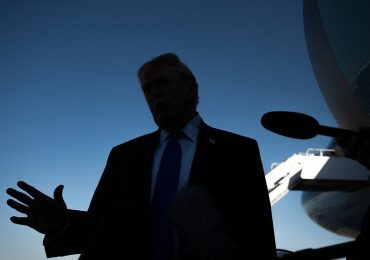

President Donald Trump is doubling down on his increasingly harsh criticism of the U.S.’s European allies as he faces pushback from European leaders over his Administration’s new national security strategy, calling Europe “weak” and “decaying” and intensifying his attacks on its migration policies.
[time-brightcove not-tgx=”true”]
Asked about the strategy, which has drawn outcry from former European officials over what one described as its “far-right” rhetoric, Trump told Politico in an interview released on Tuesday that if Europe “keeps going the way it’s going,” many countries on the continent “will not be viable countries any longer.”
The President asserted that European immigration policy “is a disaster,” and that its leaders’ desire to be “politically correct” was making them “weak.” He also criticized European leaders over their handling of Russia’s war in Ukraine, saying, “They talk but they don’t produce. And the war keeps going on and on.”
When asked if European nations would remain U.S. allies if they change and grow weaker in Trump’s eyes, the President said, “It depends.”
The security strategy the White House released late last week hit similar notes in a section on “Promoting European Greatness,” claiming that Europe is facing “the prospect of civilization erasure” and arguing that many NATO countries will soon “become majority non-European” in an echo of the racist conspiracy theory known as the “Great Replacement Theory.” The document also advocated “cultivating resistance to Europe’s current trajectory within Europe” and signaled support for nationalist far-right political parties on the continent as “political allies” seeking to crack down on immigration and push back on government “censorship.”
In the wake of its release, European leaders have warned the Administration against interfering in affairs on the continent and shifting the U.S.’s approach to transatlantic relations. German Chancellor Friedrich Merz said on Tuesday that parts of the document were “unacceptable to us from a European perspective,” adding that Europe needs to become less dependent on the U.S. given the concerning change in Washington’s strategy.
“I see no need for the Americans to now try to save democracy in Europe. If it needed saving, we would be able to handle that on our own,” Merz said.
António Costa, president of the European Council—which sets the political direction of the European Union— and former Portuguese prime minister, decried what she described as the strategy’s “threat to interfere in European politics,” asserting that the continent’s authority over its own affairs must be protected.
“Allies do not threaten to interfere in the domestic political choices of their allies,” Costa said at an event in Paris on Monday. “The US cannot replace Europe in what its vision is of free expression … Europe must be sovereign.”
He implored Europe to “protect ourselves not only against our adversaries, but also against the allies who challenge us.”
Trump told Politico in the Tuesday interview that he doesn’t “want to run Europe,” but noted that he is “very much” involved on the continent and signaled he will continue endorsing candidates aligned with his views in its elections.
Amid his attacks on the continent’s leaders and policies, he offered praise for the far-right leaders of Hungary and Turkey, saying that Hungarian Prime Minister Viktor Órban, who he noted he previously endorsed, was doing a good job on immigration and calling Turkish President Recep Tayyip Erdogan “a friend of mine” and “a tough cookie.”
Meanwhile, he levied particular criticism against Germany and Sweden, where he said the governments’ immigration policies have contributed to rising crime, and London and Paris, which he said have changed for the worse.
London Mayor Sadiq Khan, who Trump labeled “horrible” and a “disaster” in the interview, responded to the attacks on Tuesday. “I think the one part that President Trump has got right is that London is becoming a different place. We are the greatest city in the world.” Khan told Politico, adding, “I literally have no idea why President Trump is so obsessed with this mayor of London. I’m not sure what he’s got against a liberal, progressive, diverse, successful city like London.”
Trump also criticized Ukrainian President Volodymyr Zelensky over his approach to peace negotiations with Russia, saying that Ukraine has to “play ball,” and that there was “no question” that Russia was in a stronger negotiating position and had the “upper hand” because of its size advantage. Trump also accused the Ukrainian leader of “using the war not to hold an election.”
“They talk about a democracy, but it gets to a point where it’s not a democracy anymore,” he said.
Elections in Ukraine are suspended under martial law, which Zelensky imposed in February 2022 after Russia invaded the country. The Ukrainian leader, who was elected to a five-year term in 2019, has pledged to hold a new election after the war ends.
Following the release of Trump’s national security strategy, Dmitry Peskov, the Kremlin spokesperson said on Sunday that its points “correspond in many ways to our vision.”
Trump’s interview with Politico was released a day after Zelensky emphasized “unity between Europe, Ukraine and the United States” while meeting with the leaders of France, Germany, and the United Kingdom in London. The Ukrainian President also reiterated on Monday that his country will not agree to concede any territory to Russia amid the ongoing peace negotiations.
Leave a comment