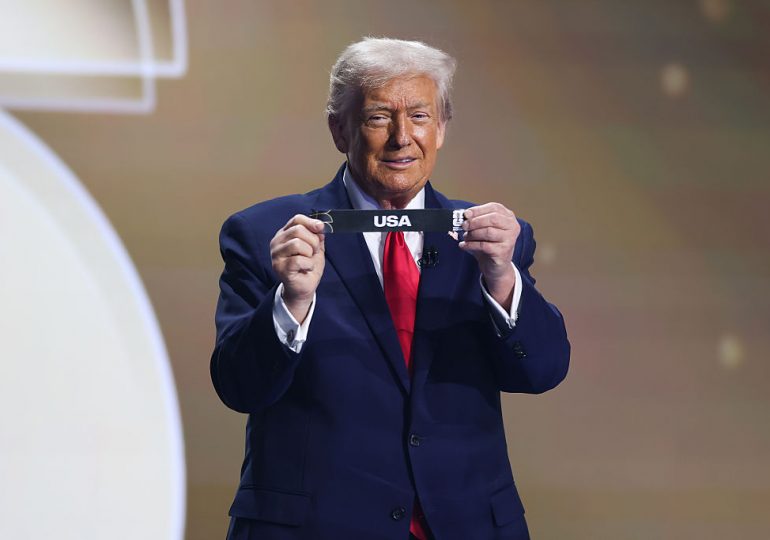
Friday’s draw was the opening act of the 2026 World Cup, which will be co-hosted by the U.S., Canada, and Mexico. The event, held in Washington D.C., was the latest act in the “Decade of American Sports” — in which the U.S. will host a string of elite tournaments and mega-events, including the 2028 and 2034 Olympic and Paralympic Games.
[time-brightcove not-tgx=”true”]
This ambitious agenda puts the spotlight on the country’s sports diplomacy, in which athletic endeavors serve as an arena for gaining influence, cultivating international leadership, interacting with foreign audiences, and facilitating conversations that can lead to better understandings.
A slate of bipartisan co-sponsors has introduced H.R. 5021 “The American Decade of Sports Act,” to create a U.S. sports diplomacy strategy to capitalize upon these hosting duties. The U.S. has engaged in sports diplomacy for more than a century. Yet, the country has never had a coherent, clearly articulated, officially recognized game plan to guide these efforts. This history suggests that developing one will be crucial to maximizing the positive impact of the country’s decade at the center of the sports universe.
The earliest U.S. sports diplomats from the government were two African American consuls stationed in France in the early 20th century. George H. Jackson and William H. Hunt both used rugby as a means to engage on a personal level in their consular districts. They secured fields for practice, recruited players, and served as founding fathers of two rugby clubs.
Other American diplomats and officials during this period played sports during their times overseas, as athletic competition became a key leisure activity for many Americans. Yet, while these activities fostered conversations and better understandings across cultural lines, they weren’t part of any formal strategy. Instead, they were extensions of personal interests and pastimes.
Read More: President Trump Meets With White House Task Force On FIFA World Cup
By contrast, organizations began to use sports diplomacy more tactically. In 1893, the Young Men’s Christian Association (YMCA) dispatched Illinois-born Melvin B. Rideout to Paris to serve as sporting director at its new outpost in the City of Light, an act of Franco-American friendship. One of basketball inventor James Naismith’s earliest students, Rideout introduced the sport to the French, presiding over the first basketball game outside of North America on Dec. 27, 1893.
During his years in France, Rideout used his work to further the YMCA’s mission of fostering healthy minds, bodies, and spirits. Basketball was a way for him to interact with a range of locals, which generated greater aimité and grew the game.
The contrast between the actions of Rideout and diplomats like Jackson reflected how the sports world, not the government, drove sports diplomacy during this formative era.
That all changed during the Cold War. Sports became a deeply political arena, and U.S. officials saw athletic competitions as a chance to demonstrate the superiority of capitalism and the American way of life over communism. The government moved to use sports to counter communist propaganda, particularly at the Olympic Games. After Hungary became a communist nation in 1949, the U.S. welcomed exiled Hungarian athletes and promoted American exceptionalism and amateurism as part of a moral compass within international sports. This advocacy implicitly held up American amateurs as morally superior to those from Eastern Bloc countries, who trained in state-run sports schools, prompting questions over just how “amateur” such athletes really were.
But the attempt to capitalize politically from sports sometimes backfired. The State Department sent the country’s most notable African American athletes on trips overseas in an effort to counter Soviet propaganda. The Soviets asserted that racial segregation and discrimination in the U.S. exposed the hollowness of the American commitment to freedom and equality. Yet, while athletes like Jackie Robinson and Althea Gibson dazzled during those encounters, they did not sugarcoat the truth about bigotry back home as American officials might’ve hoped.
U.S. sports diplomacy also encountered difficulties using women’s competitions to promote its ideology of freedom and equality. From the late 1950s through 1969, the U.S. organized official sports exchanges between its women’s national basketball team and their Soviet counterpart to help improve bilateral relations on a cultural front. Yet, officials discontinued the efforts thanks to a lackluster U.S. record and how the game’s increased physicality ran contrary to American ideals of femininity. Indeed, the USSR and other Eastern Bloc countries dominated the world basketball medal podium, which created images that questioned the U.S. commitment to gender equality.
The mixed track record of government-driven sports diplomacy during this period stemmed from these efforts being too closely aligned with ideological, geopolitical battles. While that helped fuel the sports propaganda wars of the era, it had fewer answers for how to use sports diplomacy to constructively build bridges with non-communist regimes.
In fact, the most effective sports diplomacy during the period might have been that driven by the sports world. While it was far less splashy, it more authentically communicated about and represented the U.S. American basketball players like Martin Feinberg, Henry “Gentleman” Fields, and 1976 Olympic silver medalist Gail Marquis lived and played a few seasons (or more) in France. They introduced U.S.-style tactics and techniques to French basketball, and served as real-life embodiments of “America” and American culture to French and European teammates, coaches, and fans.
Nonetheless, more official American sports diplomacy efforts continued until the end of the Cold War and beyond, though without ever being guided by a concrete strategy.
Read More: The Key Takeaways From the FIFA World Cup Draw
After 9/11, a new era of sports diplomacy blossomed, one that built upon this Cold War legacy to try once again to use sports to help win “hearts and minds” abroad. In 2003, the State Department established SportsUnited (renamed the Sports Diplomacy Division in 2017), charged with undertaking sports diplomacy programming. These efforts included sending Sports Envoys overseas to engage with local publics, bringing Sports Visitors to the U.S. to learn about the U.S. sports industry and practices, and facilitating Sports Exchanges to foster greater understandings.
U.S. Embassies and consulates also began to engage in sports diplomacy more explicitly as well. For example, Ambassador to Portugal Robert Sherman launched a digital campaign around the 2016 UEFA European Championship, which went viral thanks to his mix of jokey humor and unyielding confidence in support of the Portuguese men’s soccer team, upending most people’s idea of what ambassadors do (and don’t do) in the process. It was a golden opportunity to engage with in-country stakeholders, audiences, and the men’s and women’s national teams and fans in new ways: they tuned in for the sports but stayed for the messaging around core mission objectives, such as combating domestic violence.
Yet such efforts have remained ad hoc, at the personal prerogative of sitting ambassadors. That’s because, fundamentally, there is still no unified U.S. sports diplomacy strategy.
While previously the U.S. benefited from some sports diplomacy efforts despite its lack of a coherent strategy, today that’s an outdated approach as governments around the globe launch dedicated stratagems. Over the last 15 years, France, Australia, Qatar, and Wales, among others, have woven sports diplomacy explicitly into their foreign policy. They thread it across key policy pillars, such as economic development, trade and tourism, and international business, while serving as guidance for overseas posts on where and how to focus their local efforts.
Such plans also inform those countries’ sports world stakeholders who can then be more intentional in their international engagement. It enables these executives and athletes to cultivate global influence, leadership, and cultural cachet through sports, convening different audiences and engaging in conversations that likely wouldn’t happen without these strategies.
That’s different than the present U.S. model of sports diplomacy programming, which leaves embassies and consulates to figure out what, if anything, to do. In addition to being haphazard and inconsistent from a government standpoint, this purely programmatic approach also does a disservice to the U.S. amateur and professional leagues, which sometimes struggle to best harness sports diplomacy’s potential as a multifaceted tool.
H.R. 5021 aims to rectify this problem. History suggests that doing so will be essential to capitalizing on the flood of sports tourists and high profile events that will be staged in the U.S. over the next decade. Without a concrete strategy, the U.S. may still benefit from some of these events. But the benefit won’t be universal and the U.S. won’t be able to reap the longer-term rewards of leveraging sports diplomacy to create meaningful opportunities for continued dialogue, knowledge exchange, and being as fulsome a part of today’s global sports world.
Lindsay Sarah Krasnoff is a historian and consultant, author of Basketball Empire: France and the Making of a Global NBA and WNBA, and director of the FranceAndUS sports diplomacy project. She is a clinical assistant professor at New York University’s Tisch Institute for Global Sport, where she teaches sports diplomacy. Krasnoff previously served as a historian in the U.S. Department of State’s Office of the Historian.
Made by History takes readers beyond the headlines with articles written and edited by professional historians. Learn more about Made by History at TIME here. Opinions expressed do not necessarily reflect the views of TIME editors.