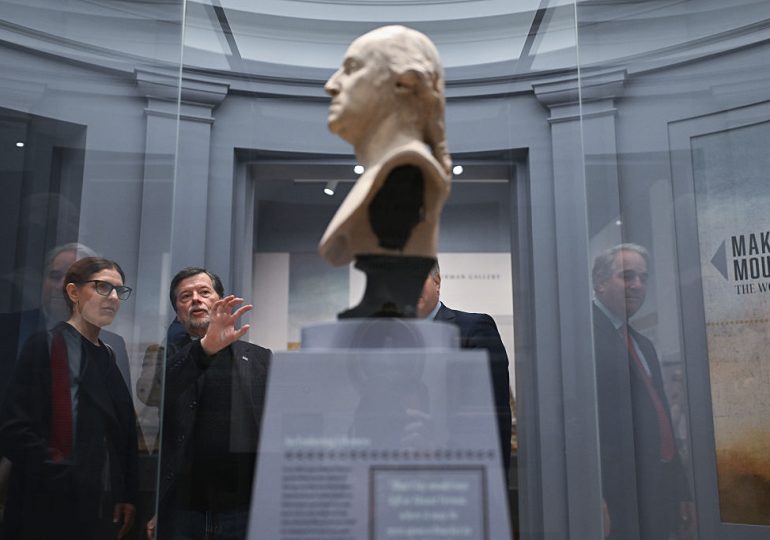
THE AMERICAN REVOLUTION, the new six-part, 12-hour series that is currently streaming on PBS (directed by Ken Burns, Sarah Botstein and David Schmidt) examines how America’s founding turned the world upside-down. Thirteen British colonies on the Atlantic Coast rose in rebellion, won their independence, and established a new form of government that radically reshaped the continent and inspired centuries of democratic movements around the globe. The film relies on generations of historians and historical research to reframe the founding story as a global conflict and a civil war. Christopher Brown (Columbia University), Kathleen DuVal (University of North Carolina) and Jane Kamensky (Thomas Jefferson Foundation/Monticello) were advisers and appear in the film. They joined Made by History for a roundtable conversation about the making of the film.
[time-brightcove not-tgx=”true”]
As a historical adviser to the film, what overlooked or underappreciated historical research or perspective did you encourage Ken Burns to include?
Kathleen DuVal: It was important to me for the film to represent the American Revolution in its international context—both European empires such as France and Spain and also Native nations, which were still sovereign powers on the border of the colonies. The Revolutionaries knew that was the world they had to work within, but sometimes Americans forget that.
Christopher Brown: I also stressed the importance of the global lens and I encouraged the team to keep the perspective of the British government in view. Many Americans have a limited understanding of what the American War for Independence was about from the British perspective: why taxation without representation made sense to the British government, why it seemed necessary to send redcoats to North America, why the British army failed to win the war even though they had superior resources. In a similar vein, I encouraged the team to present the loyalists as American dissenters and not merely obstacles to progress.
Finally, I encouraged Florentine Films, the production company, to embrace the complexity of African Americans’ positions in these years, to establish that Black people, like Native Americans, fought on both sides, and that the choice often had more to do with where the best chance for freedom and opportunity seemed to reside, even more than the principles of patriotism or loyalism.
Jane Kamensky: I’m a scholar of women and family in American and revolutionary history and helped the Florentine team develop those home-front parts of their stories. I also brought expertise in early American art and the visual world of early America. I brought my students into the project as well. In 2021, and then again in 2023, I had students working on a capstone project for my American Revolution undergraduate lecture course at Harvard. Teams of students researched images, maps, and newspapers for the film. Florentine Films wound up hiring one of my students, Grace Bartosh, who was an intern on the project for that class, so it’s been a wonderful throughline to see a student find her great interest in documentary filmmaking through that course capstone, and then get to pursue it at the highest level with this team.
Read More: Ken Burns Breaks Down the Powerful Stories Behind The American Revolution
What significant aspects of the film will help reshape popular understanding of the American Revolution?
Brown: Just about everyone will learn something about the history that they did not know. Teenagers like Betsy Ambler or John Greenwood have almost never had their stories told in the way they are here, for example. More generally, I think viewers may be most struck by the importance of Native Americans and Patriot interest in Native American land. This is an aspect of the subject that many may find unfamiliar — that the nation was founded with the creation of an empire of its own in view.
I also think viewers will be struck by the violence of the War for Independence. Wars are violent by definition, but it is an aspect of the subject that sometimes gets underplayed.
DuVal: The multiple perspectives and violence that Chris mentions will help viewers to better understand how unlikely the Revolution was to succeed. The independence of the United States was in no way easy or inevitable. The Revolutionaries knew they could not win alone against Britain. France, Spain, the Netherlands, and Native nations were vital participants, and their choices helped to determine the outcome of the Revolution.
Kamensky: Since the early 20th century, scholarship on the American Revolution has been beset with binary thinking: it’s either seen as the ideas struggle—the imperial struggle over home rule—or the struggle over “who would rule at home,” as Carl Becker said more than a century ago. Was the Revolution about taxation and representation? Or was it about how people in the colonies held and exercised power over each other?
Ken, Sarah, and David’s film refuses that binary, integrating social history from the grassroots perspective with the history of ideas about government that we typically attribute to the capital-F Founders, the signers of the Declaration of Independence. It pays attention to Native Americans and their struggles for sovereignty, to Americans of African descent and their struggles to inhabit the Declaration’s promises of liberty and equality, to women who asked what all this had to do with them. Yet it also gives due credit to the leadership of George Washington, the vision of Thomas Jefferson, the tactics of Nathanael Green, the bravery of the Marquis de Lafayette, and so on.
What conversation about recent historical scholarship happened behind the scenes during the making of the film?
Kamensky: I think Geoff Ward and the writing team seem to have read everything that’s been produced on the revolution for 150 or more years! They digested cutting-edge scholarly research, but they also mined much older work — town histories, soldier’s memoirs — that haven’t much been read in the academy for generations. As a historian, I learned a lot from a team that was reading for scholarly excellence, but also reading for story and thinking about military history, which has all but disappeared from most university curricula.
DuVal: The conversations about scholarship happened from start to finish. I was tremendously impressed even with the first draft that I read of Geoff Ward’s script, in that it not only reflected recent scholarship but that it even had footnotes! Over the years of writing and production, we historical advisers read the script in multiple drafts and saw rough cuts of the film. We would recommend changes and additional reading, and the whole team was excited to make the film get better and better. Sometimes Geoff or the co-directors David Schmidt and Sarah Botstein would email with a very specific question that sent me to my shelves to try to answer!
Brown: I have already mentioned the important role of Native people and the Patriot ambition for native land. This is a subject that is understood far better than at the bicentennial, 50 years ago. Scholarship on loyalists and the experience of the common soldier on both sides of the war has grown markedly in recent years and so Burns and his team were able to take advantage of that. Recent years also have brought much greater appreciation of the international dimensions of the conflict. This was a tough aspect to balance alongside the need to center the national story.
In your view, how did the film’s narrative evolve based on advice and expertise from professional historians?
Kamensky: From the beginning, they really wanted to hear our unvarnished reaction. They made clear that they weren’t wedded to their drafts, on the page or on the screen, and that proved fundamentally true. All humanists should learn from people who work in group process in the way the documentary filmmakers do. The final film moves between various narratives — the war, Congress, and the people in the new state capitals who were setting up the structures of government that actually funded the war and marshaled the soldiers — and that reflects an evolution in the script itself and advice from the team of scholars.
Brown: The film went through many iterations, with constant feedback from dozens of different scholars. I am not sure that the overall narrative changed much, but the points of emphasis did many times, as did the details to be selected. I am quite sure that the team acquired enough material to make a film that could have been much, much longer.
DuVal: The filmmakers always thought it was important to reflect different perspectives on the Revolution, and the conversations with the historians and our knowledge of many different kinds of work on the Revolution helped them to broaden and deepen those perspectives while still using their filmmaking skills to make it a far more encompassing experience than anything our books or articles could have done.
What could professional historians learn from the film production process?
Kamensky: Storytelling in the film takes in the whole landscape of current historical scholarship and perhaps leans more heavily on academic expertise than Ken Burns’ films have done in the past. At the same time, he is more focused than many academic historians in telling a story of us, in telling a shared and civically useful story of our plural and complex origins that can be taken forward to build the capacities of citizens. That’s something I hope academic scholars who see the film will find enviable and will feed back into our own current historical practice. We can see that you can tell a story that is rigorous and true and complex and constructive, all at the same time.
Brown: This is an interesting and important question. Academic historians devote much of our attention to the creation and dissemination of new research, to working at the outer edges of their subjects; most of our publications are analytical, interpretive, conceptual, and theoretical. This allows us to make clear to each other where the innovations reside and how they relate to existing knowledge. Many, if not most of us, do not write narrative-driven histories until later in our careers. I agree with Jane. The film shows how compelling narrative and rigorous scholarship can work in tandem, and to great effect.
DuVal: The filmmakers always thought it was important to reflect different perspectives on the Revolution, and the conversations with the historians and our knowledge of many different kinds of work on the Revolution helped them to broaden and deepen those perspectives while still using their filmmaking skills to make it a far more encompassing experience than anything our books or articles could have done.
Christopher Brown is Professor of History at Columbia History.
Kathleen DuVal is a history professor at the University of North Carolina at Chapel Hill and the author of the Pulitzer Prize-winning Native Nations: A Millennium in North America, Independence Lost: Lives on the Edge of the American Revolution, and the U.S. history textbook Give Me Liberty!
Jane Kamensky is President and CEO of Thomas Jefferson’s Monticello and Jonathan Trumbull Professor of American History emerita at Harvard University. She is the author of numerous books, including the prize-winning A Revolution in Color (2016), and Candida Royalle and the Sexual Revolution (2024), a finalist for the National Book Critics Circle Award in Biography.
Made by History takes readers beyond the headlines with articles written and edited by professional historians. Learn more about Made by History at TIME here. Opinions expressed do not necessarily reflect the views of TIME editors.
Leave a comment