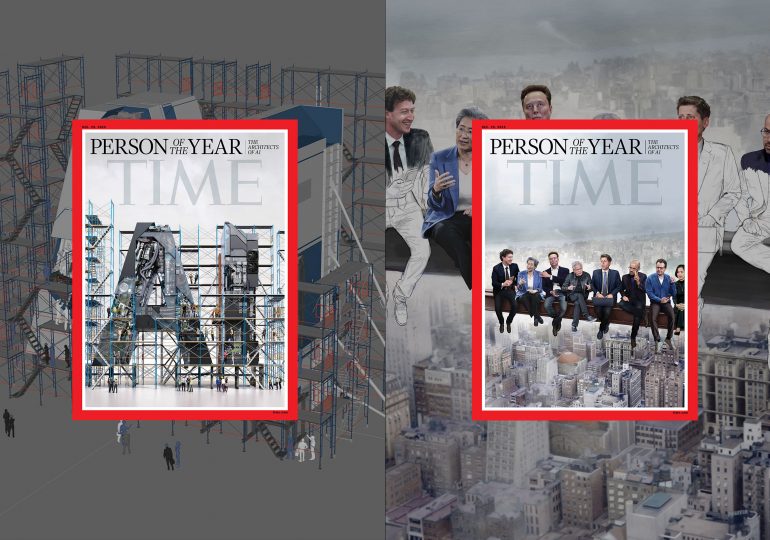
To illustrate the choice of the Architects of AI as TIME’s 2025 Person of the Year, we asked two separate artists to help us visualize the incredibly complex technological revolution that is currently underway. London-based illustrator and graphics animator Peter Crowther and digital painter Jason Seiler each created an image that speaks to the duality AI has produced – man vs. machine.
[time-brightcove not-tgx=”true”]
Inspired by the inner workings of computer chips, Crowther’s intricate AI structure looms large over the busy construction site. (See if you can spot eight key players who have helped shape the revolution, hidden among the workers.) Much like the AI industry itself, the work-in-progress structure appears in constant motion, with scaffolding that is seemingly permanent.
“I like to spend time thinking over the brief and begin once I have my design and technical approach sorted,” said Crowther, who graduated from the Royal College of Art with an MA in graphic design. “I usually get a mental picture and see the whole process at once, often as a flash at an unexpected moment.”
Some of the architects of this revolution are front and center in Seiler’s image, an homage to the famous 1932 photograph of construction workers on a steel beam 800 feet above the RCA building in New York City, which TIME named as one of the 100 most influential photographs of all time.
A classically trained oil painter who studied fine art illustration at the American Academy of Art in Chicago, Seiler spent more than a week painting the scene on a 21-in. LCD display. He has painted two previous Person of the Year covers (Pope Francis in 2013, and Joe Biden and Kamala Harris in 2020).
As TIME’s creative director, I’ve been privileged to work with some of the world’s best artists and photographers in creating thousands of images for our cover. Their voices and immense creativity bring TIME’s iconic red-bordered canvas to life, and have been critical to our visual storytelling for more than 100 years. That won’t change. But while considering how to illustrate this year’s Person of the Year cover, I did wonder how AI would create an image of itself.
Like millions of people over the past year, I turned to a pair of powerful tools, OpenAI’s GPT-5 and Google’s Gemini 3. What do you look like as a person? I asked. Or, Create an illustration using the letters AI. On this page, you can see a sampling of the results from those kinds of prompts.
Click here to buy your copy of this issue
Using AI to create artwork isn’t without controversy, especially in the realm of visual journalism. “If I am only prompting work into existence, and if that prompt itself is the result of an AI chatbot, then I am just too far removed from the process to learn anything,” says Crowther. “Ordering a meal does not make you a chef.”
Sure enough, even though I was just experimenting with the concept, I initially entered each prompt with a certain amount of trepidation. A few days in, however, I was finding the exercise useful. By generating hundreds of images, I learned a great deal about how the models processed my requests and which delivered the best results. I spent hours making small tweaks—mainly because the system wanted to create completely new images each time. But waiting with excitement to see what it would produce, I started to feel as if I were art-directing it.
We will continue to use TIME’s cover to showcase the diversity of human creativity. But the experience showed me that AI can be a valuable image-creation tool. I ended up seeing it as parallel to a painter’s brush or a photographer’s lens, the experiment having reinforced the importance of human decision-making in any “collaboration” with AI. That personal vision remains essential—as is evident in the works of Crowther and Seiler.
Leave a comment