The sculpture smashed to the floor as I raced from my home. My heart sank that this beloved gift—a Jamaican sculpture of a face—suddenly was in pieces. No time to grieve her, I thought, rushing out the door with the broken mess behind me.
The sharp pieces of my sculpture would remain on the floor until I was ready to put them in a bag and reassemble them because my nursing work at Long Island Jewish Medical Center called. We were in the thick of the COVID-19 pandemic. Our community needed us. My colleagues were exhausted. With full-body personal protective equipment, dying patients in every part of the hospital, and no treatments or vaccines, we worked. Through unprecedented darkness, uncertainty, frustration, and so much deep, genuine fear, we worked.
[time-brightcove not-tgx=”true”]
When the pandemic was at its deadliest, I told myself that if I could take one step, things would get better. If I could just help one patient… If only there were a vaccine…
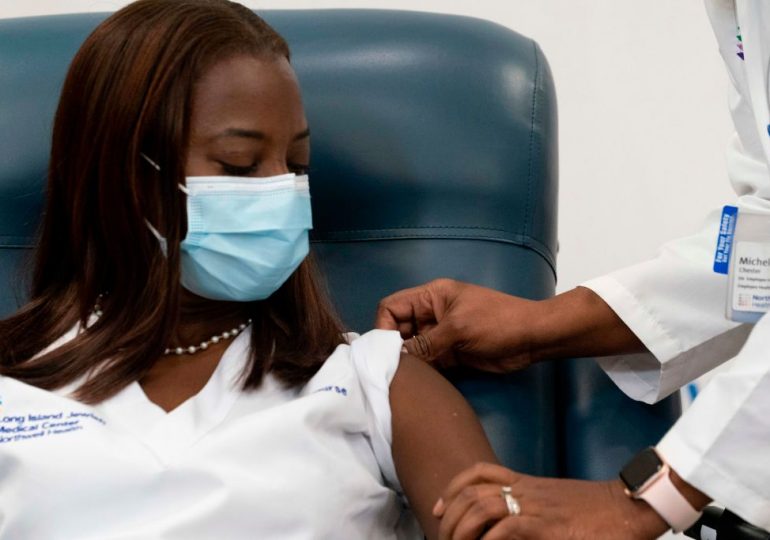
On December 14, 2020 I became the first person in the United States to receive the first FDA-approved COVID-19 vaccine. Now, as the world moves swiftly through the fifth year since the start of the pandemic, I often get flashbacks to that era which taught me the importance of public health and hope.
To mark that time, the National Museum of American History in Washington, DC houses and periodically loans for display the scrubs, work ID, and clogs I wore as a nurse during the pandemic’s worst days. They also hold the vial and syringe used for my vaccine dose.
These objects capture the day I received that first vaccine, and so many of the long days that led to it. I must have logged thousands of miles, and just as many patients, in those worn-out clogs. These items, such as my COVID-19 vaccine card and the vaccine vial and syringe are symbols of hope to me. Some days I struggle with my early memories of the pandemic’s destruction, when hope was all we had.
It may sound surprising when I say 2020 gave me hope. But that year showed me reasons to be optimistic that we can make strides in public health—like those we saw when COVID-19 vaccines were developed. This optimism is a belief I’m determined to hold, despite the dangerous undermining of public health and the institutions tasked with promoting it. But this optimism is not necessarily a comfortable stance, as elected and appointed officials make politically motivated changes to vaccine guidelines or ignore fundamental scientific principles, like the difference between correlation and causation. As current elected and appointed officials sow confusion by pinning the “cause” of autism to a single medication, I wonder what happened to our resolve to save American lives—and to give Americans the information they need to make important decisions about their health.
We can, and must, be better positioned for the next public health crisis. Though our medical and scientific institutions may be flawed, we can still earn the trust of Americans and save lives by employing a data-driven approach to public health. By prioritizing science over fear, we can prevent the next outbreak and keep our communities healthy and strong. We can choose trust over doubt, critical thinking over confusion.
Thoughtful, informed choice is a debt we owe the patients I saw fight—even in systemic, inequitable circumstances and with limited opportunities—to survive the pandemic. Public health efforts can transform those memories into strategies, programs, and actions that uplift the wellbeing of communities that suffered so disproportionately during the pandemic.
For instance, thanks to Operation Warp Speed, COVID-19 vaccines were quickly and successfully distributed, preventing many from hospitalization. At the time, the success of this program made me optimistic that trust in science and in our government would soar. But that hasn’t played out. Today, our healthcare system is struggling to regain trust amidst a barrage of disinformation and political maneuvering. The restoration of public confidence in science is as important for patients in fragile health as it is for America’s young people like my grandson.
Today, my grandson is a thriving five-year-old. But he spent the first four and a half months of his life in a Manhattan neonatal intensive care unit, his mom and dad anxiously taking expensive cabs from Brooklyn to be with him, while I donned personal protective equipment to lead my staff as they held COVID patients’ hands. I felt afraid in every area of my life during those months. I kept it at bay with hope, images of a strong future for my grandson, and care for myself so I would have the strength to heal.
It’s impossible not to carry the brokenness of that time and feel like my patched-up sculpture sometimes. When I eventually put that beloved artwork, and myself, back together, I did so imperfectly. Scars remain for all of us who survived the pandemic.
I don’t know how other people feel when they see my scrubs, work badge, vaccine card and other objects from that time. When I look at them, I think about the pain and fear juxtaposed with hope.
Leave a comment