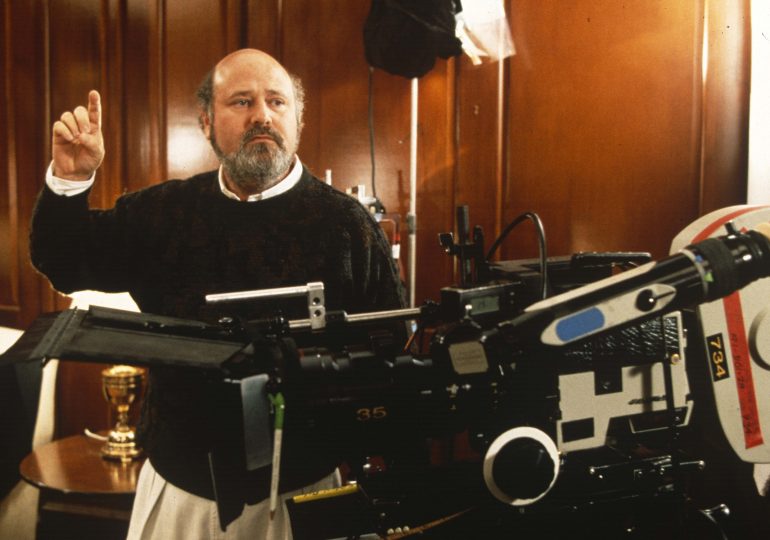
If you were to tease out a unifying thread through three of the signature films directed by Rob Reiner—This Is Spinal Tap, The Princess Bride, and When Harry Met Sally…—what you’d find is a tempered sweetness, a kind of resilient exultation informed by the knowledge that little in life ever goes as planned. The surprise twists in our lives make for more happiness over the long haul, because they can’t happen unless we remain awake to the possibility of joy every minute. That would be a glistening legacy for any filmmaker, and Reiner, who was found dead on Sunday along with his wife, producer Michele Singer Reiner, left us with that and more.
[time-brightcove not-tgx=”true”]
Reiner’s mother, Estelle, was a professional singer; his father was actor, writer, and director Carl Reiner, the creator of The Dick Van Dyke Show and a compatriot and close friend of Mel Brooks. Audiences got to know the younger Reiner from his role on the 1970s American sitcom All in the Family: as Meathead—he had a name, Michael Stivic, but no one ever remembers it—he was the liberal-minded foil to his racist, bigoted father-in-law Archie Bunker, Carroll O’Connor. As an actor, Reiner’s timing was always pinpoint perfect, a gift he’d inherited from his dad. And in real life, he held Michael Stivic-style ideals: he was a longtime supporter of Democratic candidates and causes, including a 1998 California ballot initiative that would fund early childhood programs with taxes collected from tobacco sales. He was also the driving force, economically and otherwise, behind a 2012 legal campaign designed to establish same-sex marriage as a constitutional right. And in a modern Hollywood that’s often curiously silent on current political matters, he was an outspoken critic of Donald Trump.
Reiner has always felt, somehow, like a person we knew. His debut feature, the 1984 mock documentary This Is Spinal Tap, didn’t just wow audiences at the time; it found new fans year after year, decade after decade. Because of Spinal Tap, everyone knows what “these go to 11″ means. Reiner’s fifth feature, When Harry Met Sally…, released in 1989 and written by Nora Ephron, followed many of the tried-and-true rules of romantic comedy, even as it tweaked or outright broke others: this was a story not of young people meeting cute and instantly falling in love, but of slightly older characters, people who’d been knocked around a bit by life, finding their way to romance by becoming friends first. Billy Crystal and Meg Ryan give the kind of relaxed, lived-in performances that only a fully attuned director could get. Reiner had a great ear for what was funny, but an equally sterling gift for knowing how a line could pierce straight to the heart, and he could guide his actors to that bullseye every time. Think of the moment Crystal’s Harry Burns says to Ryan’s Sally Albright, “I came here tonight because when you realize you want to spend the rest of your life with somebody, you want the rest of your life to start as soon as possible.” There’s no syrup in it, only efficiency. Harry knows he’s almost out of time to make the future happen, and the words pour out at a thoroughbred’s clip.
Reiner is also responsible for one of those films, a spectacular one, that lots of people say they could watch anytime. The Princess Bride (1987) was partly a miracle of casting: Peter Falk shows up as a wheeler-dealer grandfather bent on selling the merits of fairytales—and romance—to his grandson; Peter Cook is a somber bishop presiding over a royal wedding (“Mawage is what bwings us togethah today”); the perpetually avuncular-looking Wallace Shawn plays a Sicilian baddie; and Crystal and the tiny-titan genius Carol Kane appear as mystical healers who miraculously revive the “mostly dead” romantic hero. It took 15 years for writer William Goldman’s novel to make it to the screen, but Reiner did it justice. The movie is effervescent; there’s nothing belabored about it. The Princess Bride is pure, breezy pleasure.
In the years following, Reiner built a career making the kind of mainstream popular entertainments that barely exist anymore, pictures like The Bucket List (2007), The Story of Us (1997), A Few Good Men (1992), and the Stephen King adaptation Misery (1990). His reach extended even further through the production company he cofounded in 1987, Castle Rock Entertainment: Castle Rock films include Richard Linklater’s Before Sunrise, Before Sunset, and Before Midnight, the Christopher Guest comedies Waiting for Guffman, Best in Show, and A Mighty Wind, as well as the King adaptations The Shawshank Redemption and Dolores Claiborne—though there are many more.
Reiner’s last feature as a director was Spinal Tap II: The End Continues, a picture that, given how many people adore its predecessor, didn’t seem to find the audience it deserves. The movie reunites Christopher Guest, Harry Shearer, and Michael McKean as the members of the (sadly) fictional metal band Spinal Tap, reuniting after 41 years of dormancy; Reiner appears, once again, as the (also sadly) fictional documentary filmmaker Martin di Bergi. Spinal Tap II is more endearing and reflective than it is laugh-out-loud funny—though maybe, as an unwitting swan song, it’s pretty much perfect. We’ve all seen old rockers hauling out the gear to take the stage once again, reappearing, with pudgy stomachs and deeply receding hairlines, as fast-forward versions of their younger selves. They ask, as we do: how did we all get so old? But reunion shows often have a bracing, go-for-broke spirit, and Spinal Tap II does too. Reiner’s death is tragic and sad, perhaps more so because everything about him seemed joyful and celebratory. Maybe that’s what we’re meant to take away. If you’re going to bother with anything—writing or making a film, shaping a character, pulling funding together so someone else can make a movie—you may as well turn it up to 11. Reiner did nothing by half-measures.
Leave a comment