Back in February, I spent three days embedded with Australian Prime Minister Anthony Albanese while reporting a TIME cover story on his world-first under-16 social media ban. But while observing parliamentary sessions in Canberra and visiting flooded towns in northern Queensland, it was starkly apparent that neither children’s mental health nor extreme weather was necessarily top of the national agenda.
[time-brightcove not-tgx=”true”]
Albanese’s press conferences and spot news appearances were dominated by the same topic: rising antisemitism following a spike in the vandalism of synagogues and harassment of Jewish people. The burning question was whether American support for Israel’s offensive in Gaza, and Canberra’s close alliance with the U.S., was putting Australian Jews in danger.
“The Australian government doesn’t have a direct role in the Middle East,” Albanese told me on his Australian Air Force 737 when asked about the issue. “We’re not participants. We don’t supply weapons. Overwhelmingly, Australians want there to be peace. And they don’t want conflict brought here.”
Read More: A Timeline of Rising Antisemitism in Australia Since the Gaza War
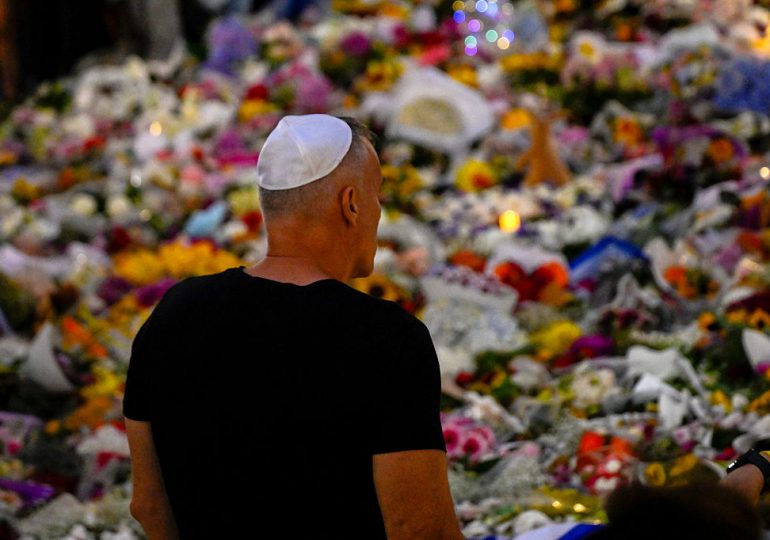
That last hope was sadly shattered on Sunday when at least 15 people were killed and dozens more injured after two gunmen opened fire on a crowd of hundreds at Sydney’s Bondi Beach. The exact motive has yet to be determined, but given that the victims had gathered to celebrate the Jewish holiday of Hanukkah, Albanese decried the attack as “antisemitism” and “a horrific act” of “terrorism.”
According to police, the two attackers were a 50-year-old father, who was killed at the scene, and his 24-year-old son, named as Naveed Akram, who was tackled and disarmed by a bystander and remains under arrest in a Sydney hospital in critical condition. It is Australia’s deadliest mass shooting in three decades, with victims aged between 10 and 87, including two rabbis and at least one Holocaust survivor.
Australia’s population of 28 million includes around 117,000 Jews, who have reported an almost five-fold rise in firebombing, arson, graffiti, and hate speech incidents since Israel’s military response to Hamas’s Oct. 7, 2023, terrorist attacks, according to Executive Council of Australian Jewry data. The surge in hate crimes was pronounced enough to prompt Mike Burgess, the director-general of the Australian Security Intelligence Organisation (ASIO), to say that the prospect of deadly antisemitic violence was his top priority.
Responding to Sunday’s atrocity, Albanese insisted that “an attack on Jewish Australians is an attack on every Australian.” He also has highlighted his efforts tackling the issue, including appointing a dedicated Antisemitism Envoy and imposing mandatory jail sentences for Nazi salutes.
Yet it didn’t take long for criticism to begin, with Australia’s opposition leader Sussan Leys accusing Albanese of failing to protect Australian Jews and for allowing antisemitism to “fester.” Israeli Prime Minister Benjamin Netanyahu also laid blame firmly with the Australian government, which “let the disease” of antisemitism spread “and the result is the horrific attacks on Jews we saw today.” Albanese, whose government in September recognized Palestinian statehood, had “replaced weakness with weakness and appeasement with more appeasement,” Netanyahu added.
Still, not everyone agrees that pandering to extremism is the problem. Clarke Jones, a criminologist focused on terrorism at the Australian National University, tells TIME what transpired on Sunday “doesn’t surprise me [as] this sort of thing is bubbling away.” However, Jones says that marginalized people in a “pressure cooker” of isolation, disaffection, and resentment can feel “denied being able to voice concerns or perspectives without the fear of trouble or being silenced.”
“This Palestinian-Israel situation has been going on for a long, long time—well before the Hamas attacks,” says Jones.
Discerning the true motivation for the violence will take the focus of ongoing police investigations, with ASIO revealing Akram had been questioned for extremist links in 2019 but deemed “not an immediate threat.” Australia’s already strict gun laws are also poised to be reviewed after it emerged the weapons involved were obtained legally. Three improvised explosive devices were also found at the scene, spotlighting that the carnage might have been much worse.
Read More: ‘Hero’ Bystander Who Tackled Bondi Beach Gunman Identified By Relatives
The next hours and days will be tense as community groups rally to try to lower the temperature. A broad swathe of local Muslim groups including the Darulfatwa Islamic High Council of Australia, Ahmadiyya Muslim Association, the Australia Palestine Advocacy Network, and the Bonnyrigg mosque near the alleged assailant Akram’s home have all separately condemned the attack. Efforts to calm tensions have been buoyed by the fact that the man who heroically tackled Akram, fruit shop owner Ahmed al-Ahmed, is himself a Muslim father of two. A fundraiser set up on behalf of al-Ahmed raised more than $365,000 in 12 hours.
But calls for unity have been undermined by several troubling incidents. A Muslim cemetery in south-western Sydney was reportedly vandalized with butchered pig heads. A woman wearing a keffiyeh has been ushered away from the Bondi memorial by police for allegedly disturbing the peace.
“I hope there’s going to be no copycats,” says Jones. “And I am aware of the good work the communities do to prevent these things happening. But terrorist attacks do happen in waves.”
As the self-styled “Lucky Country” reels from the attack, soul-searching in such a polarized society will not be easy. “What we see is Australians coming together,” Albanese told a press conference on Monday. “There is no place in Australia for antisemitism. There is no place for hatred.”
Leave a comment