There’s a tradition at Brown that changes the way you see the world. As first-years, to mark your entry into the university, you’re led in a procession through the Van Wickle Gates at the front of campus and into your life as a college student. Then, at graduation four years later, you retrace your steps in reverse, passing through the same gates back out into the city of Providence as the school releases you into adulthood.
[time-brightcove not-tgx=”true”]
It’s not walking out of the gates that’s unforgettable—it’s what’s waiting on the other side. Few graduating seniors know what to expect; those of us who’ve experienced it tend to hold our tongues, maybe because we know that a description will never live up to what it’s like in the moment. Just wait, we might say. You’ll see.
Because when you take that symbolic leap beyond the boundaries of campus, you land, quite literally, in the arms of a community so powerful it knocks the breath from your lungs. Thousands of alums line the streets to welcome you into the fold. There are so many screaming, ecstatic adults, from recent grads to those clutching walkers and canes, that whatever feelings you might be gripped by in the moment—grief for the end of your college years, terror of the unknown—are blasted away, replaced by a pure and stunning kind of joy. As you pass through a tunnel of smiling faces, exchanging cheers and high fives and greeting strangers like family, the message is clear: you may be leaving the comfort of college, but you’re far from alone.
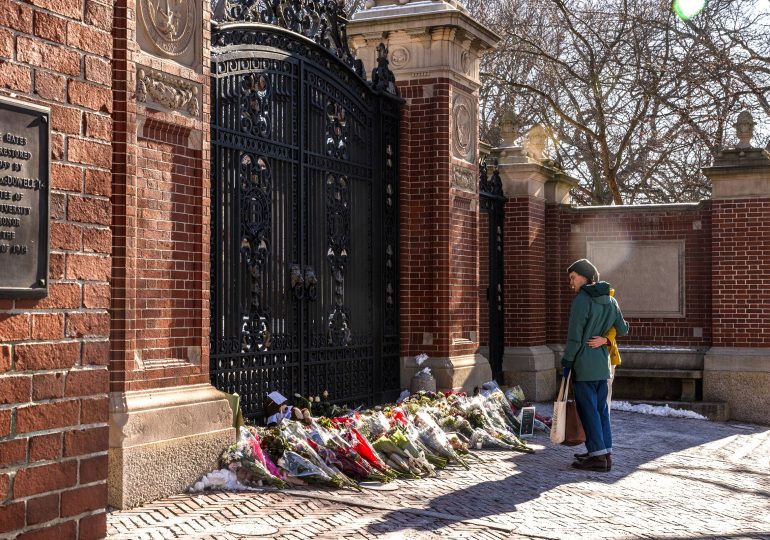
Those same gates are piled high with memorial flowers this week, after a gunman opened fire in a lecture hall on Saturday afternoon. Two students were killed—19-year-old sophomore Ella Cook and 18-year-old freshman Mukhammad Aziz Umurzokov—and nine more were injured. As videos of a suspect, still at large, circulate online, my attention has stayed locked on a different image. There’s a photograph, taken by Annamaria Luecht and published in the Brown Daily Herald, of a pair of mourners standing in front of the Van Wickle Gates in daylight. Their arms are wrapped around each other in the cold as they look over the scene: dozens of bouquets and a single stuffed bear, Brown’s mascot, leaning against wrought iron. You can feel the shock. And you can hear the silence.
For me, Brown was everything you hope college will be. There was the campus, red brick and lush grass, an offbeat blend of 20th-century construction and New England charm that felt unpolished in the best way. There was the famous Open Curriculum, a lack of standard course requirements, which rewards students with broad curiosity and the confidence to self-direct. And most of all, there were the people. The funniest, smartest, kindest, most passionate people I’d ever met. Have ever met.
On Saturday, all afternoon and all night, messages poured in from former classmates. We found ourselves starting to talk about it—this shocking, unthinkable thing—and then we just stopped, withdrawing or changing the subject. Because what is there to say about a mass shooting that hasn’t already been said so many times before?
It would be dishonest to say that Brown—that any college—is completely devoid of danger. There are bad actors in every setting. And I can’t pretend we always felt safe. We walked in pairs at night, like they told us to. We never accepted unsealed drinks at parties. A few of us took a self-defense class, learning how to shove the heels of our palms into an attacker’s nose. My boyfriend emptied his pockets every night before driving to the place off campus where he parked his car. And none of these actions were unfounded—now and then we’d get reports of a mugging. More than one of my friends was sexually assaulted.
But one thing we didn’t worry about was a masked man with a gun. We didn’t worry that someone might enter a classroom determined to end our lives. That kind of violence was one we didn’t know to fear—we didn’t have to. That the entire Brown community will now carry this weight, that students everywhere have to, is a tragedy.
At least two undergraduates currently at Brown came to the university having already survived a school shooting. Mia Tretta, 21, was shot in the stomach at her Santa Clarita, Calif., high school in 2019. Zoe Weissman, 20, was outside her middle school across the street from Marjory Stoneman Douglas High School in Parkland, Fla., when 17 people were killed in 2018. In an interview with MS Now on Saturday, Weissman sat in her dorm room with a steely expression on her face, voice steady and determined: “I’m really angry that this is happening to me all over again.” She knew, when asked by the reporter where on campus her dorm is, not to disclose her location. She has seen too much.
College is supposed to push you—it’s supposed to be a place where you can try things, make mistakes, fall in and out of love, meet people who open your eyes to new ideas, test the bounds of your own autonomy. It’s supposed to be a place where you learn and grow and start to become the person you’re going to be.
To us, Brown was that place. It was a place that caught us when we stumbled. It was alive and exciting and full of possibility. It was home. And on the whole, it was safe.
I want to say this is not supposed to happen here. Not at Brown. Not at this special, magical place. But how can I say that, when the same should be said for every other safe haven where no one should have to worry that a person with a gun might storm through and take everything away? It’s not supposed to happen on the campus that made us who we are, and it’s not supposed to happen at an elementary school, or a high school, or a church, or a synagogue, or a country-music festival, or a nightclub. It’s not supposed to happen anywhere, and yet it does, again and again and again, and we bow our heads in sorrow and we cite the statistics—like the devastating fact that there have already been more mass shootings in the U.S. than days in the year so far—and we move on.
Brown students call me all the time, wanting to talk about my path in journalism and how they can forge their own. What they’re really asking, under breathless questions about internships and networking and job applications, is whether it’ll all be OK—if, when they step out beyond the security of college, they’ll find their way. I tell them things I know, things I’ve learned from experience that I wish someone had said to me. Most emphatically, I tell them that yes, it will be OK. They’ll figure it out, one step at a time, and when they take some wrong turns, which they will, they’ll figure that out too. I tell them to worry a little less about the future and to try to appreciate the time they have left in college, because it’s fleeting.
But what can a person say to a kid about this? I’ve been scratching at the walls, trying to find the words, and I don’t know the answer. Except that it’s not right. It’s not fair, and it’s not just, and I’m so sorry, and you deserve better from a world that claims to put you first and still does little to prevent tragedies like this from repeating.
And this: look for us outside the gates at graduation this year. And the next year, and the one after that. Because we’ll be there every time, thousands of us, ready to extend our hands and walk by your side through anything—toward a future that is your right.
Leave a comment