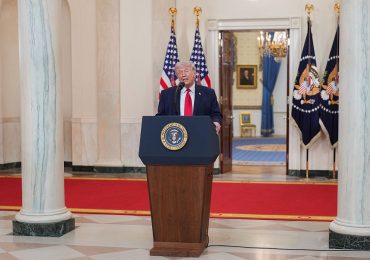

President Donald Trump announced late Tuesday he had ordered a “A TOTAL AND COMPLETE BLOCKADE OF ALL SANCTIONED OIL TANKERS going into, and out of, Venezuela”—an escalation of the Trump Administration’s military pressure campaign on the South American country.
“Venezuela is completely surrounded by the largest Armada ever assembled in the History of South America,” Trump posted on Truth Social. “It will only get bigger, and the shock to them will be like nothing they have ever seen before — Until such time as they return to the United States of America all of the Oil, Land, and other Assets that they previously stole from us.”
[time-brightcove not-tgx=”true”]
Trump’s announcement comes a week after the U.S. seized an oil tanker off the coast of Venezuela, prompting Venezuelan President Nicolás Maduro’s government to accuse the U.S. of “international piracy.” The U.S. previously imposed sanctions on Venezuelan oil, and has long alleged that Venezuela skirts these sanctions by illegally selling its oil via Cuba. The Trump Administration said the seized tanker was heading to Cuba, although some experts have suggested it was more likely headed to China based on its size.
Venezuela said in response to the announced blockade that it rejected Trump’s “grotesque threat.”
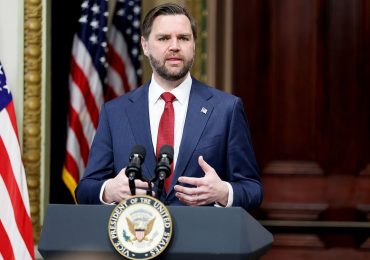
Rep. Joaquin Castro, a Texas Democrat, said the House will vote on Thursday on a bipartisan war powers resolution to end the Trump Administration’s hostilities towards Venezuela and “decide if they support sending Americans into yet another regime change war.”
“A naval blockade is unquestionably an act of war,” Castro said in a post on X. “A war that the Congress never authorized and the American people do not want.”
Pressure campaign rationale shifts
Since September, the U.S. military has killed at least 90 people in strikes on boats in the Pacific and Caribbean that it alleged were carrying drugs to the U.S. The governments and families of those killed have said they were fishermen, not the “narco-terrorists” that the Trump Administration has described.
The strikes have been the centerpiece of a pressure campaign on Venezuela that some—including the Maduro government—argue is not really about drugs, but about Trump seeking regime change in Venezuela.
White House Chief of Staff Susie Wiles appeared to support that claim in a bombshell Vanity Fair interview published this week. “He wants to keep on blowing boats up until Maduro cries uncle,” Wiles said.
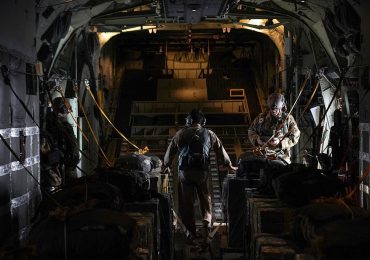
The Trump Administration has accused Maduro of being the head of the so-called Cartel of the Suns, an allegation that the Venezuelan government has rejected, and has put a $50 million bounty on Maduro. The U.S. has also repositioned warships to the Caribbean Sea in the biggest deployment of navy vessels to the region since the Cuban Missile Crisis in 1962.
Targeting Venezuela’s oil
The U.S. has repeatedly cited the flow of drugs from Venezuela and national security reasons as the basis for its strikes and military build-up. But it suggested that last week’s seizure of an oil tanker was a routine military action on a sanctioned vessel. Trump told reporters that the U.S. would “keep” the oil from the seized tanker.
The move was followed by new sanctions on six more ships accused of carrying Venezuelan oil, as well as sanctions on Maduro’s relatives and businesses associated with his government.
In his announcement of the oil blockade, Trump provided a litany of reasons for it, including calling the “illegitimate Maduro Regime” a foreign terrorist organization and pointing to the “Illegal Aliens and Criminals that the Maduro Regime has sent into the United States during the weak and inept Biden Administration.”
Trump also accused Maduro’s government of using stolen oil to “finance themselves, Drug Terrorism, Human Trafficking, Murder, and Kidnapping” and demanding Venezuela return stolen U.S. assets. Trump appeared to be referring to the decision by former Venezuelan President Hugo Chávez to nationalize Venezuela’s oil industry nearly two decades ago. Trump did not offer any explanation for why he believes any of Venezuela’s vast natural resources belongs to the U.S.
“While there have been charges of expropriation, which have been arbitrated in an international tribunal, there is no basis for arguing that Venezuela’s oil was stolen from the United States,” David Goldwyn, president of international energy advisory consultancy Goldwyn Global Strategies, told the Washington Post.
Lawmakers, legal experts, and others have argued since September that the Trump Administration’s military actions amount to extrajudicial killings and an overreach of presidential authority, and that they risked sparking a full-blown war with Venezuela.
After last week’s seizure, experts suggested that an oil blockade could come next—and that such a move would have devastating consequences. Oil exports are Venezuela’s biggest source of revenue
“Because Venezuela is so dependent on oil, they could not resist that very long,” retired U.S. Marine Corps Colonel and a senior adviser at think tank Center for Strategic and International Studies Mark Cancian told the BBC last week.
Leave a comment