
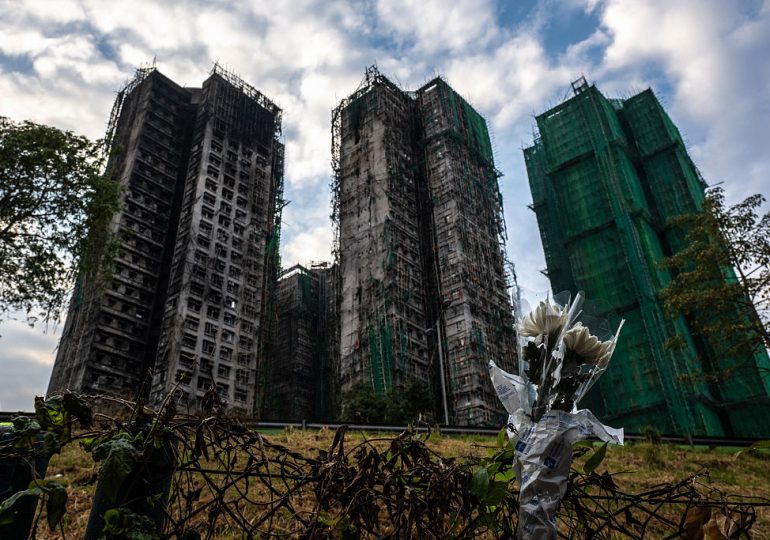
For much of my twenties, I travelled back and forth between urban Hong Kong and the New Territories, a hilly area where my university campus sat. On countless afternoons, just outside of a campus gate, I would board a bus and watch the lush mountains in the distance as the bus skirted Tolo Harbour. Soon, the bus would take a left turn, and a row of high towers with light brown façades would come into view. That was Wang Fuk Court.
[time-brightcove not-tgx=”true”]
To numerous Hong Kongers like me, these towers were a signature of Tai Po new town, and a visual reminder that we were on our way to trade the verdant expanse of the New Territory for downtown Hong Kong’s buzzy districts. When I close my eyes, I can still see Tai Po’s curved train tracks cradling Tolo bay’s coastline, the crowded bus terminus, the grids of working-class housing blocks. Amid it all, the eight Wang Fuk towers standing tall.
After the mass pro-democracy demonstrations in 2019, I moved to Taiwan to finish my first novel. In the following years, I haven’t thought about Tai Po much, assuming it would stay steady, housing my memory of Hong Kong. This year, I decided to visit my family back home.
On Nov. 26, the day before my planned trip, a deadly fire broke out in Wang Fuk Court. As soon as I landed, I met up with a few friends at a cha chaan teng cafe to have claypot rice for late lunch. By then, the fire had been largely brought under control. But news sites and social media were still blanketed by images of tremendous flame and smoke spreading over these towers. The reunion was tearful. Horrified, we struggled to find words to comfort each other. At least 160 lives were lost.
I moved through the next couple of days in a fog. Doomscrolling at all times, I kept up with the humans and pets—cats, dogs, turtles—being rescued or recovered. The death toll of residents, home aids, and building workers climbed. In the evenings, I had dinner with friends from my university days, some of whom still live in Tai Po area. I dreaded seeing the blackened outline of what used to be a quotidian landmark.
The gruesome incident shocked us into a grim awakening: the idea of a safe and unchanging home was all but a dream.
In the 1950s, when hundreds of thousands of Chinese mainlanders fled political turmoil and sought refuge in Hong Kong, the city saw an acute housing shortage. The British colonial government began setting up resettlement communities. These buildings represented the earliest public housing initiatives of modern Hong Kong. In the following decades, they grew into large rental estates. For low-income families, they offered modest comfort and a measure of stability.
For the first five years of my life, my family lived in a public housing unit in Kowloon, a northern territory separated from Hong Kong island by the Victorian Harbor. In that tower, corridors wrapped around a central lightwell. I loved running around the hallways with the other children in the building. A single shout could reach neighbors on several floors. In the open shaft, the love and resentment in our lives felt like a soap opera staged in public. We kept little to ourselves—family chats, couple’s arguments, the smells of cooking and cigarette smoke were all shared. We were witness to and took part in one another’s lives.
By the late 1970s, the housing shortage continued. The government introduced the Home Ownership Scheme (HOS) to help families buy subsidized apartments. When they vacated their rental units, people with greater needs were able to move in. In a decade or so, more than two hundred thousand families became HOS homeowners. After Wang Fuk Court was built in 1983, it welcomed thousands of households.
Moving from public rental housing into an HOS apartment often felt like winning the lottery. One of my aunts wanted it so badly that she made monthly visits to Buddhist temples and kept a vegetarian diet to accumulate good karma for two years. For her generation, the transition from paying rent in a public estate to owning an HOS apartment meant way more than a change of address. Finally, they could buy nicer furniture with the knowledge that they’ll be able to live there for as long as they wished and eventually pass down the property to their children.
In the 1990s, my parents were lucky to be able to secure a three-bedroom HOS unit in the Tseung Kwan O neighborhood in New Territory, where most HOS projects were constructed. The walls were still thin, but instead of running around the hallways, I had access to a real playground. New towns like Tseung Kwan O and Tai Po were eerily similar: life centered around a low-rise shopping area with a supermarket, a cha chaan teng, a bakery and a clinic; Nearby, a wet market offered seafood and meat, and there was a garden with benches for residents to hang out; At the community sports centers, ping-pong tables were always busy. Many residents’ daily routines were confined entirely within this radius: buying groceries, sending kids to school, seeing the doctor, visiting a friend. What more would one need?
Five days after the fire, I finally prepared myself to lay flowers at Wang Fuk Court. When I first arrived in the neighborhood, it was strange to see some of the aspects of normal daily life were still in place. Shops were open. Schools were in session.
But of course, everything had changed. Part of the community center was designated for families to identify the dead. An open area of the center was transformed into a shelter. It was occupied by thin and crumpled mattresses. The guests’ meager belongings were laid out in rows.
That morning, I stopped by a forlorn laundromat. I had read an interview with its owner in the local press. She told the reporter that most of her regulars were residents of Wang Fuk Court. In the days after the fire, she had been calling them one by one to check on them. Through the window, I saw stacks of clean clothes.
I couldn’t stop thinking about these neatly folded piles of clothes. For some survivors, they may be the only possessions from their life before the fire. Some of the clothes would probably remain there for a long time, along with the claim tickets tucked into their pockets, waiting for a call that will never come.
Leave a comment