
It was close to 9 p.m., Christmas Eve, and I was in a car with my family in the Swiss countryside. Down a succession of ever quieter and narrower roads, lit by yellow streetlamps in the villages, utterly black in the fields, we made our way to our destination, the hamlet of Ziefen.
The streets were absolutely silent. Not a soul was stirring, and we wondered if we were in the right place. Then, turning up the lane to the church, we caught them in our headlights: men with tall black hats.
[time-brightcove not-tgx=”true”]
I was in Ziefen in the final, dark hours before Christmas because it’s then that the lights of the village go out, and silent men in hats as tall as houses walk through the streets. Around his neck, each walker bears a heavy, gonging cowbell. At the head of the procession is a man with a white beard, holding a long rod with a sooty rag at the tip. The men’s hats, I had read online, had to be seen to be believed: Based on the scant information I could dig up, they were strange constructions, eerie stove pipes towering some 20 or 30 feet.
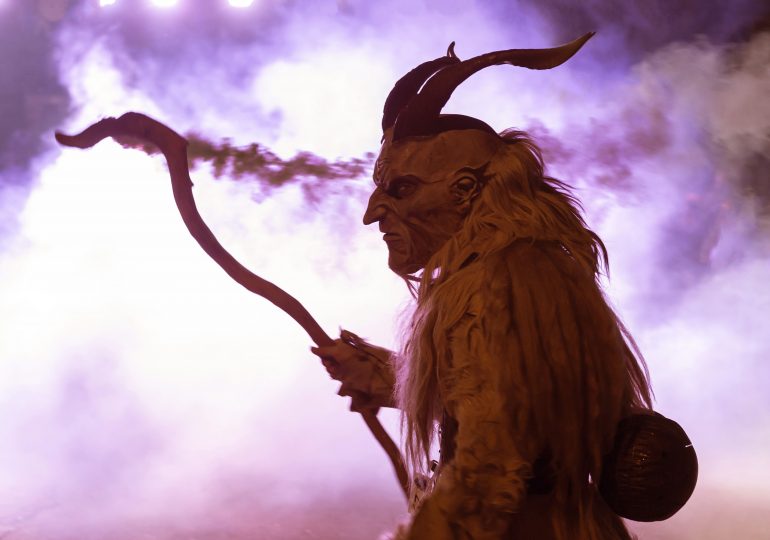
Switzerland isn’t the only place where haunting rituals are performed in the winter darkness. As the days grow shorter and the night draws in—and, it must be said, farmers find themselves with time on their hands—people get up to strange things. In the South Tyrol in December, demonic Krampuses—neighbors in elaborate, blood-curdling disguise—run through the streets. Between Christmas and January 6 in Germany, hairy monsters parade through darkened lanes. In late February—when days are longer, but darkness still reigns—chaotic Carnival festivities, in which the usual order of things is overturned, take the stage. Around the same time, the enormous costumed monsters of the Tschäggättä in Valais in Switzerland roam villages, scaring children and probably a few adults.
What is it about the darkest time of the year that elicits these rituals? And what does it mean when someone puts on a mask of goat fur or a hat twenty feet tall?
“We have a long, rich history with darkness,” says Nick Dunn, a professor of urban design at Lancaster University in the U.K. and author of the book Dark Matters. And while the absence of light has many negative connotations—it is, after all, a state in which human ancestors might have been at greater risk of meeting nocturnal predators and in which, these days, you have a greater risk of stubbing your toe—that negativity is an interpretation we put on it, too. “It’s really worth remembering we are born with two innate fears: Falling and loud noises. We’re not born with a fear of darkness,” he says. Indeed, it’s the contrast with darkness that makes light interesting, says Tim Edensor, a professor of social and cultural geography at Manchester Metropolitan University who has worked with Dunn.
What’s more, equating darkness with evil and goodness with light may be a relatively recent invention. Edensor links it to the rise of Christianity, a point echoed by University of Sussex anthropologist of magic Susan Greenwood. But even if you dissociate darkness from evil, darkness still holds power, she says.
“There’s a myth throughout most of northern Europe of the Wild Hunt, this ghostly cavalcade that roams through wild places,” Greenwood says. “They are led by a deity, usually Odin or Woden, on horseback and accompanied by a load of really fierce wild hounds or black dogs.
“When I was doing field work, I was working with a group of pagan witches in a coven, and they set a challenge whereby you had to walk alone through the wood at night, call in the Wild Hunt, and call a hound to earn the right of the woods,” says Greenwood, who gamely walked through the dark woods on her own. “It was absolutely terrifying,” she remembers. “These myths and legends, whatever we call them, they’re powerful.”
As we walked into the village of Zeifen, we passed an array of hats. They were leaned against the wall of a barn, each mounted on a carrying frame like the ones used in a band to carry drums so that the weight would fall on the wearer’s shoulders while the brim rested on the head. We took a wrong turn and found ourselves in utter darkness hot-footing it down a path between fields when, from ahead of us, came more men in black carrying hats. We stepped to the side and let them go by.
We made our way to the gas station (closed, like everything in the village on Christmas Eve). At this point we began to notice other people gathering. Until now the streets had been dead. But now there were nine or ten others, their faces dimly lit by the streetlamps. As we waited, more and more shadowy forms poured out of the alleyways of the town. There were no vendors, no festive mulled wine sellers, no noise to speak of—just the occasional low sound of voices.
At 9 p.m., the church on the hill above rang the hour. And on the final stroke, the lights went out. The street was bathed in black. In the distance, a sudden clamor arose, an incredible din of innumerable bells. The walk had begun.
Villager Franz Stohler, an 87-year-old Zeifen expert on this tradition, says that for more than 200 years, the walk has followed the same route around the ancient core of the village. The Nünichlingler, as the walkers are called, walk because in the past, the villagers believed that on these darkest, shortest days of the year, a window opened in the earth to another world, and spirits were loosed. The sound forces them back, away from the village for another year.
The roar of bells in the darkness drew me like a magnet. They were moving now through the old streets of the town, and I walked with increasing urgency towards the sound. Then, in the distance, a camera flash lit up a hellish sight—wreathed in the smoke from village fires, a great black pipe organ, as tall as the houses on either side, heaved and rolled across the square. When the camera flash was over, we could again see nothing, only hear the fantastical sound of bells. But they were coming.
When they passed by me, lit again by a camera flash, I saw the tallest hats walked at the front of the procession, and behind, in rows of three, came lower and lower hats, until at the end there were men in the simple felt hats of cowherds and long dark coats, clanging their bells. I ran alongside, my hands over my ears, watching the rippling movement of the tallest hats, some three or four times the height of their wearers. On, on they went, turning at the darkened gas station, off onto the byways, looping through the town. Our group had lost each other in the night and the cacophony—atomized by the strangeness—but miraculously found each other again.
The hats are an addition to the older tradition, Stohler says, but the rule is that the tallest hats get to walk first. When he was a young man, after World War II, the tallest hats were only three feet or so high. Since then, they have grown and grown, although now they are as tall as they are likely to get, he thinks; the ancient route goes under powerlines, which place a natural limit on hat height.
At one point, a car came whipping down the street, clearly on the way to nearby Basel and using this road as it was mostly meant to be used: as a modern highway. What must they have thought when hundreds of faces loomed out of the shadows on the shoulders of the road, a woman waved them furiously down and made them turn off their lights, and then, from the inky blackness, an enormous centipede of men in black hats with bells crawled from an alley and across their view. They must have felt a surge of uneasiness—here on Christmas Eve, maybe on their way to Mass, a fragment of an ancient, weird past had stopped their progress.
On some level, these rituals of darkness are about keeping people in line, says Greenwood. The Krampus scares children, to remind them of the wages of naughtiness. The man at the front of the Nünichlinglers has a rag on a stick to attack anyone who might steal a glimpse out their window. (These days, Stohler notes, onlookers are welcome, but the stick endures.) Other rituals have similar morals. But they are also about the changing of the year, the beginning of the end of the short days. “It’s about reaching the deepest, darkest point in winter, and the rebirth of the light. That goes right through to the Christian nativity,” Greenwood says. “It’s the return of the light.”
Stohler says that today, first and foremost, the Nünichlingler walk is an expression of joy. The young men who walk it—it is always the young men of the village—feel at the end that they have been through something, and come out the other side. The darkness won’t last forever.
When we followed the walkers into the fields outside of town again at the procession’s end, on a cue from the leader they silenced their bells. The black hats tumbled like felled trees onto the grassy hillside. The men melted back into the village, bound for dinner, indistinguishable again from the crowd.
–
Sascha Roger Kouba translated for Mr. Stohler.
Leave a comment