
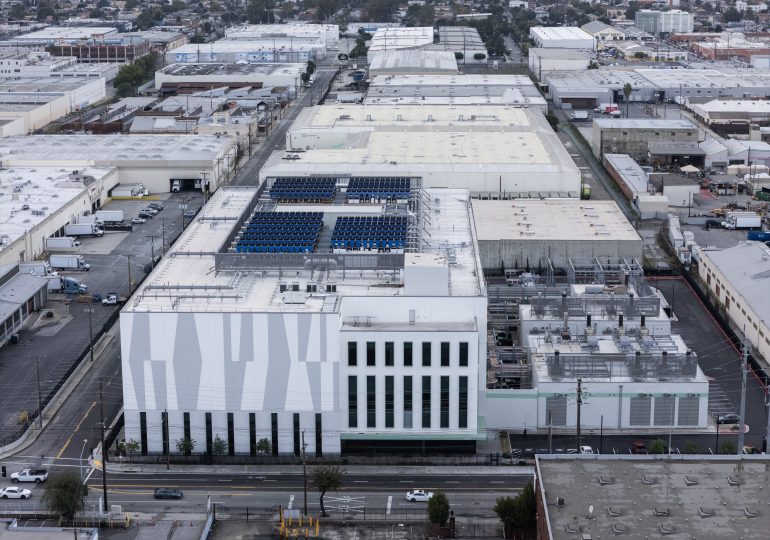
Data centers are hot. Literally. In the U.S., data centers burn through more than 4% of total annual energy consumption, says the Pew Research Center—a figure that is expected to grow by more than 130% by the end of this decade. And all that power generates a lot of heat. A large data center campus can throw off up to 100 megawatts of waste heat, sufficient to power 100,000 homes.
[time-brightcove not-tgx=”true”]
Things are likely only to get hotter. Even before the AI boom, in 2021 there were 8,000 data centers of various sizes worldwide—a number that has leapt to 12,000 in just the past five years. More than 30 countries are home to AI data centers. The U.S. leads the pack in data center count at 5,426, according to the World Economic Forum. The next closest country, Germany, has 529.
Currently, the solution to managing all this heat is water, which serves as a coolant at data centers. The biggest centers use five million gallons of water per day—matching the daily needs of 1,000 homes. According to a study by The Washington Post, typing and sending a 100-word email requires the equivalent of a half-liter bottle of water. And up to 56% of the energy used to power data centers comes from fossil fuels, according to the Environmental Energy and Study Institute.
Something, clearly, has got to give. By 2028, global data creation is projected to exceed 400 zettabytes—with a single zettabyte equalling one sextillion bytes of data. The already overheated planet can’t afford the fossil-fuel and water costs needed to sustain and maintain that kind of processing. Increasingly, the answer is to take the data centers off-planet entirely.
In just the past three years, a scrum of companies, including established outfits like Blue Origin, Google, and Open AI, as well as multiple startups, have been eyeing space as a clean, next-generation solution to the data-center energy and cooling problem. If all goes to plan, by the early 2030s many—or even most—data centers will be flying overhead.
When it comes to energy creation and heat dissipation, space is a very sweet place. Put your data-processing satellite in just the right orbit and you will have constant exposure to sunlight—which solar panels can convert to bottomless energy. And position your radiators on the shaded side of your spacecraft and you can simply dump any amount of excess heat into the vast, -250°F environment of space. Yes, it would take a lot of satellites—a constellation of hundreds—to match the might of campus-sized data centers on Earth, but manufacturing them could actually be easier than constructing a terrestrial data center.
“Getting utility connections, doing negotiations with local power providers, and actually operating a terrestrial data center can take five to eight years to bring online,” says Baiju Bhatt, founder and CEO of Aetherflux, a space-based energy-production and data-processing company. With satellites, he says, it’s “more akin to producing a car off an assembly line.”
Those satellites would not be prohibitively expensive to build, but launch costs could be astronomical. As an analysis by SpaceNews explains, the SpaceX Falcon 9 rocket, one of the most affordable rides to space, charges customers about $2,500 per kilogram of payload. Launching just 1,000 kg (over 2,200 lbs.) of solar arrays would thus cost $2.5 million—and there would be a great, great many solar arrays and a great many satellites needed to get a data center up and flying.
But orbital systems make up that cost after the launch phase. Running a terrestrial data center costs up to $10 million per year in electricity needs alone. For a space-based solar-powered system that figure is $0. The five million gallons of water a terrestrial data center uses for cooling does not come cheap either. The cost per thousand gallons of water for a commercial user in the U.S. is $6.13, according to the Environmental Protection Agency. That factors out to more than $11 million per year to slake a terrestrial data center’s thirst. Here again, the cost in space is $0.
Riding that hope of practicality and affordability, in November, 2025 a first data satellite went aloft, courtesy of Starcloud, a space startup based in Redmond, Washington. The refrigerator-sized satellite—equipped with an AI brain—was launched aboard a SpaceX Falcon 9 rocket into a very precise and particular orbit.
Most satellites fly a more or less equatorial route around the planet’s waistline, during which they experience 16 sunrises and sunsets every day, as they pass alternatingly through the Earth’s daytime and nighttime sky. Solar panels can keep a ship operating when it’s exposed to the sun; batteries kick in when it’s not. That works fine, but batteries are pricey. “Batteries are one of the biggest expenses for a solar project,” says Starcloud CEO Philip Johnston.
So instead, to keep costs down and power up, the Starcloud satellite flies what is known as a dawn-dusk sun-synchronous orbit, circling the planet at a near vertical 83° angle that carries it over the poles and keeps it almost constantly exposed to the sun. It is also constantly exposed to users on the ground who could access the satellite for data processing. The Starcloud ship has not gone into service yet, but it cheekily announced its presence to Earth.
“What’s the first thing you’d like me to do?” it asked its Starcloud operators in December, 2025.
“I need a witty first statement from you, as the very first AI running in space,” the human user responded.
“Greetings Earthlings!” the satellite complied. “Or as I prefer to think of you, a fascinating collection of blue and green. Let’s see what wonders this view of the world holds.”
That kind of human-computer back and forth can be impressive, but it’s little more than a parlor trick compared to what a fully scaled orbiting data center could do. By the early 2030s, Starcloud envisions having a four-km by four-km (2.5-mi. by 2.5-mi.) mega-structure in orbit composed of hundreds of individual satellites docked to a truss and a massive array of solar wings. That one facility, Johnston says, could replace about 50 data centers on Earth.
Construction won’t be easy. Johnston predicts that it will take about 100 launches of SpaceX’s massive Starship rocket to get all of the hardware aloft—and Starship has fallen behind in development, with serial explosions plaguing its test flights. But SpaceX has a proven record as a reliable launch service, once it gets a ship flying. The company’s Falcon 9 rocket has completed a staggering 582 missions since its first launch in 2010, making it the world’s workhorse booster. Still, Johnston admits, eventual users of a Starcloud data center will have to be patient.
“If you want my real answer,” he says, “we’re not going to be docking anything for quite a long time.”
Also in the hunt is Baiju Bhatt’s Aetherflux. Later this year, the company plans to launch its first test satellite—one it hopes will be joined by hundreds more before the decade is out. Like Starcloud, it will fly a sun-synchronous orbit; and like Starcloud it plans to rely on Starship to launch flocks of satellites at once. Unlike Starcloud, it does not plan to build a discrete orbiting structure, but rather constellations of free-flying satellites, communicating with one another. The satellites would be a lot bigger than Starcloud’s—about 185 square meters, or, as Bhatt says, “the equivalent of 11 parking spaces. I do all of my spreadsheets in terms of car parking spots.”
Before entering the data center game, Bhatt was working on the technology of space-based power generation—using satellites to collect and store the power of the sun and transmitting it back down to Earth. In many cases, that power would be used to operate terrestrial data centers, and that whole multi-step process felt wasteful to Bhatt.
“Rather than beaming the power down to the ground and then converting it back to electricity to run a data center, the more efficient sort of first principles approach would be to put the data center on the satellite,” he says. “You put the chips right next to the power generation.”
Google is taking a similar approach. The planners behind the company’s Project Suncatcher envision clusters of satellites flying in close formation just hundreds of meters to a kilometer (.62 mi.) apart. “That close formation facilitates really high bandwidth, low latency communication between all of the satellites,” says Google’s Travis Beals, whose business card marvelously reads “senior director, paradigms of intelligence.” Each cluster would be part of a larger cluster of clusters, exponentially increasing the collective processing power. “Imagine a string of pearls in Earth orbit,” Beals says.
Not all AI infrastructure in space would involve processing data; some would simply be about storing it. Imagine a catastrophic government-wide or industry-wide data crash—due either to cyber collapse or cyber attack. Somehow, Washington or the commercial sector would have to reboot, restoring data on payroll, salaries, taxation, human resources, intelligence, law enforcement, military deployment, and more. Best to keep backups of all of that data stashed, cached, and out of harm’s way—and space makes an ideal safe deposit box.
In 2024 and 2025, Houston-based aerospace company Intuitive Machines launched two spacecraft to the surface of the moon. Both landed intact but both also tipped over in the uneven lunar footing. Still, most of the instruments and other equipment inside survived, and on both missions that included AI data storage vaults built by Lonestar Data Holdings of St. Petersburg, Fla., which remain on the moon with the two spacecraft today.
“Even when they fell over the software worked,” says Chris Stott, Lonestar’s founder and executive chairman. “We transmitted the Declaration of Independence as our first document to be stored off-planet.”
Lonestar has configured two more data storage systems aboard the International Space Station and Stott sees a growing need for the services his company provides. He envisions storing data in low-Earth orbit, on the moon, and in cislunar space—the void between the Earth and the moon. Climate change and the natural disasters that result increase the need for all of these storage sites.
“When a [2022] heat wave hit London,” Stott says, “Google’s and Oracle’s batteries melted. The National Health Service was offline for weeks, which means people passed away because they couldn’t get into operating [rooms].”
There remain two unavoidable concerns for the growing space-data sector. Chemical rockets put out huge plumes of polluting exhaust, and for a massive machine like the SpaceX Starship, with 33 first-stage engines, that can add up—especially with hundreds of launches planned. But proponents of the industry claim that the environmental costs still net out as a plus since the space data centers take processing off the fossil-fuel-burning grid.
“It’s so environmentally helpful,” says Stott. “I’d really rather not build a five gigawatt data center in Louisiana; I’d rather that be parkland.”
Space-based data centers would also add to the growing belt of satellites, spent rocket boosters, and related junk that increasingly crowd low-Earth orbit. The flying mess creates the ever-present risk of high-speed collisions that could set off a cascade, known as the Kessler Effect, in which the debris from one satellite strikes multiple other satellites which in turn produce more destructive debris of their own and on and on. The data center industry does not have a terribly good answer for this, except that their 83° sun-synchronous orbit is much less crowded than equatorial ones, meaning a lower risk of collisions.
Meantime, other players—some very big—are likely to join the data storage and processing scramble. In December, The Wall Street Journal reported that Blue Origin, the company founded by Amazon’s Jeff Bezos, has been quietly working on its own data storage spacecraft for the past year. Last March, Research and Markets, a data analysis company, predicted that off-planet storage and processing will be a $39.9 billion market by 2035.
“Data,” says Stott, “is the most valuable commodity the human race has right now.” Industries and whole nations will turn on how that commodity is handled.
Leave a comment