
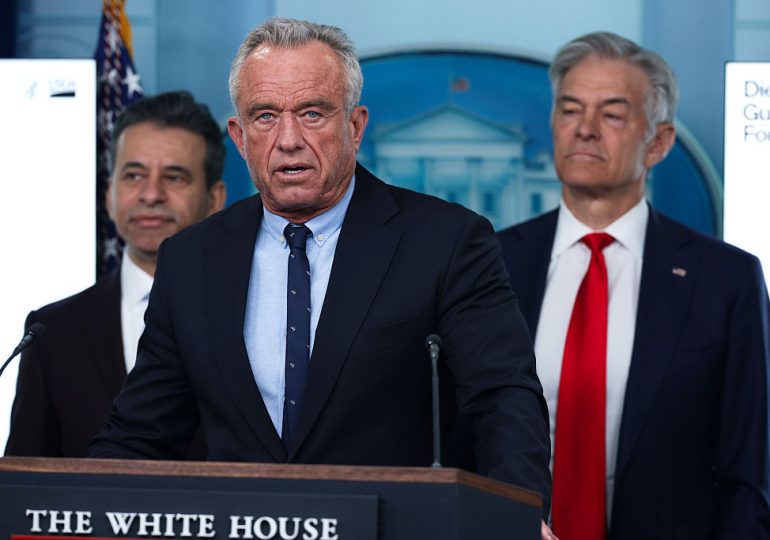
In a sweeping shift on Jan. 5, federal health officials revised the U.S. childhood immunization schedule, narrowing which vaccines are recommended for all children and moving several into a “shared clinical decision-making” category.
[time-brightcove not-tgx=”true”]
As both a physician and a mother, my stomach dropped when I read the schedule for myself.
With no regard for the agency’s usual expert panel process, Robert F. Kennedy Jr., U.S. Health Secretary and Jim O’Neill, the CDC’s acting director, unilaterally removed the recommendation that all children receive four vaccines: influenza, rotavirus, meningococcal disease, and hepatitis A. These once-routine, scientifically-proven vaccines are no longer recommended by the nation’s foremost health agency.
I fear that the impact of this policy will be devastating and children, especially those from low income families, will pay the highest price.
Undermining health care standards
For many who feel like modern parenting is already one long consent form, “shared decision-making” may come as a relief—more choice and less pressure. “Shared clinical decision-making” can be a good thing in medicine when it means a real, thoughtful conversation that respects families’ values and circumstances.
But here’s the issue: in the United States, moving vaccines from “routine” to “optional” doesn’t make life simpler. It just changes who has to do the work, and who pays the price when the work doesn’t get done.
Labeling life-saving vaccines as “routine” communicates to parents that vaccines are simple, important, and worth doing. Meanwhile, “shared clinical decision-making” suggests that they are negotiable. And in our busy lives, “negotiable” can quickly become “not today.”
A vaccine schedule isn’t just a clinical checklist. It’s infrastructure. It tells pediatric offices what to stock and prioritize. It tells parents what are standard ways to care for and protect your children. It provides busy clinicians with a consistent checklist to ensure all children receive the same care.
The impact of the recent vaccine schedule change will not impact all families the same.
If you have a flexible work schedule, a car, a pediatrician who replies quickly, and the experience of being listened to in medical settings, “shared decision-making” might feel like collaboration. You can ask for another appointment, make follow-up calls, and chase down a shot if the clinic doesn’t have it in stock.
If you are paid hourly and missing a shift means missing rent, if you’re navigating language barriers, or if you’ve been brushed off by the health care system, “shared decision-making” can feel like a new hurdle to get your child what used to be a straightforward standard of care.
The realities of the American health care system
As an ER physician, I know more than most that we don’t get to live in the world of intentions. Rather, we live in the world of outcomes.
Not long ago, I treated a toddler who came in limp with dehydration after days of vomiting and diarrhea. The parent was apologizing nonstop, trying to explain that they weren’t neglectful. They were out of sick days, couldn’t get an appointment quickly, and didn’t have childcare for another visit. They tried to manage at home until it became an emergency. When the system adds friction, families fall through the cracks.
The Trump Administration’s argument for their policy change is that it’s aligning the United States with other high-income nations. However, comparing schedules without comparing health systems is like comparing traffic laws without comparing roads.
The American Academy of Pediatrics has made this point before: while vaccine guidance across high-income countries is broadly similar, it can differ because of disease threats, demographics, health systems, vaccine access, and delivery programs. In countries with universal health care and stronger social supports, families may have fewer barriers to follow-up care. In the United States, where access is fragmented and paid leave is not guaranteed, making prevention “optional” can quietly make it inaccessible.
Health care’s trust crisis
This inaccessibility has contributed to a lack of trust in the American health care system.
As a Black physician, I understand why some communities are cautious about medicine in the United States. That mistrust has a history and a logic. The CDC’s own materials acknowledge that informed consent was not collected in the U.S. Public Health Service (USPHS) Untreated Syphilis Study at Tuskegee. The story of Henrietta Lacks, whose cells were taken and used for research without consent in an era that did not have today’s standards, remains another touchstone for why “just trust us” doesn’t land the same for all patients.
But here is what frustrates me about how trust is being used to justify this policy shift: you don’t rebuild trust by making scientific guidance feel political, or like a matter of personal opinion. You establish trust in science by transparently providing patients with all relevant, evidence-based content.
For the Black community specifically, we should tell the full story about trust because we’re not outsiders to the history of immunization. We have been part of it from the beginning, even when credit and power were denied.
In 1721, during a smallpox outbreak in Boston, an enslaved African man named Onesimus shared knowledge of inoculation, what was called variolation, a practice he had known before enslavement with his enslaver, Cotton Mather. Though Mather once credited for the breakthrough, the U.S. National Library of Medicine notes that African slaves introduced variolation into the United States and that Mather learned about it from Onesimus.
Onesimus’ story holds two truths at once. First, Black people have contributed to lifesaving public health knowledge. Second, vaccine controversies are not new. They’ve always been about power, fear, misinformation, and whose expertise counts.
This is why the American Academy of Pediatrics (AAP) has resoundingly condemned the Trump Administration’s changes, calling them “dangerous and unnecessary.” The AAP has said it will continue to recommend a complete set of vaccinations. Pediatricians are pleading with parents, “Please don’t confuse the current administration’s policy with what your child’s doctors still believe is safest.”
The ultimate impact
If parents ignore the AAP’s recommendations, here is what I fear will happen next: parents will be told a vaccine is “optional” and assume it is not important. Or a family with fewer resources will miss a vaccine window and their child will catch a dangerous, avoidable disease. Indeed, the children who face the most barriers to care are the ones most likely to feel the consequences.
Parental autonomy is only meaningful when access is real. And real autonomy looks like clear, stable, evidence-based guidance. It’s a transparent process the public can understand, pediatric care that is available and reachable, and a society that doesn’t punish parents for taking time to keep their kids healthy.
Disease prevention should be boring, routine, expected, and easy to access. The kind of protection you don’t have to negotiate for your child because the system is built to deliver it without drama.
Children don’t get to vote in public health politics. They just absorb the consequences. And in the United States, when routine becomes optional, inequity becomes inevitable.
Leave a comment