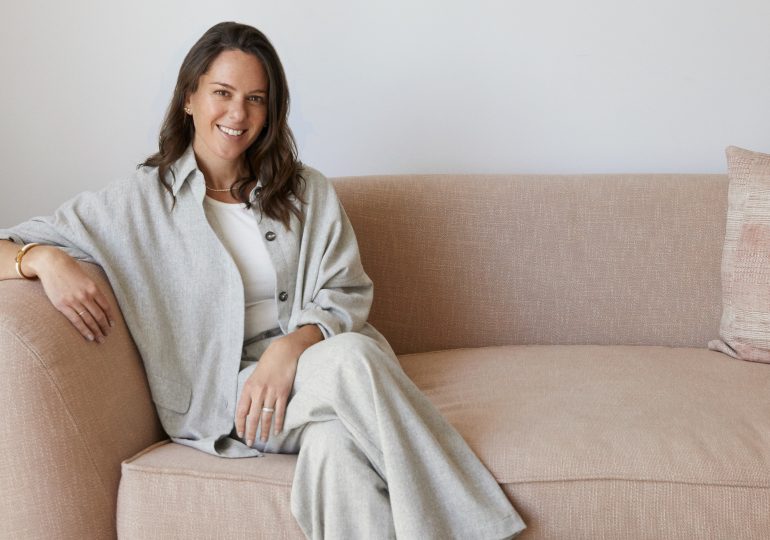
Hali Borenstein knew early on that she would end up in the retail sector, but took a detour before she got into the business. She started her career in consulting, at Bain & Company “to really just learn how to solve problems,” she says. After attending business school, she landed in merchandising at a children’s clothing company, where she says learned a lot, but eventually began thinking beyond the typical model.
[time-brightcove not-tgx=”true”]
“I was at this conventional company, where we were constantly talking about the average cost of a unit, and it was about getting that lower and lower, because you wanted to bring the product in cheap enough that you can promote it,” she says. “And I had this moment of like, how are we valuing labor? How are we valuing creativity? And it’s kind of this downward cycle.” When the founder of fashion brand Reformation approached her about joining the company, she says she was excited about its unconventional model. “This idea of sustainability and putting people and planet first was really exciting to me, and felt fresh.” She joined as director of merchandising and over the past 11 years has worked her way up to the position of CEO, which she stepped into in 2020, a year after the company was acquired by private equity firm Permira.
Borenstein spoke with TIME late last year about Reformation’s plans for growth and sustainability, navigating tariffs, and collaborating with Monica Lewinsky.
This interview has been condensed and edited for clarity.
Reformation has emerged as something of a cult brand, and there seem to be an increasing number of brands targeting a similar customer base. Consumers are also being bombarded with fast-fashion options online and in stores. How do you ensure that Reformation remains competitive in this landscape?
What is really core to our success is two things: Product and brand. First and foremost, we make incredible products that make our customers look and feel great. We survey our customers. Something like 80% or 90% report that we make them feel confident, which is something you don’t [often] hear from a brand. And the amount of time we focus on fit, on quality—I try on every single garment we release personally, because I think it’s so important that anything we offer feels unique and special and really makes our customer feel different than if they were in another garment. Most brands are just churning product out, or they’re not really thinking about who they’re servicing in terms of the fit and how we really ensure our customer looks and feel her feels her best consistently. We’ve enabled this through an incredible supply chain. It’s geographically diverse and it’s really fast. Over 50% of our product comes in 60 days or less. If your supply chain is 12 months out, you have to kind of be clairvoyant. Look into the future and say, leopard [print] is coming back, or red is the color of the season, but you get it wrong. Instead, we built this supply chain that is so nimble and responsive to what’s going on around us that we can look at our customer, we can look at what’s selling, we can look at the marketplace, make exactly that. So I think the product piece is super critical, and that you can’t just retrofit the supply chain. That’s what probably keeps us really unique and ahead of the pack.
The second piece is this brand piece, which is really about how we connect with our customer. From Day One, we had this value that we were going to be a friend. How do you build this intimacy with the customer? I think the brand voice is a really good example of that. And sustainability is a really important part of that, because there’s so much more dimensionality to the relationship, and so much more, frankly, for us to talk about with you, beyond just what you bought because of the values that we stand for.
You talked a bit about customer satisfaction. Dressing rooms can be a place of dread for many women. You have a 60% conversion rate from try-ons to purchase. What is it that you’re doing differently in your stores to achieve that?
I think it comes down to product, because you love it when you try it on. But the other piece that I think we do really differently that makes our retail experience so unique is this technology we built. So if you walk into one of our stores, there’s actually three ways for you to shop. So, what you’ll see on the floor are samples, one of everything we have. We have inventory [in the] back, but we’re only showing one of everything, and you’ll see screens everywhere. And so you can come in and peruse the racks and walk around and say, I want to try this on. There’s an associate with a handheld device who will build you a dressing room.
The second method is, there’s a screen on the wall with a full catalog of what’s available to shop in our store [to add to your dressing room.] And the third thing is your mobile device: You can walk around and scan the items yourself to make your own dressing room. When you’re ready, you click, “Build me a dressing room” and just it feels very similar to e-commerce. We’ve actually leveraged our e-commerce platform as a learning tool, but our back-of-house looks like a mini distribution center—they’re fulfilling your dressing room. In the dressing room, you have screens that have a bunch of different features—different lighting settings. So you can have bright setting, you can have a sexy time setting. It’s fun, it’s engaging. The screen also has everything you’re trying on with styling advice, with the sustainability information, you can ask for a different size while you’re in there. We’re really enabling or building an experience where one, you can have fun with it, and two, you can get the information you really want about each product. And so I think that, combined with just fundamentally good product, has allowed us to have this very unique metric. No one else has the amount of data that we have, where we’re able to track every single step of the shopping journey because of this technology. We know conversion rate by item. So if there’s a sweater that’s selling terribly, we’ll actually pull it back and say, what’s going on? Is there a fit issue? We just have such a richness of information that really helps us improve that customer experience.
Retailers are being impacted by tariffs affecting supply chains, the rising cost of living is affecting people’s decisions about where they’re spending their money. How are these things affecting Reformation?
I’m very proud to say that the business is still growing healthily, and we’re on track to continue to achieve record annual revenue targets. It’s undoubtable that customers are waiting to see what’s going to happen in the broader marketplace and how this is going to impact them. It’s funny, on Liberation Day, that first couple days you did see demand slow, because everyone was like, “What just happened?” But then it came down. And so I think it’s a lot of stop-start right now. You know, uniquely Reformation is positioned in a way where about a quarter of our consumers are Gen Z, and a quarter of them are actually Gen X, and then the rest are millennials. So it’s a really broad customer base, and because of that, we’re really able to market to different types of consumers who are looking for different things at this point, and we have a broad catalog of product to do exactly that. But for Gen X, who are a bit more established, I think potentially, who were buying even more expensive items, we are a really good value offering, and so we’re seeing those customers really lean in.
And then for our customers who are earlier in their careers, they’re seeing us as a destination for that really special piece. We did not take a ton of pricing for that reason. So we’re really focused on retrofitting our supply chain where we can and controlling and managing within constraints that we’re given. We are making moves on the supply chain, but we have a lot of geographies already in place, so it’s more about doubling down in one geography versus building something from scratch, which has been helpful for us. We’re definitely feeling it, but I think the breadth of our assortment and the breadth of our customer base really gives us a resilience to help navigate these times.
What sort of changes are you looking at in the supply chain?
For us, it’s not about which exact geography we’re going to be in. We are refining our principles on how much diversification we need and what’s the max any one geography can be. We’re going to have a broader range of geographic concentration.
You’ve done some quite high profile collaborations with people like Monica Lewinsky and Casey Musgraves. That can be somewhat risky today—I’m thinking of Kanye West and Adidas, or Sydney Sweeney’s ad with American Eagle. What do you consider when you’re thinking about who you collaborate with and how you handle those sorts of partnerships ?
I mean, look, Monica Lewinsky was a real risk. It could have gone a lot of ways. We do have guidelines where we really want to understand what’s the goal—why are we doing this collab? Is it for brand awareness? Is it because of sustainability and our mission? When you have a very clear objective, [it’s] helpful to measure impact. That’s the first and foremost thing that we do. We also really make sure that whoever we work with is brand-aligned in terms of values, of who we are, our mission, and how we like to show up to customers, and so we get to know our collaborators pretty well throughout the process, and that’s an important part of making sure we can control the narrative. II think the buzziness of it is actually kind of fun at times. And for sure, it could be risky, but it is important that brands show up in surprising and new ways, and so I think for us, these collaborations really do allow us to tell our story in a different way and offer a special product that is often limited edition, to infuse some newness and new ideas there. Anything in this world can be risky these days, but being completely honest, most of the time for us, collaborations have only really been a creative and I’m really happy about the way we engage in it. The way where I think they maybe go awry at times is when they just do it to do it, versus having a real reason and a story behind it. And so that’s something that internally, we’re constantly trying to figure out—what’s our why?
[And] it’s okay to take some risk and push a boundary if it’s consistent with who we are and how we want to show up with the world. You know, Monica Lewinsky, I think, unfortunately, had a lot of negative history with brands. She had that Weight Watchers thing that went really poorly. And, you know, her name is synonymous sometimes with negative stories. But we met her, and she was really a strong woman who was really caught up in something that was quite unfair, and so we felt really good about being brave with her and telling her story in a very different way.
I also wanted to talk about your sustainability goals. You are aiming to become climate-positive soon and to be fully circular by 2030. Can you tell me how that’s going?
Sustainability has been a core principle for us since Day One. It’s really infused in all of our decision making. Our supply chain was set up this way from Day One. And so what that really enables us to do is set very ambitious leadership-making goals in the industry. We’re definitely ahead of schedule on the 2030 commitment. Think 100% of our product today is now recyclable, which is a brand new achievement and super exciting for us. We can take back anything, and we’re really working on minimizing all of the new materials that are in our products.
And then on the carbon side, we’re making great progress. The recycled cashmere has actually been a big win for us, because conventional cashmere, although a very, very little piece of our usage, is actually our biggest impact from a carbon perspective. So making these strides has been incredibly helpful. Materiality and transportation are the two biggest areas where we are making progress and will continue to be focused. The macro world around us does not make it easy, so tariffs and global supply chain disruption does not make sustainability any easier. But regardless, our team is super committed.
You’ve been making an international expansion, and you also have the new jewelry category. Can you tell me about your plan for growth and where you see Reformation going over the next five years?
The way we’re really growing is through product expansion, through geographic expansion, through channel, and lastly brand awareness. So, first on product. Originally, back when I began, we were a destination for all things “occasion”—67% of our revenue was dresses—today, it’s a much smaller portion of our business, as we really have worked on building a wardrobe or providing you options across your wardrobe. Sweaters are a huge business for us. Denim, shoes and now, with jewelry coming. Really it’s that goal of being more for our customer and representing a broader lifestyle.
The second piece is geography. About 20% of our revenue comes from outside the U.S., and we’re still very early on this journey. The resonance of our product sensibility and our mission alignment is so strong, particularly in Europe, that we’re seeing incredible traction there.
Third [is] channel—so we’re going to open 15 stores this year [2025], all across new markets, as well as doubling down on some of our best markets. And so [having] more stores has been very successful. It’s a great way to bring our product, our voice, to our local communities.
Lastly is brand awareness. If you actually look at our brand awareness numbers compared to our competitive set, we’re quite low. So we have this opportunity to continue to tell our story in a bigger way to a broader base of customers.
What have you learned about leadership over the course of your career?
The first thing is, I’m constantly learning. Every day, I feel like I’m learning something new. Leaders don’t have all the answers, and we shouldn’t. What we should be able to do is listen really well to our team, to the marketplace, to our customer, and take the insights across all of these areas and come together to bring new insight, new ideas to the forefront. So what I’ve really learned is to keep learning and to never stop learning and listening, because that really, really does differentiate us.
The other thing I’d say that’s pretty top of mind right now, is you can’t control everything. Really focusing on what you can control and what truly differentiates us, particularly at times like this, at the times when things could be challenging, I think is a big learning for me that will stay with me for years to come.
(To receive weekly emails of conversations with the world’s top CEOs and decisionmakers, click here.)
Leave a comment