Team USA is sending one of its strongest figure skating squads ever to Milano Cortina.
The U.S. Olympic Trials for figure skating are always a nail-biting pressure cooker, and version 2026 was no exception. Three spots each were available in the women’s, men’s, and ice dance events, and two spots for the pairs event. The deep fields led to tough competition at the U.S. national championships in St. Louis, which double as the Olympic Trials.
[time-brightcove not-tgx=”true”]
For the first time, U.S. figure skaters could make history by winning medals in four of the five skating events—in the team, men’s, women’s, and ice dance disciplines. And at least three of those medals could be gold.
The number of athletes a country can send to the Olympics depends on how well skaters finish in the previous year’s world figure skating championships, and the U.S. boasts three of them. Alysa Liu is the reigning women’s world champion, and her teammates Isabeau Levito and Amber Glenn finished fourth and fifth, enough to send the maximum of three athletes in the women’s event. Ilia Malinin, called “the quad god” for his mastery of multiple quadruple jumps, is the men’s world champion, and his teammate Jason Brown’s 8th place finish together also gave the U.S. men the maximum three athletes for Milan. Madison Chock and Evan Bates are the current world champions in ice dance, and their teammates’ fifth and ninth place finishes allowed the U.S. to send three teams in that event. The U.S. pairs finished sixth and seventh at the world championships, which earned the U.S. two spots in that event at the Olympics. And Team USA will be one of 10 countries competing in the team event that kicks off the skating competitions in Milan.
Here are the athletes who could make U.S. skating history in February.
WOMEN
The U.S. women are currently among the best female skaters in the world; among them they earned six U.S. titles and two world medals. But that doesn’t mean that they see each other as rivals. Amber Glenn, Isabeau Levito, and Alysa Liu have developed a sisterhood that is rare in the world of solitary singles skating, often finishing each other’s sentences or thoughts and easily falling into witty back and forth exchanges that are hilarious and entertaining to witness. (Case in point—during a press conference following the women’s event at the Olympic Trials, Liu fanned out her new striped hair for everyone to enjoy, while Glenn quipped that she looked like the fish from Shark Tales.)
Glenn, from Plano, Tex., will be competing at her first Olympics after winning her third straight U.S. title in St. Louis, the first woman to do so since Michelle Kwan. Glenn, 26, took time off from skating to address her anxiety and depression, which she says built during her early skating career as she spiraled into an unhealthy cycle of striving for perfection and constantly comparing herself to others. She has openly talked about seeking mental health help, including spending time in an in-house facility, to build resilience and coping skills that have supported her in her comeback journey. “It took completely stripping down everything to just survive every day,” she says. “I was able to connect with family, and friends and get to a place where I felt I wanted to have a future again.” Her return to competitive skating has been a study in perseverance. During COVID-19, Glenn focused on learning the triple Axel, one of the more difficult jumps women perform; it’s since become a formidable weapon in earning her spots on both national and international podiums.
Liu burst into skating fame in 2019, when she became the youngest skater to win the senior U.S. national championship at 13. The Oakland native wowed the sport with her easy triple jumps, and made history with a number of firsts—she is the first U.S. woman to land three triple Axels in a single competition, and to also land a quadruple jump in competition. She repeated as national champion in 2020 and represented the U.S. at the 2022 Beijing Olympic Games, where she finished sixth and helped Team USA earn bronze in the team event. She retired, at age 16, after those Games, enrolling at UCLA to focus on her education and looking to skating as a “dopamine hit.” But in 2024, the lure and adrenaline of competing brought her back in earnest, and she began training again to make her second Olympic team. This time, however, she made it clear to her father, a single dad who raised her and her four siblings, and to her coaches, that she was no longer the child who followed their lead but that she would navigate the major decisions about her career. She is determined to enjoy this Olympic experience on her own terms. “I don’t think anything is going to be hard about the Olympics,” she says. “What is there to lose? Every second you are there you are gaining something. I can’t think of anything that I would find stressful or anything that could bring me down.”
Liu hasn’t brought back her triple Axel—yet—but she has been training the jump regularly, according to one of her coaches, and given her penchant for surprises—she debuted a new free program at the Olympic Trials in St. Louis, along with a new halo patterned hair color—it could still pop up in her program in Milan.
The youngest of the trio, Levito, 18, from New Jersey, is, in a sense, returning home when she travels to Milan to compete in her first Olympics. Her mother, Chiara Garberi-Levito, is from Milan, and her grandmother and other family from the city plan to be at the arena to cheer her on. Levito is the balletic counter to Glenn and Liu’s powerhouse style, but her long lines and easy flow on the ice are balanced by her consistent triple jumps, which could land her in the top 10 at the Olympics. “I’m excited to make the most of every moment in the [Olympic] Village,” she says, noting that making the Olympic team was more stressful than what she anticipates competing at her first Olympic Games will be. “It’s smooth sailing from here.”
PAIRS
The U.S. is sending two pairs teams, but the squad doesn’t include the current U.S. gold or silver medalists. That’s because each team includes a member who is not a U.S. citizen—Elisa Efimova, a native of Finland, and her husband and partner, Misha Mitrofinov, repeated as national pairs champions, but Efimova is not eligible to represent the U.S. International Olympic Committee rules state that athletes must hold a passport for the country they represent at the time the Olympic team is announced, and Efimova currently has a green card after marrying Mitrofinov in 2024. Normally green card holders have to wait three years before becoming eligible for U.S. citizenship, and Matt Ferrell, CEO of the U.S. Figure Skating Association, said while they had made appeals to argue the case for expediting Efimova’s citizenship, “at the end of the day, there was not anything tangible enough to make [the possibility of citizenship] feel real, even up to the last second, despite heroic efforts to try to make it happen.”
They’re not the only team facing citizenship challenges. The silver medalists, Katie McBeath and Daniil Parkman are also ineligible because, while McBeath is a citizen from Ohio, Parkman is from St. Petersburg, Russia. While Parkman has been living in the U.S. for several years, it was clear before the competition that he would not be eligible to represent the U.S. in Milan.
That led USFSA to name third and fourth place finishers, respectively, Ellie Kam and Danny O’Shea, and Emily Chan and Spencer Akira Howe to the Olympic team. O’Shea’s Olympic dream began when he was seven years old and watched the Games on television and has been skating for 30 years to make that dream a reality, starting as a singles skater before moving to pairs. When he was considering retiring, he began working with Kam in 2022, after Kam’s previous partner left, and the pair decided to launch a new collaboration. Kam admits to being a little slower to believe they could make it all the way to the Olympics, but they have worked on improving their finishes and became national champions in 2024, and finished 7th at the world championships last year.
Chan and Howe were U.S. silver medalists in 2023 but struggled at the last national championships, finishing just off the podium. They skated to fourth and sixth places at their two international Grand Prix competitions this season. Chan began as a singles skater and switched to pairs, partnering with Mitrofanov at the novice level. She and Howe teamed up in 2019 and began training at the Skating Club of Boston and in 2023, earned a silver at the U.S. championships and a fifth place finish at the world championships. Howe enlisted in the U.S. Army in 2024, joining the Army’s World Class Athlete Program.
MEN
Like the women’s team, the U.S. men’s team is a close-knit trio; as skaters at the junior level, they were selected to represent the U.S. at the junior world championships in 2020. This time, they are reuniting to compete, each for the first time, at their sport’s biggest competition, the Olympics.
Ilia Malinin
All eyes will be on Malinin, for the stunning array of quadruple jumps that the Virginia native pulls off with a mind boggling ease. Last December Malinin became the first skater to successfully land seven quad jumps in a single program, a feat he may try to repeat in Milan, which makes his performances must-see. Malinin is coached by his parents, both Olympians who competed for Uzbekistan, and is elevating men’s figure skating to new heights. Left off the U.S. team in 2022 for another skater with more experience at international competitions, despite finishing second at the nationals and Olympic Trials, “gave me the fire inside of wanting to push forward, push more and elevate my skating,” Malinin said. “Without that, I don’t think I may have made the team this year. I have been looking forward to this moment my whole life. It’s been such a journey, such a push and effort to get to this point in time.”
Andrew Torgashev
Torgashev began skating at age 9, coached by parents, both of whom are skaters. After competing at the world championships with Malinin and Naumov as a junior, injuries set in and he took time off to consider whether he wanted to continue with his skating career. “Most people at 18 go to college and start to become adults, and discover themselves,” he said. “I didn’t know if I wanted to continue skating.” He decided to move to California for a fresh start in his skating career, and began training with Rafael Arutunyan, who coached Olympic gold medalist Nathan Chen, who “completely changed my technique,” Torgashev said. Now working with former U.S. pairs champion Brandon Frazier, Torgashev is traveling to his first Olympics.
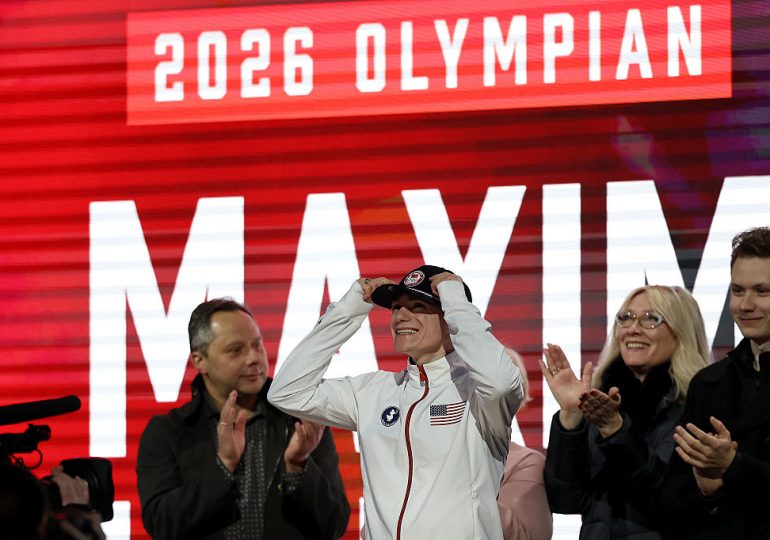
Maxim Naumov
At the U.S. national championships that doubled as the Olympic Trials, Naumov earned his first national medal, a bronze. And a spot on the US men’s figure skating team. But the people he most wanted by his side for the milestone were only there in spirit—Naumov’s parents, world champion pairs skaters Evgenia Shishkova and Vadim Naumov, who were also his coaches, were killed in the plane crash in January 2025 in Washington, D.C., along with nearly 60 others as they returned home from a skating development camp. Naumov said it took a while before he could even lace up his skates again, and he wasn’t sure he would ever compete again. But he and his parents had talked regularly about their collective dream of him competing at the Olympics, and in one of their last conversations, his father laid out a plan for his training in the current season that would improve his chances of making the team for Milan. “I carried that with me,” Naumov said, and he found the courage to begin training and competing again. “I am not sitting here without the unimaginable work, effort and love from my parents,” he said. “It means absolutely everything to me to fulfill the dream we collectively had as a family since I was first on the ice at five years old. I know they are looking down, smiling and proud.”
DANCE
Ice dance became an Olympic sport in 1976, and for decades was dominated by eastern European teams. But after changes in judging rules in 2002 created more standardized criteria for evaluating dance skills and addressing block judging that favored the European teams, couples from North America have earned places at the podium, and the U.S. squad hopes to continue that trend.
Madison Chock and Evan Bates are the reigning world champions, and gold medal favorites in the event. They are part of the impressive contingent training at Ice Academy of Montreal, with founders Marie-France Dubreuil and Patrice Lauzon. Known for their innovative storytelling themes and the costumes that Chock designs—in their last Olympic program, called Alien, Chock took on the role of an alien who is discovered by astronaut Bates—they continually find new ways to thrill the audience with their lifts and ground-breaking choreography. This season, Chock is a matador and Bates a bull in another creative program that requires Chock to navigate a long, flowing skirt that symbolizes a matador’s cape. While they have competed in three Olympics together, they have yet to win an Olympic medal, something they hope to change in Milan.
Emelia Zingas and Vadym Kolesnik earned their first national medal at the senior level at the recent U.S. championships in St. Louis, which earned them their first trip to the Olympics. Zingas, who previously skated in singles, and Kolesnik, who is Ukrainian, partnered in 2022 after their coach, Igor Shpilband, convinced Zingas to switch to ice dance. They quickly rose through the ice dance ranks in the U.S., and finished in the top five at their international Grand Prix competitions in recent years. Zingas said the transition wasn’t easy—“I would get almost all of the corrections at every session, and Vadym would only get two”—but has no regrets. Kolesnik moved to the U.S. when he was 15 with his mother to train with Shpilband, and went home that year to celebrate his birthday. But his mother’s visa to return back to the US was revoked and he had to come back alone, living with the family of his then-partner. (His mother now lives with him in Detroit while his father remains in Ukraine.) Last March, Kolesnik had surgery for a sports hernia and wasn’t sure he would compete again. “It was really bad for me, not being able to get up,” he said. Now headed to his first Olympics, “I hope I make them proud,” he said of his parents, who have sacrificed living together as a family in order to support his dream of competing at the Games.
Like Chock and Bates, Christina Carreira and Anthony Ponomarenko train at the Ice Academy of Montreal, but at the academy’s new satellite facility in London, Ontario. The couple joins Team USA with a strong skating pedigree—Canadian Carreira’s mother is a skating coach, and Ponomarenko’s parents are Olympic ice dance champions. Carreira was living in Michigan and working with Ponomarenko, who is from California, when they decided to train in Ontario. But to maintain her green card eligibility, Carreira needed to continue living in the U.S., and for several years, stayed in Michigan and drove across the U.S.-Canadian border every day to train. “It was a tough few years, but I’m happy I did that and finally got my citizenship [last November],” she said. Since their first world championships in 2023, they have continually improved their placements, getting closer to the podium with each appearance.
Leave a comment