I had a day of ordinary routine mapped out for Jan. 3: rise early, drink coffee while scrolling through news and answering my emails, get some exercise, and sit down to write an article for Letras Libres, a Mexican magazine, on what might await Venezuela in that still-uncertain future when the dictator Nicolás Maduro would no longer be in power.
[time-brightcove not-tgx=”true”]
I had barely fallen asleep when Bruno, my son, jolted me awake.
“Papa, they’re bombing Caracas.”
I was in Boston, 2,175 miles from Caracas, where I was born and raised. I turned on my phone. My WhatsApp was boiling with messages and videos. On my phone screen, I watched bombs fall, helicopters slice through the sky, and people exclaim: “It’s real.” “The gringos are taking down Maduro.”
What was unfolding brought back another night of explosions and uncertainty in Caracas. On Feb. 4, 1992, Hugo Chávez, Maduro’s predecessor, attempted to overthrow the democratic government of Carlos Andrés Pérez by storming the Miraflores Palace with tanks. Chávez failed, but the assault marked my life and that of millions of Venezuelans. Six years later, it propelled him to the presidency and gave rise to the populist cult known as Chavismo.
Thirty-three years later, it is easy to see that episode as the direct antecedent of the U.S. military intervention that removed Maduro from power, ending his 12-year reign but not Chavismo itself. Many Venezuelans, after years of democratic struggle, had hoped the U.S. would help restore democracy. What they got instead was a makeover of the dictatorship and Venezuela’s conversion into a country under White House tutelage. They also did not expect President Donald Trump to be dismissive of María Corina Machado, the opposition leader, as he was at his press conference after the removal of Maduro.
Venezuela has the largest oil reserves in the world, which account for more than 90% of export revenues. After the removal of Maduro, although Delcy Rodriguez, a stalwart of the Chavista regime, has been sworn in as interim president, Venezuela is being governed from abroad and crucial decisions about oil are being made in Washington.
The emperor has spoken: Venezuela, c’est moi. Many Venezuelans I spoke to this week are grateful to Trump for freeing them from Maduro. Venezuelans once supported Chávez, a left-wing populist, but they have long admired American culture. If Trump were to restore even a slice of what they had in the 1970s—that heady era known as “Gran Venezuela,” when soaring oil revenues bankrolled highways, skyscrapers, and a consumer boom that made Caracas feel like Miami with green mountains and a paradisiac climate—many would likely accept the uncomfortable idea of becoming a protectorate of a foreign power.
Even after the economic contraction of the 1980s, a period that Latin Americans came to call the “lost decade,” when debt crises and austerity measures swept the region, Venezuela retained, until the early 1990s, one of the highest per-capita incomes in Latin America and a functioning democracy—a relative rarity in a neighborhood crowded with military juntas and authoritarian strongmen.
Can Trump deliver?
Aware of the U.S. failures in Iraq and Afghanistan and their colossal costs, Trump has avoided an American invasion and occupation of Venezuela. Instead, he has chosen a different path: leaving the Chavista leadership, minus Maduro, in charge to avert chaos and anarchy. Trump does not speak of democracy or nation building, careful not to alienate his MAGA base or hand more ammunition to Democrats.
Under this scheme of things, American and international energy companies extract Venezuela’s wealth, which Trump promises to return in the form of U.S. products. Washington controls the minimum cash flow the Venezuelan state needs to function as a tool to control the interim government. The assumption is that a trickle-down effect will generate growth and prosperity.
Experts warn otherwise. More than $100 billion in investment and at least a decade would be required to revamp a decaying oil industry and raise oil production from one million barrels a day to the projected five to six million. Without deep institutional reform, the plan will fail. Venezuela today is “uninvestable,” Exxon CEO Darren Woods told Trump at the White House.
The U.S. president could turn Venezuela into an exhibit for his “Donroe Doctrine” on a fast track. Success would allow him to sell skeptical voters on new hegemonic ventures ahead of the midterm elections, which he believes he needs to win to avoid another impeachment. What Trump wants and what can be done are two different things.
So far, Venezuelans have witnessed a controlled implosion managed by the Chavista regime without Maduro. Delcy Rodriguez, the interim president appointed by Maduro and blessed by Trump, has begun releasing, sparingly, some of the regime’s over 800 political prisoners. But Diosdado Cabello, the interior minister and Chavismo’s strongman, still controls the security forces and the colectivos, the paramilitary gangs that terrorize the population.
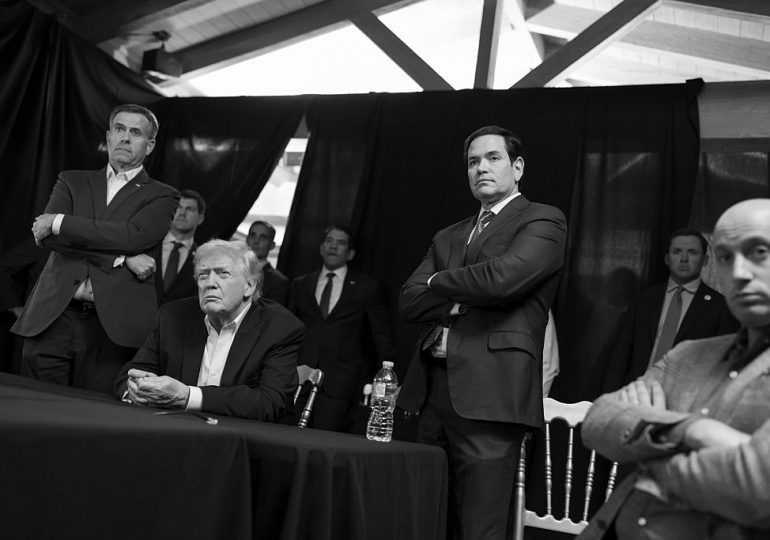
Secretary of State Marco Rubio’s plan for Venezuela envisions three phases: stabilization, economic recovery, and a political transition toward a more “representative” government, and a stronger civil society. None of this will be possible unless Venezuelans recover real freedoms with guarantees and civil rights.
Cabello, the interior minister, is the main obstacle to that transformation. Before being extracted from the country, Maduro signed a decree of external emergency that effectively suspended some constitutional guarantees, which serves as a blank check for Cabello to unleash violence if he chooses. The only way to eliminate this danger is to remove Cabello from the government and dismantle his networks of repression.
Caracas is not dancing
An important, revealing sign of the national mood is the absence of significant celebration after the removal of Maduro. There was no major liberation party. “People only go out for what’s essential, and they go back home before it is dark,” a friend in Caracas, who asked to remain anonymous for security reasons, told me. “Even then, they take risks. If a security force stops you, they can do whatever they want—make you disappear, or if you are a woman, abduct you for human trafficking.”
I asked how he was coping. “It is tense and emotionally exhausting. I go to the market only if it is unavoidable. Lines can take hours. The fear is still there.” Every time he leaves his house, he deletes his WhatsApp chats. The Orwellian state of affairs has crept into the language. “Here you don’t say ‘forget it’ anymore. You say, ‘bórralo!’ ‘delete it!’ I have become my own minister of forgetting.”
Venezuelans are exhausted after 26 years of Chavismo. Understandably, many are willing to accept American tutelage as the price to pay. The most realistic assumption is that Venezuela will become, for an indefinite period, a U.S. protectorate, with varying degrees of what some see as an unwanted dependency. The worst version of that scenario is the current one: an alliance between Trump’s right-wing populism and Chavismo’s left-wing populism, with no clear path to democracy. Trump has expressed his satisfaction with how Rodriguez is collaborating with his Administration. The irony is evident: the extreme right and the far left united, will never be defeated.
The way forward
Venezuelans should not settle for a recycled dictatorship or a protectorate. Venezuela’s opposition leaders can remain comfortably numb as they have been, or shift into emergency mode and demand a voice in decisions about the country’s future. The opposition needs to reopen the path to democracy. María Corina Machado’s expected visit to the White House to meet Trump this week is a first step. It cannot end with a photo op of Trump receiving from her the Nobel Peace Prize she legitimately won—a prize he has repeatedly claimed for himself. Machado must try to secure Trump’s commitment to a clear democratic transition architecture in Venezuela and a credible roadmap to achieve it.
What Venezuela needs for a democratic transition is straightforward and largely aligns with the plans outlined by Rubio. Even if Delcy Rodríguez, or another figure from the current regime, serves as the provisional face of this transition, the first step is the renewal of key state institutions: the ministries of interior and justice, the national police forces, the security and intelligence agencies, the electoral commission, and the Supreme Court—all of which have been hollowed out or captured by years of authoritarian rule.
Political rights must be guaranteed for all actors, including Chavistas who are willing to renounce the apparatus of repression and commit themselves to democratic norms. This will require initiating a process of transitional justice—one that investigates both the grand corruption and the human rights abuses that characterized the dictatorship. Without such a reckoning, there can be neither justice nor reconciliation; the past will fester.
Press freedom must be restored to enable journalists and news organizations to investigate our recent past and serve as a safeguard of transparency going forward. Without a free press, there can be no accountability or democracy. Moreover, either formal international recognition of Edmundo González Urrutia as Venezuela’s rightful president-elect—the winer of the 2024 election that Maduro stole—or a clear timetable for free and fair presidential elections is essential.
There must be an explicit commitment to restoring Venezuela’s full national sovereignty, both political and economic. Accepting the United States as a principal partner, even a dominant one, need not mean surrendering the country’s capacity for independent decision making. The path forward will be finding the balance between gratitude and autonomy.
Freeing a country is not the same as governing it by proxy. When sovereignty is confiscated and freedom administered from the outside, when the terms of liberation are dictated, the result is not a democratic transition but a protectorate dressed up in the language of damage control.
Venezuelans have fought for years to recover their political agency. They should not now be treated as kindergarteners in need of a guardian. Their future cannot be written in distant offices by people who do not share their history or speak their language, or in a diplomatic idiom they did not choose.
Venezuela must not become the laboratory of a new American hegemony in Latin America. Washington’s role, if it is to be constructive, must be limited and precise: to help create the conditions of stability necessary for Venezuelans to decide their own fate. No less, but no more. Everything else is a euphemism for old fashioned domination that the region has spent generations trying to escape.
Leave a comment