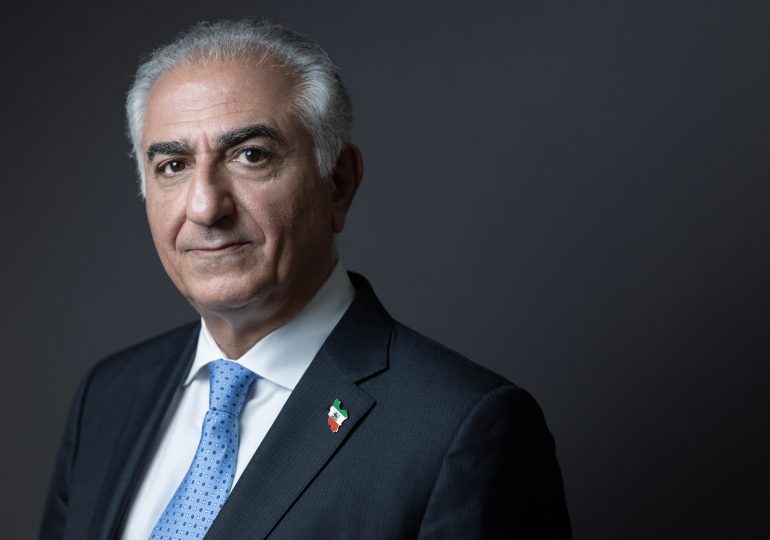
It’s been just over a week since Reza Pahlavi, the exiled prince of Iran, set a high-stakes gamble in motion. Along with other activist groups and dissidents, he urged Iranians to take to the streets, betting that the nation had reached a point of rupture with the Islamic Republic.
Read more: Inside Iran, Protesters Urge Trump to Act: ‘If Nothing Happens, It’s a Catastrophe’
[time-brightcove not-tgx=”true”]
Protesters have paid a staggering price. By some accounts, including an estimate by a Tehran doctor speaking with TIME, at least 20,000 demonstrators were killed by security forces in just three days.
Now, as fear and force push demonstrators indoors, Pahlavi says he and “the Iranian people” are counting on President Donald Trump to step in to protect them, even after the president said on Wednesday he had been told “the killing in Iran is stopping.”
“The Iranian people see President Trump as a man of his word and believe he will follow through with the promise he made to defend them,” Pahlavi told TIME on Thursday in written responses to a series of questions.
Read more: For Trump, a Path Forward on Iran That Goes Beyond Bombs
Several Iranians told TIME they were emboldened by Trump’s repeated warnings, dating back to Jan. 2, that if Iranian authorities killed protesters, “We are locked and loaded and ready to go.”
Based on conversations with Iranians and chants such as “O’ king of Iran, come back to Iran, the mullahs have trashed the country” that echoed across the rallies, many were also encouraged to march for Pahlavi. When asked if it was irresponsible to call Iranians into the streets without protection, Pahlavi placed the blame on Iran’s Supreme Leader, his regime and “their supporters in the West.”
“They have the lives of tens of thousands of my bravest compatriots on their hands,” he said. “But we will ensure their sacrifice is not in vain and we will win.”
Trump has not offered details about how the U.S. may or may not respond to the killings.
“My team and I are in touch with the administration,” Pahlavi said, though he declined to discuss specifics of what he had asked the Administration for, and what, if anything, it had committed to do.
“We do not need foreign boots on the ground, but we do need action that prevents the IRGC [the Islamic Revolutionary Guard Corps] and security forces from continuing mass violence against the people,” he said. “People need help to level the playing field.”
Trump has been reluctant to lend his full support to Pahlavi, however. “He seems very nice, but I don’t know how he’d play within his own country,” the president said. “I don’t know whether or not his country would accept his leadership, and certainly if they would, that would be fine with me.”
Pahlavi has spent decades casting himself in this role. Iranians inside and outside Iran told TIME that in recent years, his popularity has surged, in part because no other opposition figures have the profile to unite and lead them. But Pahlavi remains polarizing. Some Iranians remember his father’s reign as an era of development and close ties with the West; others recall authoritarianism and the notorious SAVAK secret police.
The 60-year-old laid out his plans for a secular post-Islamic Republic transition in a roadmap published online last July. The plan centers on a council with “major interim state functions”, its members appointed by him, alongside executive and judicial bodies whose leaders would be installed or removed with his approval.
After the regime falls, the plan calls for a referendum on the future system of government, either a “democratic monarchy” or a “democratic republic.” His role, he said, was to remain impartial and not “tip the scales” in favor of either.
When asked if and how he would govern the country if people called upon him, he responded: “The people must vote and decide on this.”
Karim Parwizi, a member of the leadership of the Kurdistan Democratic Party of Iran, an opposition group based in northern Iraq, argued that the roadmap leaves too much power in Pahlavi’s hands.
“He is presented as the one who decides everything,” he told TIME. “That suggests the foundations of another dictatorship are being laid.”
Pahlavi was born to be a king—the crown prince, long-awaited after Mohammad Reza Shah’s two failed marriages, before his marriage to Farah Diba.
That trajectory was abruptly cut short. At 18, while Pahlavi was training to fly fighter jets at Reese Air Force Base in Lubbock, Texas, the 1979 Islamic Revolution toppled his father’s rule.
Pahlavi went on to earn a bachelor’s degree in political science at the University of Southern California, got married, and now has three adult daughters. Living mostly in Los Angeles and the Washington D.C. area, he has continued to call for the fall of the Islamic Republic.
It is difficult, however, to determine the exact extent of his popular support among Iran’s roughly 92 million people.
“My view of it is that Reza Pahlavi is just simply being the leader to coordinate the removal of the regime,” a resident of Shiraz, who heeded Pahlavi’s calls to protest last week, told TIME on condition of anonymity. He added that he “wouldn’t mind if he becomes the next shah.”
A 2024 survey by the Netherlands-based research group Gamaan found that if Iran were to hold a free and fair election, Pahlavi would be the “preferred candidate” among more than 30 political and civil society figures.
“He has symbolic importance in capturing the popular rejection of the Islamic Republic, and this owes a great deal to the nostalgia for his father and grandfather’s periods,” said Vali Nasr, a professor at Johns Hopkins University’s School of Advanced International Studies. “But I am not convinced his support is broad based and will be directed into a meaningful political movement.”
Critics have said the exiled prince and his team have not done enough to unite opposition factions, both inside and outside Iran, or to reach out to minority ethnic groups, which are thought to make up about half of the country’s population.
“Pahlavi and his colleagues have shown no indication of dialogue with ethnic minorities, not only Kurds but also Baluch, Turks and Arabs,” said Amjad Hossein Panahi, a political member of the opposition Komala Party of Iranian Kurdistan. “There is no meaningful difference between him and the current regime.”
Shirin Ebadi, Iran’s 2003 Nobel Peace Prize laureate, hopes Pahlavi, working alongside other groups, can help manage any transition. “Let the regime fall,” she said.
Many US government officials also see Pahlavi as the most viable opposition figure, a US-based analyst explained, “partly because his group and the regime have spent so much time discrediting other opposition figures.”
She spoke on condition of anonymity because, she claimed, some of Pahlavi’s supporters in the Iranian diaspora are “bullies.”
Pahlavi, however, presents himself as a unifier. Many in Iran’s opposition “know only I can help lead the transition to democracy.”
“That,” he said, “is why I am stepping forward to lead.”
Leave a comment