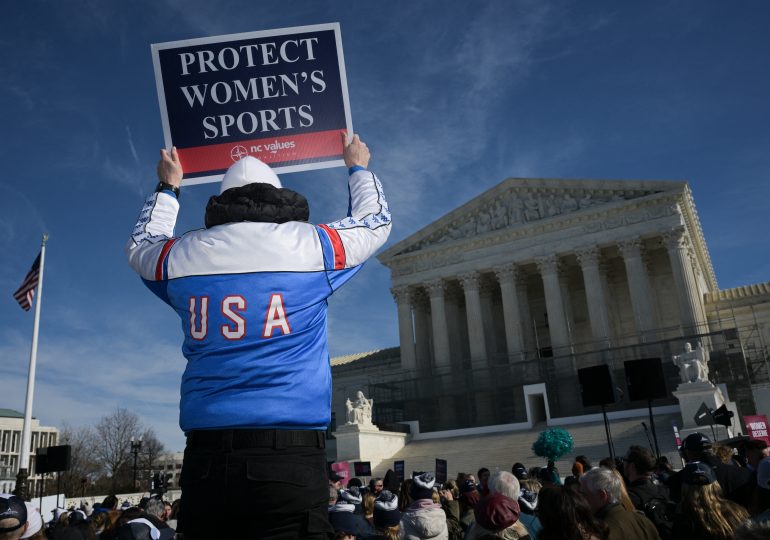
On Jan. 13, the Supreme Court heard oral arguments in two cases that could determine the future of trans athletes in the United States: West Virginia v. BPJ and Little v. Hecox. At issue is whether states can ban trans women and girls from competing in women’s sports—a decision that could uphold exclusions nationwide.
[time-brightcove not-tgx=”true”]
Outside the Court, that question was already being answered in real time.
I was there to support trans athletes’ right to play. If I had stepped about 10 feet to my right, I would have joined a completely different rally: one calling for trans women and girls to be barred from sports altogether. The divide was physical and ideological, but also sensory. Nothing quite prepares you for hearing a queer cheer squad in one ear, while a self-described “father of a daughter” warns about the end of women’s sports in the other.
What struck me most that day wasn’t just the hostility, it was the contradiction. The people claiming they were there to “save” women’s sports seemed to know almost nothing about them. And that contradiction reveals something deeper about this debate. This fight was never really about fairness in athletics. It was about who gets to belong.
On Instagram and TikTok, I make content about women’s sports that reaches millions of people. I tell stories about women athletes that I wish the mainstream media spent more time covering, and whenever I can, I highlight queer joy in sports. So you can imagine my surprise at seeing signs reading “Save Women’s Sports” or “Protect Women’s Sports,” and learning that women’s sports apparently need rescuing.
I turned to my friend and fellow content creator Allie O’Brien and joked that many of these protesters probably don’t even watch women’s sports. She laughed, then suggested something better: Why not ask them? Could they name five women currently playing professional sports?
I was nervous. But I also knew the question would expose something important. So we walked straight into the crowd of signs invoking biology, reality, sex, and Jesus.
The pattern became clear almost immediately. The first man I approached agreed to be recorded. When I asked whether he could name five professional women athletes, he answered honestly: “No.”
A woman holding a purple “Save Women’s Sports” sign offered the Williams sisters, only one of whom still competes. After a pause, she admitted she couldn’t think of anyone else.
Another woman, holding a sign that read “Stop Transing Gay Kids,” named Riley Gaines, a former college swimmer whose public profile now rests largely on opposing trans inclusion in sports, not on competing professionally.
Near the end of our interviews, Allie asked a man holding a “Protect Women’s Sports” sign the same question. “I don’t watch women’s sports,” he replied.
Again and again, the people claiming to protect women’s sports acknowledged they didn’t follow them. They knew little about the athletes they were supposedly saving, except that those athletes, somehow, needed protection from trans girls.
Inside the Court, the justices were considering whether states can legally exclude trans athletes in the name of fairness. As a fan of women’s sports, I find that prospect deeply troubling not just for trans athletes, but for the values women’s sports were built on.
Women’s sports were not founded on exclusion. They were created to correct it. They exist because women were once told they didn’t belong on the field, the court, or the track. Inclusion is not a threat to women’s sports—it is their very reason for being.
Discussions about trans athletes often begin with statistics. This framing has always made me uneasy. In 2024, out of roughly 500,000 NCAA athletes, fewer than ten identified as trans. Now, there are likely even fewer. In Feb. 2025, the NCAA banned trans women student-athletes from competition, saying in a news release: “A student-athlete assigned male at birth may not compete for an NCAA women’s team.”
Defending a marginalized group by emphasizing how small it is suggests that harm becomes acceptable at a certain scale. Those protesting to oppose the inclusion of trans women and girls often cast themselves as victims of this small minority group. But to me, ten athletes was never an insignificant number. Even if there was only one trans athlete in the country, I would still have been standing on those steps.
Critics of trans inclusion typically frame their grievances as an issue of fairness. But this perspective reveals a total lack of understanding about how sports, men’s or women’s, operates. Do people realize how many aspects of sports are inherently “unfair”? Does Katie Ledecky not possess a biological advantage as she laps elite swimmers? Does Simone Biles, the most decorated gymnast of all time, not have the ideal body type for gymnastics? Is four-time WNBA MVP A’ja Wilson’s height on the basketball court unfair?
The fact that anti trans protestors don’t watch women’s sports also matters because it quickly becomes clear that they have not considered how the policies they are advocating for would be implemented in practice, and how they threaten to put all women and girls at risk. Given the long, troubling history of sex testing in women’s sports, how would these bans even be enforced, especially among minors? Who gets to decide which girls “look” trans? And why do those accusations so often fall disproportionately on women of color?
Anti-trans protestors’ focus on trans women also reveals an inherently misogynistic perspective. Why is it not an issue for trans men to compete in men’s sports? If excellence itself becomes evidence of really “being a man,” what does that say about how we value women athletes? When Riley Gaines raced against trans swimmer Lia Thomas at the 2022 NCAA Division I Women’s Swimming and Diving Championships, they tied for fifth place, an outcome that hardly supports the narrative of domination. And if the concern is biology, why are trans women banned from women’s chess?
These questions rarely receive good-faith answers. I know that because I’ve tried.
After I walked away from the woman with the purple sign, she followed me into the crowd. Someone began recording as she asked if she could interview me. I declined politely. She then asked me to “define a trans person.” I said that a trans person is someone who identifies as trans. In hindsight, I could have offered a more clinical definition, but I was shaken. She laughed.
As she continued filming and pressing me to engage, the reason I wouldn’t became clear, even to me. A conversation cannot be productive when one side denies the existence of the other.
She did not believe trans women are women. I do. And as a cis person, I would never claim to know more about a trans person’s identity than they do themselves.
So I walked back to the other side of the Supreme Court steps, the side filled with pride flags and trans flags, music and stories, and people fighting for the right of a girl they’ve never met to play the sport she loves. They’re the same flags and faces I see at Washington Spirit and Mystics games here in D.C. The same feeling I have at every women’s sports event: that I’m part of a community shaped by people who fought to be included in spaces that once excluded them.
By the end of the day, I didn’t need to ask whether the protesters watched women’s sports. If they did, they wouldn’t have been standing where they were. If they knew women’s sports, they would understand the culture girls find when they play: a culture built on teamwork, resilience, and belonging.
That community is worth protecting. And it’s worth protecting for every athlete.
Leave a comment