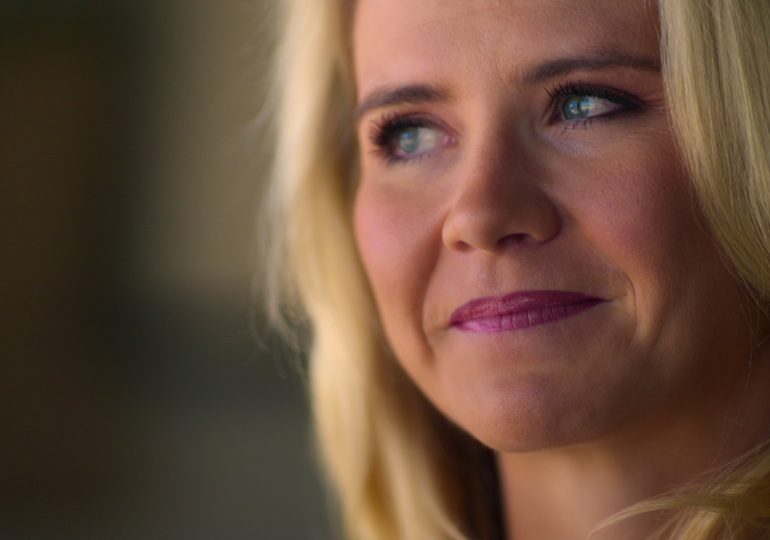
In the Netflix documentary Kidnapped: Elizabeth Smart, out Jan. 21, Smart recalls the night she was abducted from her bedroom in Salt Lake City, Utah, by Brian David Mitchell, who believed he was following a call from God.
Smart was kept captive and repeatedly sexually assaulted by Mitchell for nine months. On March 12, 2003, she was found walking on the side of a highway with Mitchell and his wife.
[time-brightcove not-tgx=”true”]
Kidnapped: Elizabeth Smart covers the months-long search for Smart, featuring members of her family and law enforcement officers who worked on the case. Smart also appears, speaking about how she recovered from the kidnapping and reflecting on her life today.
Here’s a look at the major milestones in the case.
The night Elizabeth Smart was kidnapped
Among the most chilling parts of the documentary are the details of the night that Smart was kidnapped. Her younger sister, Mary Katherine, was also in the bedroom and became the only witness to the abduction. “That night Elizabeth and I said our prayers together and went to sleep,” she says in the film. “The next thing I remember, there was a man in our bedroom telling Elizabeth if she screamed, he would kill her. I was paralyzed.”
Smart remembers waking up and realizing there was a knife at her neck. “I was terrified,” she says. “Was he going to hurt me? Was he going to kill me? I was hoping my parents would wake up, but nobody came.”
Mary Katherine was in shock, but eventually mustered up the courage to go to her parents’ room and tell them that her sister had been taken away. At first, their parents thought Mary Katherine was just having a nightmare, but then they found a broken screen that indicated someone must have broken into the house.
Smart says she was led through her backyard and up a trail by a man who went by Emmanuel David Isaiah—later identified by his real name Brian David Mitchell—who reassured her that he wasn’t going to rape and kill her. They reached a tent in the woods, and his wife Wanda Barzee–who went by Hephzibah–emerged wearing a full-length tunic and headdress. She hugged Smart and washed her feet. Then she gave her a similar outfit to wear.
Smart says the abuse began afterwards, recalling: “I remember feeling like my doom was approaching. I was crying. I was scared. These are his exact words, he said: ‘I hereby seal you to me as my wife before God and his angels as my witnesses.’” When she screamed out “no,” he told her that if she yelled like that again, he would kill her, threatening to “duct tape your mouth shut.” Then, Smart says, he raped her, leaving her in a huge amount of pain, and told her that God commanded him to kidnap seven young girls and that he had his eye on her sister and cousin next.
Life in captivity
Smart opens up about how Mitchell raped her several times a day at the campsite during the summer of 2002. Afterward, he would pray for 45 minutes.
“He used God to justify what he did,” she says. “But more than anything, he loved power. He loved feeling like he was in control.”
Smart says his wife stood by and watched as he subjected her to daily humiliations. Mitchell would withhold food from Smart when he thought she was disobeying him and put a leash around her neck and walk her to a nearby spring to collect water. He forced her to drink beer until she vomited: “He left me face down in my own vomit.”
Mitchell knew a search was on for Smart and taunted her with newspaper articles and missing person posters he found, telling her that all of Salt Lake City was looking for her but that he wouldn’t let her be discovered. He’d show her the knife he would use if any rescuer came to the tent.
How Elizabeth Smart was rescued
About four months after the kidnapping, Mary Katherine had an epiphany that Emmanuel, a man who had once done housework for the family, took her sister. Their mother, Lois, met Mitchell in downtown Salt Lake City in Nov. 2001, when he asked her for money, and she gave him $5. Then, she invited him to come do a day’s work repairing the roof of their house and raking leaves. He hit it off with Smart’s parents, who invited him to come back and work on future home improvements, but they never heard from him again.
The Smart family did a lot of publicizing around the case, at one point releasing a police sketch of Mitchell on their own because they thought investigators were not working fast enough. After the Smarts released the sketch, they got a call from a man who said Emmanuel might be his brother-in-law. In the doc, Smart’s uncle Tom plays a tape recorder with that conversation in which the caller describes his brother-in-law Brian David Mitchell as living in a teepee in the mountains.
“The absolute key moment is when the family decides to release the sketch,” says the film’s executive producer Claire Goodlass. It got the attention of Mitchell’s brother-in-law, who provided key information to the police and put “momentum back into the case.”
Police looked into the tip and found out that Mitchell was arrested for stealing beer in September 2002, during the time period Smart had been kidnapped.
On March 12, 2003, someone called 911 to report people walking along a highway in Sandy, Utah, near Salt Lake City in long, white robes and veils, just like the pictures broadcast on America’s Most Wanted. Smart and her captors had just gotten off of a bus from California. As her disappearance got more press attention, Mitchell had tried to take her to San Diego so they wouldn’t be caught. But Smart convinced him to take her back to Salt Lake City because she told him God had spoken to her—speaking Mitchell’s own “warped” language, says director Benedict Sanderson. He marvels at how Smart had “the wherewithal to do that as a 14-year-old” and the way that “she had more agency in her rescue than I certainly I first realized.”
Police officers showed up to Sandy right away and took the youngest girl in the group aside, showed her a picture of Elizabeth Smart on a flyer and asked if it was her. She replied, “Thou sayeth.”
Mitchell was found guilty of kidnapping and transporting a minor across state lines for sexual activity and is serving a life term in prison. Barzee pleaded guilty to the same charges, was sentenced to 15 years in prison, and was released in 2018.
Where is Elizabeth Smart now?
After she was rescued, Smart struggled with feelings of guilt.
“I was scared of men,” she says. “I felt a lot of shame and embarrassment about what happened.”
But she persevered, enrolling in high school shortly after her rescue and earning a college degree from Brigham Young University. Now 38, Smart is married with three children in Utah. “I always dreamed of finding someone who loved me,” she reflects in the doc. “That did come true.”
She is the founder the Elizabeth Smart Foundation, which advocates for victims of sexual violence. She wrote two memoirs about her ordeal and has been active on the speaker’s circuit, in hopes of connecting with other survivors and assuring them that they are not alone: “I wanted survivors to know they had nothing to be ashamed of.”
The final scenes of the film show both her physical strength and emotional strength. Viewers will hear audio of her discussing how she mustered up her inner strength while watching her running outdoors, through “the very mountains that she was kept captive in,” as Sanderson puts it. Smart has the last word in the documentary: “I’m stronger than I thought I was.”
Leave a comment