Ryan Murphy never gives us any peace. One month, the megaproducer is on Netflix, using Ed Gein as a vehicle to indict the audience that devours the kind of lurid true-crime tales that are his specialty; the next, he pops up on Hulu, pairing a half-dozen acclaimed actresses with one of the most famous women on the planet for what is nominally a lawyer show but actually just hollow girlboss pastiche. In February, he’ll celebrate Valentine’s Day with Love Story, an FX anthology series that will dramatize real-life romances, beginning—riskily—with that of JFK Jr. and Carolyn Bessette-Kennedy. But for his first contribution to the network in 2026, The Beauty, he and co-creator Matthew Hodgson have concocted a genre-hopping oddity that sounds even less likely to work. The big surprise is that, unlike so many of Murphy’s recent projects, it does.
[time-brightcove not-tgx=”true”]
Premiering with two episodes on Jan. 21, the series proceeds from a premise that immediately calls to mind the darkly comic horror movie The Substance, an underdog 2024 Best Picture contender that earned Oscar nominations for both its director, Coralie Fargeat, and its star, Demi Moore. A revolutionary biotech product called The Beauty catalyzes—through a grotesque process involving a sort of flesh cocoon—radical physical transformations, turning the old, the sick, the ugly, and the merely average into young, healthy, stunning specimens of human perfection. Most creators would presumably want to downplay the resemblance between their new show (which is based on a decade-old comic by Jeremy Haun, an executive producer, and Jason A. Hurley) and one of the most prominent movies of the last few years. But brazenness has always been Murphy’s M.O. Of all the people he could have cast as The Beauty’s yassified mastermind, he chose Ashton Kutcher, a man equally famous for his career as an actor turned venture capitalist and for marrying a 42-year-old Moore when he was 27.
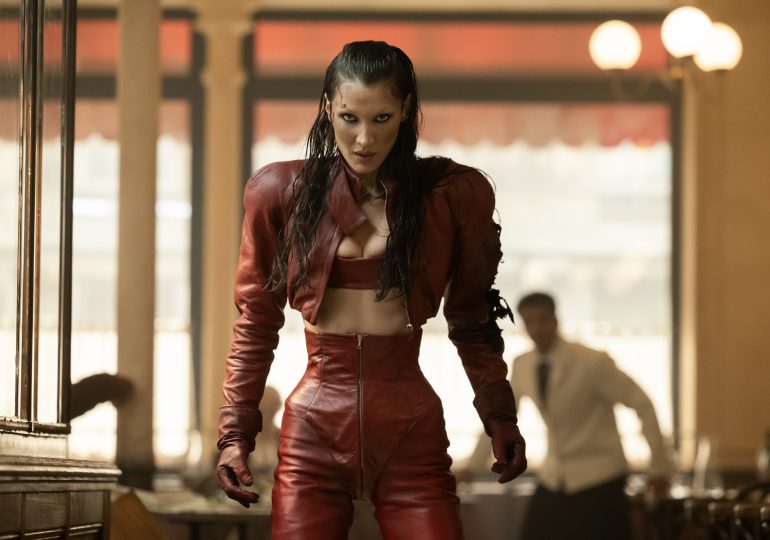
You’d think the Substance–Beauty, Kutcher-Moore connection would be tough to get past. (Moore, who had a role in 2024’s Feud: Capote vs. the Swans, is also part of the Murphyverse.) As it turned out, I basically forgot about that bit of casting-as-metacommentary within the first few installments of the 11-episode season. That’s one benefit of Murphy’s maximalist approach to storytelling: rarely does a single element of his shows overwhelm the rest. Yet the result is too often, especially in the past decade, as his output has exploded, exhausting—a messily assembled collage of camp, glamor, genre tropes, celebrity stunt casting, and strident sociopolitical satire. The Beauty delivers all of the above as early as its opening sequence, which sends a model played by Bella Hadid on a violent rampage through Paris. But its mix of styles, performers, tones, and ideas is organized into a tighter, more dynamic narrative than we usually get from Murphy. Instead of tiring us out with one macabre set piece after another, he switches up the mood regularly enough to keep scripts nimble and (mostly) avoid repetition.
Although the show picks up settings and storylines as it goes, the setup is fairly simple. Jordan Bennett (Rebecca Hall) and Cooper Madsen (Murphy regular Evan Peters) are FBI agents sent to Europe to investigate a string of gory supermodel deaths. (Who would give the name Cooper, first or last, to an FBI-agent character after Twin Peaks? Ryan Murphy, of course.) Partners and friends with benefits who’ve ruled out romance, they have potentially incompatible worldviews. He’s into “embracing imperfections”; she’s always chasing something better, whether it’s a ritzier hotel on assignment or breast implants. They mean more to each other than either seems to realize. In a series thick with Murphy’s signature schadenfreude, and one that casts its strongest actors in the few roles that require emotional realism, theirs is the rare bond that feels authentic.
As their investigation points to a sexually transmitted virus as the cause of victims’ journeys from schlumpy to hot to dead, we glimpse a more deliberate path to perfection. Kutcher’s character—the richest man in the world, who calls himself The Corporation—has, in defiance of all ethical, legal, and medical precepts, developed The Beauty. Though its primary purpose is to beautify, this miracle injection fundamentally alters the human body, turning back the clock on aging and illness, with profound implications on everything from gender to disability. The STI version poses a threat to The Corporation, both because it creates a black market and because patients who undergo the bootleg treatment tend to meet disgusting, public ends. So he’s got a roving hitman (Anthony Ramos’ The Assassin) on the payroll to kill them before they can spread it. The Beauty’s portrayal of The Corporation as a sociopath (though it’s The Assassin who loves Christopher Cross the way American Psycho’s Patrick Bateman loved Huey Lewis) with conspicuous parallels to Elon Musk is Murphy at his broadest. He says things like: “Billionaires, we don’t need friends. We have staff.” In its bluster and smarm, it’s the ideal role for Kutcher.
If The Corporation were its protagonist, like the many one-dimensional monsters around whom Murphy has built many hit TV franchises, The Beauty might be pretty hard to take. Instead, taking structural cues from the comic-book medium, it makes neither Kutcher’s character nor the FBI lovers constant presences. More than a cat-and-mouse game between him and them, the series uses that procedural framework to imagine, in psychologically astute and electrifyingly strange ways, an entire world altered by The Beauty. There’s an unexpectedly moving vignette about a trans scientist and her supportive lab partner; a pocket family melodrama in which the parents of a profoundly ill girl are faced with an unthinkable dilemma; and a mini teen soap that applies all the overused conventions of the afterschool special to this outlandish scenario.
The Beauty is sometimes an action thriller—there are a few cool fight sequences—sometimes a sci-fi thought experiment, sometimes a body horror frightfest, sometimes a screwball romance, sometimes a Succession-on-steroids wealth satire. It’s a lark, except for when it’s a gut punch. It’s silly, except for when it’s serious. A gruesome incident that goes down amid snarky fashion-world gossip in the notorious Condé Nast cafeteria threatens to eclipse this spring’s The Devil Wears Prada sequel. There’s great scenery chomping from Isabella Rossellini, whose operatic performance as The Corporation’s trophy wife turned scathing critic reveals a perspective on beauty and its discontents accessible only to those who’ve possessed, then transcended it. Demographically, her character is the closest The Beauty comes to Moore in The Substance. But her relationship to her aging body is less predictable, her experience just one data point on a matrix of individuals shaped and warped by our society’s obsession with beauty. The problem isn’t limited to older women.
The show rarely lingers long enough in any mode to strain viewers’ patience. In lieu of the subtlety we’ve learned never to expect from Murphy, who reliably turns subtextual references to AIDS or Ozempic or the Sackler dynasty into blunt dialogue that mentions them by name, we get brisk movement from one analogy to the next and plenty of thoughtful synergy between intersecting themes. The pleasure, as with the unpredictable FX not-quite-anthologies Atlanta and Reservation Dogs, is in never knowing what each compact episode will bring.
I wouldn’t put The Beauty in the same exalted league as those shows, not by a long shot. Murphy and Hodgson, longtime collaborators who wrote every episode together, throw too much low-carb spaghetti at the wall for all of it to stick. An early storyline features what might be the laziest incel caricature ever committed to video. Once we know which horrors to expect out of the standard Beauty onset, the lengthy transformation scenes get redundant. The dialogue sometimes lapses from bad-funny to just bad. As per usual for Hollywood, but in a choice that undermines this particular show’s themes, characters who we’re supposed to see as plain are played by extremely attractive actors. (Peters does not have “a face like a catcher’s mitt,” come on, be serious.)
The Beauty puts all of its ideas on the surface of the story, leaving little room for interpretation or ambiguity. But it’s so entertaining—and feels so timely without being a doomy drag—that it seems uncharitable to complain that it isn’t a masterpiece. The rare drama that manages to be smart without being subtle, it might make you suspect that Murphy injected himself with some professional equivalent of The Beauty and evolved, however briefly, into his ideal TV-creator self.
Leave a comment