This article is part of The D.C. Brief, TIME’s politics newsletter. Sign up here to get stories like this sent to your inbox.
The wisdom of the all-but-certain government shutdown on the horizon is dictated by a simple question: Was last year’s record-breaking version worth it?
Democrats seem surprisingly unified as they steer into another shutdown, this time tied to President Donald Trump’s dragnet operation against immigrants instead of an end to subsidies for health insurance used by roughly 20 million Americans. Republicans seem equally as united to stand again behind Trump’s policies—even after federal agents killed two Americans in Minneapolis.
[time-brightcove not-tgx=”true”]
The White House has publicly brushed off the outrage over Trump’s aggressive crackdown on immigration with the same steely indifference it deployed last year as it refused to bend to public opinion backing those Obamacare subsidies. But Trump allies have beseeched his advisers to pare back the over-the-top efforts in Minnesota before they completely turn off voters heading into midterm elections that Republicans are already bracing to go badly. Even inside the MAGAverse, there is a queasiness over a Trumpist show that now has a tangible bodycount. Yes, Trump has long had strong public support to tighten the border and to deport violent criminals but he does not have anywhere near that support to storm communities with armed agents carrying no ID or warrants.
So as Washington barrels toward another shutdown—it’s second in four months—the question of whether Democrats are making the smart play depends on whether the last one was deemed successful for the minority party.
In the fall, as Congress was faced with the choice of extending Obamacare subsidies or allowing health insurance costs to soar for millions of Americans, polls found an extension was broadly supported, regardless of party. It was the textbook example of an 80-20 issue, a no-brainer of a reason for Democrats to step in and shut down the government unless the dollars were extended, and a winning issue for the minority party on an issue most closely associated with their branding.
Republicans did not budge and Democrats, after 43 days, realized they could not out-stubborn Trump.
Those supportive of the strategy will point out that Republicans took the bigger chunk of blame for that standoff. Others will note that Democrats have nothing to show for the extended drama—the subsidies are now gone. Nonetheless, they are on the verge of following the same playbook again.
But the polling central to this current spending fight is not like Obamacare, which has support from about two-thirds of all adults. The underlying issue in play this week—ICE and its tactics—is trending in Democrats’ direction, but still remains far less popular, and with a wider partisan divide.
To be sure, the killing of 37-year-old Alex Pretti, a nurse at a veterans’ hospital, dramatically moved the needle. Almost instantly, polls showed a real shift in public opinion on the primary agency carrying out Trump’s crackdown on immigration, with a majority of Americans telling YouGov pollsters ICE’s tactics are too forceful, and more now saying they support eliminating Immigration and Customs Enforcement entirely than those who want to keep it.
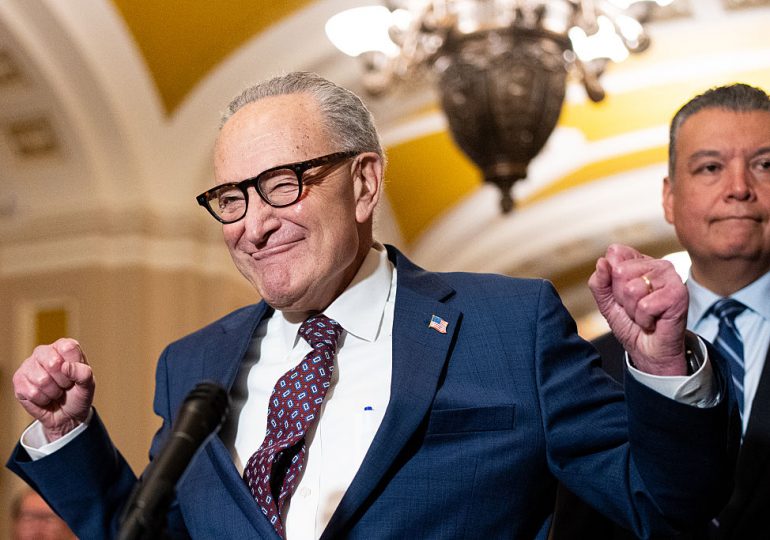
Democrats rushed to a new footing. Their take-your-medicine defeatism from just last month morphed into fast action. On Wednesday, Senate Democrats emerged from their weekly lunch with the kind of unity that, frankly, they had not been able to muster since Trump’s election. Aides said the Pretti death was such a clarifying moment for their bosses that inaction was no longer an option. Senate Minority Leader Chuck Schumer, who has the least enviable job on Capitol Hill, emerged from that session with three main demands in exchange for keeping the government open beyond Friday: more coordination between ICE and local law enforcement—including getting warrants in some cases, a new code of conduct for agents, and requiring they ditch the masks and always wear body cameras while working.
Barring a bipartisan agreement—through legislation, no Trump-signed executive orders—Democrats said they would not fall in line to keep the lights on past Friday.
At the Capitol, Senate Majority Leader John Thune took himself out of the mix even as he rejected calls to pass everything but the Homeland Security spending package and deal with it as a stand-alone question. “I think right now the conversation should be between the White House and Democrats,” Thune said, pushing the issue to Trump.
And at the White House, aides reached out to offices of the handful of Democrats who voted in December to join Republicans to keep funding the government. Those lawmakers declined even a meeting.
So, it seems like the impasse is more durable than it appeared even a week ago. It now feels a lot more like where we were a few months earlier, when everything but the most urgent of government functions got mothballed. Much as before, the public is with Democrats. Also much as before, Trump remains indifferent to popular opinion and thinks he can out-wait his opposition.
Make sense of what matters in Washington. Sign up for the D.C. Brief newsletter.
Leave a comment