When Puerto Rico’s former governor Wanda Vázquez Garced received a pardon from President Donald Trump on Jan. 16, many Puerto Ricans reacted with anger and disbelief. “WHAT?” wrote one Instagram user in response to the news posted by the local newspaper El Nuevo Día. Another called Trump “the savior of corruption.”
[time-brightcove not-tgx=”true”]
This pardon is not just about Wanda Vázquez. It’s about how federal power repeatedly shields Puerto Rico’s political class while demanding austerity and sacrifice from everyone else. Accountability is optional for the powerful, and cooperation with the justice system does not guarantee fairness.
Two cooperating witnesses in the federal case against Vázquez did not receive pardons. The former governor did. In any system that claims to value the rule of law, this inversion would raise alarms. In Puerto Rico, it confirmed a belief widely held across the political spectrum: Justice bends toward power, money, and political convenience.
The case did not emerge in a vacuum. For years, Puerto Rican politics has been marked by blurred lines between public office and private benefit. Vázquez denied wrongdoing and insisted she never lobbied for personal favors, yet reporting documented luxury vehicles, private meetings tied to business interests, and the quiet normalization of ethical gray zones.
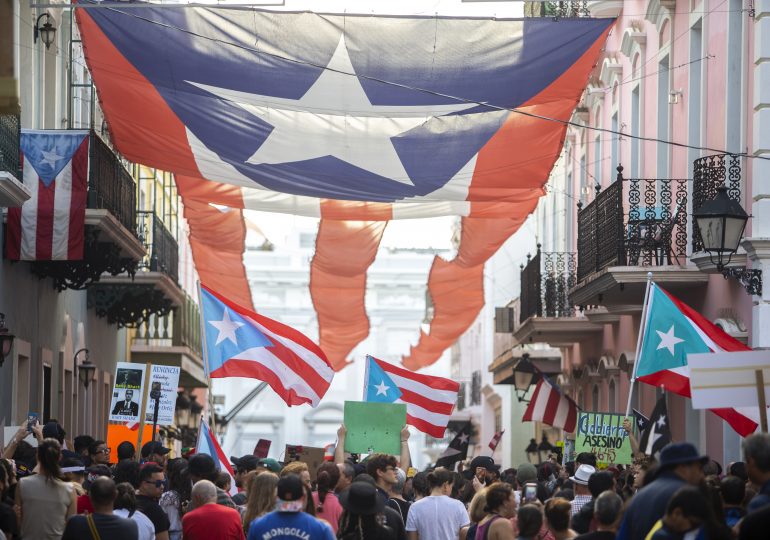
Vázquez became governor in 2019, following the resignation of Ricardo Rosselló, whose administration collapsed after the leak of hundreds of pages of private Telegram messages between the governor and members of his inner circle. The messages—widely condemned as vulgar, misogynistic, racist, and homophobic—also revealed discussions about manipulating media coverage, targeting political opponents, and casual references to the misuse of public funds. Mass protests forced Rosselló from office, marking a rare moment when public outrage translated into political consequence.
Vázquez later lost the New Progressive Party’s 2020 gubernatorial nomination to Pedro Pierluisi, himself a figure long dogged by corruption allegations, before becoming embroiled in her own scandal.
In 2022, the FBI arrested Vázquez on bribery charges tied to her 2020 campaign, alleging she offered to appoint a banker’s preferred financial regulator in exchange for donations. In 2025, Vázquez pleaded guilty to a campaign finance violation, becoming the first former governor of Puerto Rico to do so, though she and her co-conspirators were pardoned by President Trump after a relative made a $2.5 million donation to a Trump-aligned political action committee.
The economic cost of corruption in Puerto Rico
Corruption in Puerto Rico is not merely moral failure; it is economic sabotage.
Puerto Rico’s economy has been in a state of prolonged recession for nearly two decades. The median household income is $27,213, and roughly 37% of the population lives in poverty. Young people leave the island not because they want to, but because opportunity has been systematically stripped away.
Billions of dollars that could have gone toward infrastructure, education, and public services have instead been diverted into inflated contracts, legal settlements, patronage networks, and crisis management. Roads crumble—of the 581 road repair projects initiated after Hurricane Maria struck in 2017, only 29 have been completed—while funds vanish. Schools close as officials retain perks. The University of Puerto Rico faces repeated budget crises despite its central role in social mobility. Corruption has ensured that whatever growth occurred rarely translated into broad prosperity.
Infrastructure decay is perhaps the most visible symptom. Only a fraction of highways are in good condition. Public transportation remains inadequate. The power grid— privatized, mismanaged, and politically entangled—fails with alarming regularity. Between 2021 and 2024, on average, each household lost electricity about 19 times and spent almost 27 hours without power, according to the U.S. Energy Information Administration. Each failure reinforces migration, which in turn shrinks the tax base, accelerating decline. Corruption does not merely coexist with these problems; it actively worsens them.
Puerto Rico has tried to fix corruption before
In 2016, the imposition of the Fiscal Control Board was meant to impose order, reduce deficits, and restore credibility. Instead, it entrenched austerity while leaving the political culture that caused the crisis largely intact.
Corruption scandals continued under the board’s watch. Government officials were arrested. Illegal schemes persisted, including environmental violations involving illegal construction in protected coastal areas such as La Parguera, because enforcement was weak. In recent years, federal investigations have linked contractors connected to politically influential families to these developments, including cases in which individuals associated with the in-laws parents of Gov. Jenniffer González Colón were arrested by the F.B.I. in Oct. 2025.
Against this backdrop, Trump’s pardon did more than absolve a former governor. It intervened directly in Puerto Rico’s already fragile justice ecosystem. Local accountability mechanisms are constrained by federal oversight, partisan entanglements, and a long history of selective enforcement.
Loyalty to power matters more than cooperation with the law
When a former governor is pardoned while cooperating witnesses are left exposed, the lesson is unmistakable: Loyalty to power matters more than cooperation with the law.
The defense offered by allies of the pardon that it was a legal prerogative, that it corrected an injustice, or that it was benevolent rings hollow in Puerto Rico’s context.
In a territory where corruption is widely understood as systemic, the pardon functions as reinforcement, not a remedy. It tells current officials that even if federal prosecutors intervene, consequences can be undone. It tells future whistleblowers that cooperation may not protect them. And it tells the public that cynicism is rational.
This message is especially destructive given Puerto Rico’s colonial condition. As a territory of the U.S., the island lacks full representation, yet bears the full weight of federal decisions. Puerto Ricans are told to endure austerity, accept cuts, and trust institutions, while watching those institutions protect the very actors who helped engineer the crisis.
Trump’s pardon should be understood not as an isolated political favor, but as an intervention that amplifies Puerto Rico’s government’s worst tendencies. It rewards a political class whose corruption has cost the island an estimated $7.4 billion since the early 2000s, about $527 million a year, roughly 10% of the annual government budget, according to estimates by the Pontificia Universidad Católica de Puerto Rico and the Puerto Rico Comptroller’s Office. The pardon weakens deterrence and signals that federal power, rather than correcting colonial distortions, can just as easily entrench them.
Democracy cannot function when justice is perceived as negotiable.
Leave a comment