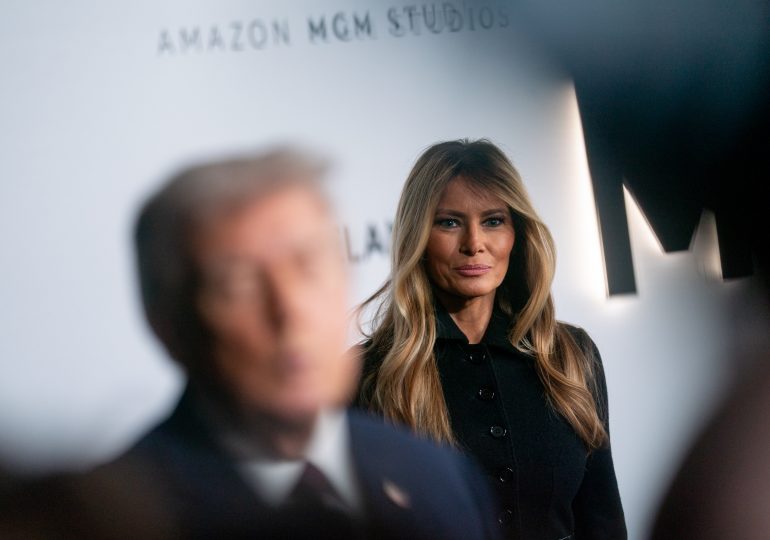
First Lady Melania Trump’s new film has been widely reported as the most successful documentary opening in a decade. Grossing over $7 million in its first weekend, the number is being presented as proof of audience demand, cultural relevance, and cinematic success. But that designation depends on the premise that the film is, in fact, a documentary. It is not.
[time-brightcove not-tgx=”true”]
Melania has been marketed as a documentary, but it can more accurately be defined as a one-hour and 44-minute branding exercise, or an extended piece of reputation management presented in the visual language of nonfiction cinema. When viewed through this lens, the box office figure does not represent a triumph of documentary filmmaking so much as the successful activation of a political brand.
Documentaries, at their best, investigate, contextualize, and interrogate reality. They may advocate, but they do not exist solely to promote the subject’s preferred self-image.
Melania does something else entirely. Even Melania Trump has resisted the documentary label. In public remarks, she has described the film not as a documentary but as a “creative experience,” emphasizing mood, perspective, and personal portrayal rather than investigation or inquiry.
This distinction matters, and explains why the opening-weekend numbers are being misread. Political documentaries, particularly those aligned with a mobilized base, do not behave like traditional documentaries. They operate as campaign rallies, book tours, or branded events. Their success is not measured in persuasion, but in turnout.
Seen this way, the $7 million gross (and $75 million that went into making the film) is less a cinematic milestone than a data point in political marketing. It reflects the effectiveness of distribution, messaging, and audience activation, not the vitality of the documentary form. To herald it the most successful documentary of the decade is to confuse genre with strategy.
Over the last decade, political actors have increasingly used the formats of journalism, documentary, and entertainment to do the work of branding and persuasion rather than investigation or inquiry. The aesthetic and credibility of nonfiction media are borrowed to deliver messages that are fundamentally promotional. The “documentary” label provides legitimacy and cultural cover, allowing this category of content to circulate in spaces traditionally reserved for journalism or art.
What makes the Melania proclamations notable is the insistence on measuring success by theatrical revenue alone. Box office is an ill-suited metric for documentaries, which have traditionally circulated through festivals, broadcasters, streaming platforms, and educational distribution. By emphasizing opening-weekend grosses, the conversation shifts away from substance and toward spectacle. Treating box office revenue as the primary measure of success reframes the film as a marketing victory, not a documentary or cinematic achievement.
The coverage also reveals how easily marketing language can be mistaken for cultural analysis. The tagline “most successful in a decade” is smug, declarative, and suggests momentum, relevance, and demand.
Success at the box office does not reveal whether a film expands understanding, challenges power, or contributes meaningfully to public discourse. It communicates only that turnout was successfully engineered.
Skepticism about the film’s potential audience was widespread. But the opening-weekend turnout does not correlate with the claims being made about the film itself. In that sense, its performance reflects the effectiveness of its marketing strategy, not a sudden resurgence of documentary cinema.
This is more critical than ever because categories mean something. When promotional media is repeatedly classified as documentary, the genre itself becomes less legible. Audiences grow cynical, skepticism replaces trust, and the expectation that nonfiction cinema will offer more than a politically managed narrative erodes.
Recent Pew Research Center surveys show trust in mainstream information sources has fallen significantly, with only about 56% of Americans saying they have at least some trust in information from national news outlets.
Other documentaries have not been immune from controversy. Films like Vaxxed: From Cover-Up to Catastrophe, widely criticized as anti-scientific propaganda, and The Great Global Warming Swindle, formally rebuked for misrepresentation, have stirred debate about nonfiction credibility, as have high-profile streaming titles such as Netflix’s Seaspiracy, challenged by experts for misleading claims, and the docuseries Afflicted, whose participants alleged their portrayals were distorted.
Together, these disputes reflect a broader uncertainty about truth, accuracy, and the obligations of the documentary form.
The question, then, is not whether the film “succeeded.” Amazon acquired the film for an estimated $40 million and spent another $35 million on advertising and marketing. Whether or not it will ultimately turn a profit remains to be seen. Rather, the question is why so many have been willing to accept this framing uncritically, and what that willingness says about the current media environment.
In a moment when politics increasingly borrows the aesthetics of culture, clarity counts. Melania’s opening weekend certainly represents something earned. But treating a promotional project as a documentary and its box office as evidence of cultural achievement is a category error that serves marketing, not truth. Celebrating box-office performance as proof of cultural value mistakes mobilization for meaning. What’s being celebrated in Melania’s box office results is not documentary success, but the triumph of positioning over purpose.
Leave a comment