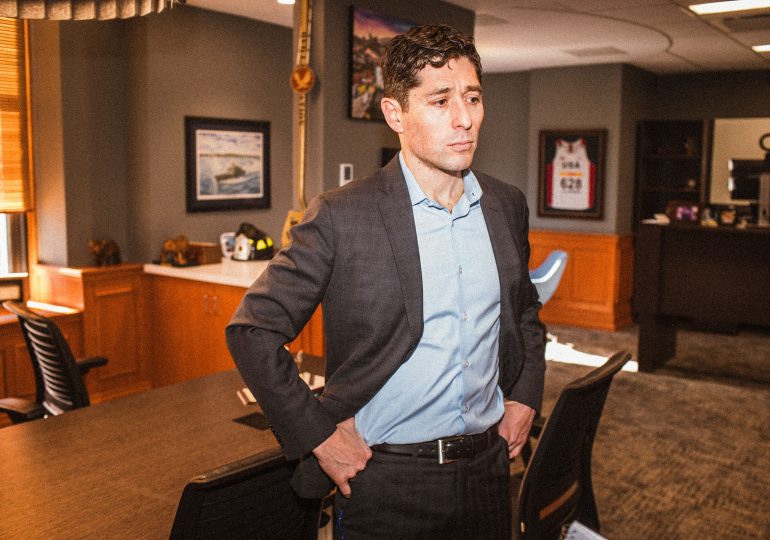
Jacob Frey had just helped his 5-year-old daughter into her ballet slippers at dance class when Minneapolis police chief Brian O’Hara called. Federal agents had shot someone, O’Hara told the mayor: “It was bad.”
It was Saturday morning, Jan. 24. A few miles away, an ICU nurse named Alex Pretti had been shot to death across from a doughnut shop on Nicollet Avenue, the second American citizen in three weeks killed by federal agents in this city under siege. Frey rushed for his coat, arranged for another parent to take his daughter home after class, and darted out the door. “I didn’t say goodbye, which I felt really badly about,” he recalls in an interview in his city hall office.
[time-brightcove not-tgx=”true”]
Frey, 44, is in his third term as mayor of Minneapolis, a tenure marked by an almost unfathomable series of tragedies. Two years after he took office, COVID crippled the city’s downtown. Then came George Floyd’s murder by a Minneapolis cop, catalyzing protests and riots, a painful fight over police reform, and a depletion in the department’s ranks. Last June, two Democratic state legislators in the Minneapolis suburbs were shot along with their spouses in what authorities called an act of targeted political violence. In August, two children were killed and more than two dozen others were injured in a shooting at a school Mass at the city’s Annunciation Catholic Church. The current Immigration and Customs Enforcement occupation was preceded by a scandal involving the defrauding of social-service programs. That put the city under the MAGA movement’s microscope, which many, including Frey, believe figured in the Trump Administration’s decision to make Minneapolis the focus of the largest federal immigration-enforcement deployment in American history.
Operation Metro Surge, launched in December, has brought some 3,000 agents, many heavily armed, masked, and dressed in tactical gear, to this frozen city of lakes, often tailed by protesters wielding cell phones documenting their aggressive tactics. Photos showed Liam Conejo Ramos, a 5-year-old in a blue bunny cap, being taken into federal custody. Video captured a woman on her way to a medical appointment dragged from her car, her seat belt slashed as she struggled. Protesters have been manhandled, pepper-sprayed at close range, enveloped in plumes of tear gas. At some schools, absenteeism jumped as high as 40%. Immigrant-owned businesses pull down their gates as sales plummet and workers stay home. Residents monitor preschools, log unfamiliar license plates, and gather in protest, trying in ways big and small to help their neighbors.
Frey is at the center of it all, caught between a President who casts him as a radical leftist defying federal authority and a progressive city of 430,000 that wants him to do more to resist the immigration crackdown and regain control. Frey’s governing creed, forged in the crucible of previous crises, is that resistance is most effective when it is deliberate and restrained. Part of the pushback is “showing that we can have Democratically run cities that can work,” he says: picking up trash, de-icing alleyways, removing graffiti, filling in potholes. He’s given fiery speeches, demanding ICE “get the f-ck out” after Renee Good was killed by an ICE agent in early January. But in some ways, his performance demonstrates the limits of his powers.
A reprieve appears to be coming. With polls showing a growing majority of Americans believe ICE has gone too far, the DOJ opened a civil rights probe into Pretti’s death. President Trump softened his tone and swapped out the aggressive commander of the Minneapolis operation for his border czar, Tom Homan, who announced a partial drawdown of federal forces. But a sizeable number of agents will remain. “There’s a very straightforward antidote, and that is to leave,” Frey told me. “They leave, those businesses have customers again. They leave and fear is reduced on the street. But of course, this is not about safety. This is not even about immigration. This is a political narrative that they’re trying to concoct.”
Minneapolis isn’t the first city to contend with the consequences of Trump’s immigration crackdown. But it has become the clearest warning of what a mass-deportation campaign that aims to remove 1 million people from the U.S. each year can look like on the ground—and of the reckoning awaiting more of America’s mayors and citizens when the federal government turns its power inward.
I first met Frey on an icy Wednesday morning as he dropped his two girls off at day care. The mayor helped his 5-year-old daughter step carefully along a frozen sidewalk as he toted his 6-month-old baby in her carrier. It’s often the one time of day he gets to see his kids, and he lingers inside with them for a few minutes before wishing them a good day.
Riding to city hall in his black Escalade, the mayor reflected on the latest attack from the President. The day before, Frey had a call with Trump that he describes as “pretty collegial.” But then Frey reiterated on X that the city’s roughly 600 police officers would not participate in immigration enforcement. “I don’t want them spending a second hunting down a father dropping his kids off at day care who is about to go work a 12-hour shift,” he tells me. In response, Trump had launched another broadside that morning, saying Frey was “playing with fire.” The warning was an attempt at coercion, Frey says—a nod to the recent federal subpoena he’d been served as part of a Department of Justice investigation.
Frey is a Minneapolis transplant. A former professional distance runner from Virginia, he fell in love with the city’s trails and lakes and moved there in 2009 to practice employment and civil rights law. In 2011 he helped organize the first Big Gay Race, a charity event to raise money for marriage equality. Two years later he was elected to the city council. “He didn’t have a legacy here,” says council member Linea Palmisano, an ally of the mayor’s. “He’s always had to be his own self-made man.” Frey campaigned as a unifier, pledging to mend the city’s divisions and becoming the second youngest mayor in Minneapolis history and second Jew to hold the office. Colleagues saw a leader with boundless energy and a desire to talk to people who disagreed with him.
The unity appeal collided with the turmoil that befell the city after Floyd’s murder, which led to a protracted fight over the future of policing in Minneapolis. Frey opposed calls to defund the police, a position that was unpopular on the left at the time. The critics from back then are on him again now—except this time many are urging him to have local police act more proactively to protect residents from ICE’s excesses and to hold the line on noncooperation with DHS.
For all the attention Frey has received for his impassioned public defense of the city, in person he is cautious, pausing carefully to choose his words. In the mayor’s third-floor office suite, thick stacks of printed talking points sit on desks.
Around a conference table at city hall, Frey convenes a morning meeting. He asks O’Hara, the police chief dialing in on Zoom, for the latest intel on ICE operations. The chief reports a slight decrease in activity, then recounts a few unconfirmed rumors. One is that a federal agent staked out a home with a hostile sign in the window. Another alleges that an agent impersonated a volunteer at a food–distribution center. Police were also called to a hotel housing ICE officers, where protesters had gathered to make noise outside.
City leaders have no comprehensive way of tracking Department of Homeland Security activity. Much of the information they have about the ongoing federal operation arrives the same way it does for local residents, via viral videos, social media posts, and word of mouth. Frey and his team try to keep track of incidents by following the frenetic stream of 911 calls and dispatches from the -independent trackers who blanket the city in organized neighborhood groups. (Hundreds are coordinating across more than a dozen separate Signal chats.) Residents are encouraged to report incidents of suspected DHS abuse to a state attorneys general website. The mayor’s staff of 15 has been bombarded by some 30,000 constituent complaints in the past two months. Some have received threatening messages, prompting the office to remove their contact information from the city’s website.
The hub of community resistance has been the Whipple Federal Building, where people detained by ICE are held in crowded cells. Some report an absence of access to food, water, or medical care. On a freezing Thursday morning, a small band of locals—a music teacher, a retired veteran, a grandmother of three—stood shoulder to shoulder, screaming “Shame” and “Traitor!” as agents drove in and out of the facility in unmarked cars.
Frey hasn’t visited the demonstrations at Whipple. And while he joined thousands of locals marching in a recent “ICE Out” protest, the self-described “pragmatic progressive” has drawn criticism from liberals on the city council, some of whom are helping to organize the resistance movement. “I personally have never heard or seen him out in the streets,” says Elizabeth Bonin, communications coordinator for the Twin Cities Democratic Socialists of America group, which opposed Frey in November’s election. “Our community is out here every day watching over the streets, making sure kids get to school safely. We’re delivering groceries to neighbors, we’re printing whistles on people’s 3D printers, we’re raising money to pay rent because our system of government has failed us.”
After the meeting with city officials, Frey visits the 24 Somali Mall, a shopping center filled with vendors, many of them citizens who’ve lived here for decades, selling everything from rugs to electronics to tax services. These days, it’s about 50% vacant. Dozens of immigrant business owners are too fearful to go to work. Others have shuttered shops because of decreased foot traffic. But as word spread the mayor was paying a visit, Frey was swarmed. People called his name and grabbed his arms, sharing a chorus of concerns: No one is coming. People are scared. When will they leave? “We’re working on it,” Frey tells them as he buys tea and samosas.
Minnesota has the largest Somali community in the U.S., and Frey has worked to ingratiate himself. He’s picked up some of the language; his older daughter can count to five in Somali. He bristles at what he sees as the precipitating reason for Operation Metro Surge: the sprawling scandal in which, as of January, 64 people, most of whom are of Somali descent, had been convicted of taking state and federal funding for phony social-service programs. A former senior policy aide of Frey’s was among those arrested. For Trump, the scandal presented a political opportunity. Minnesota is a blue state Republicans have sought to put into play in presidential elections, led by a governor who was on the 2024 Democratic ticket, and the chaos that engulfed Minneapolis after Floyd’s killing made it a national symbol of the Black Lives Matter movement. A historic immigration-enforcement operation in a city a fraction of the size of Chicago or Los Angeles—one with a lower-than-average proportion of undocumented immigrants—doesn’t make much sense until you consider how it intersects with themes of Democratic mismanagement and crimes committed by foreigners. “Look, the fraud is real,” Frey says. But “you do not hold an entire community accountable for the actions of the criminal.”
Latino businesses have been hit hard. The Lake Street corridor, a commercial and cultural artery, is quiet. Rebuilding a sense of security will take time even after the federal footprint decreases, Frey says: “People need to have confidence leaving their home that they’re gonna come back to it.” Critics say Frey needs to do more to support the city in the meantime. The mayor is good at translating the surreal reality on the ground for the cameras, says council member Robin Wonsley, who is urging Frey to back an eviction moratorium, “but that’s not translating to what is a clear coordinated plan of how he’s using the city’s reservoir of resources to show up in this moment.”
Later that afternoon, Frey escorts 24 new police-academy grads down the aisle of the opulent Basilica of St. Mary in downtown Minneapolis. Bagpipes echo through the church as the officers prepare to take the department’s oath to protect and serve. “The work ahead is not going to be easy,” Frey tells the cadets. “The bright lights—not just of this church, but of the world—will be directly on this department.”
Frey’s efforts to rebuild trust between the department and the city ranks among his proudest accomplishments. “We’ve done a lot of work over these last five years,” Frey says. “The good news is it’s being recognized. The bad news is that trust is also fragile.”
The department lost roughly 300 officers in the aftermath of Floyd’s killing, as progressives called for its abolition and a federal civil probe found a pattern of discrimination and unconstitutional policing. Meanwhile, each video clip of immigrants, demonstrators, or bystanders being harassed—and in some cases assaulted—by federal agents deepens a perception that federal authority is being wielded indiscriminately and that local leaders are powerless to stop it. Under the direction of Frey and O’Hara, Minneapolis police have adhered to the city’s separation ordinance, which dictates they avoid involvement in immigration enforcement. Part of this is ideology—Minneapolis is a sanctuary city—but it’s also an issue of limited capacity.
For now, Frey has managed to navigate the challenges of the city’s parallel police presences, says former police chief Medaria Arradondo. But if people “witness their rights being violated by members wearing these federal uniforms, and members of the MPD are not stepping in and intervening and protecting them,” Arradondo says, “it’s not going to matter which uniform they’re seeing.”
The day after we met, Frey traveled to Washington to meet with fellow mayors in a gathering he called a needed “therapy session.” He cast his colleagues as defenders of the Republic at this precarious moment. “We are on the front lines of a very important battle,” he told them. “If we do not speak up, if we do not step out, it will be your city that is next.” —With reporting by Leslie Dickstein/New York
Leave a comment