
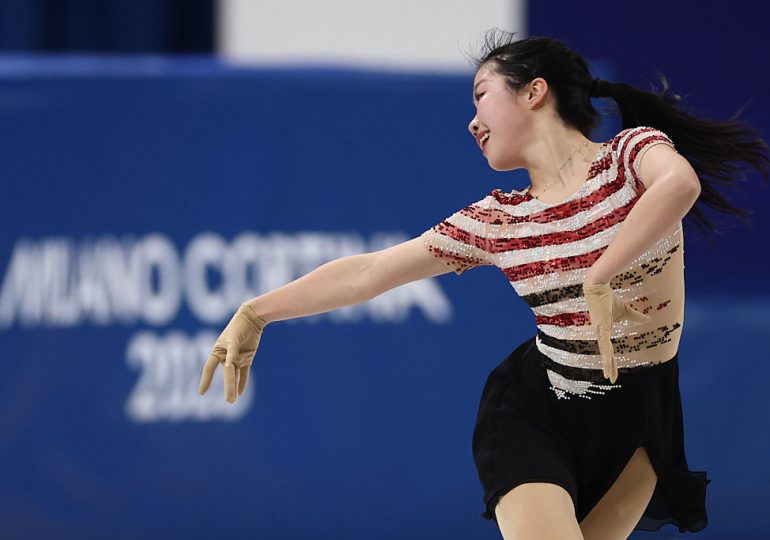
If there is one thing the figure-skating events at the Milano Cortina Olympics have proven, it’s that nothing is predictable. From gold-medal favorite Ilia Malinin of the U.S. finishing eighth in the men’s event to the hotly debated final in ice dance to the pairs champions coming from fifth to snag gold, the skating competitions have been full of surprises.
[time-brightcove not-tgx=”true”]
Now it’s the women’s turn.
The race for the podium in the women’s event is a tight one, with a crowded field including U.S. and Japanese skaters, as well as dark horse Adeliia Petrosian from Russia, who is competing as a neutral athlete after Russia was barred from competing as a country following the 2022 invasion of Ukraine.
Leading the pack going into the final free program is 17-year-old Ami Nakai of Japan, followed by teammate Kaori Sakamoto and the U.S.’s Alysa Liu. Japan’s Mone Chiba is in fourth, giving Japan a strong chance of securing not just one, but potentially a couple of medals.
The women’s competition kicked off on Tuesday with the short program, which carries added pressure since skaters must complete a set of required elements, including a triple jump, a double or triple axel, a combination jump and several spins. If they don’t fulfill each of those skills, they receive no points for that element. So every element counts.
For U.S. skater and national champion Amber Glenn, those scoring rules proved punishing. Glenn came into her short program, choreographed to Madonna’s “Like a Prayer,” on a high note of support from the music icon herself, who encouraged the skater’s Olympic journey in a video released earlier in the day. And the skate itself began well: one of only two skaters in the competition to include a triple axel in their program, Glenn opened with a textbook perfect one, solidly landing it and staking her claim to a position on the podium. She then checked off the jump combination, a triple flip-triple toe loop, building momentum with her choreography. Then came the triple loop jump, which Glenn popped, failing to complete three revolutions in the air, despite landing clean versions a couple of hours before the competition as well as in the six-minute warm-up before her group skated. Because she didn’t fulfill that requirement, she received no points for the element and fell to 13th. Fully aware of how costly the mistake was, Glenn couldn’t hide her disappointment immediately after hitting her final pose, grimacing and trying to hold back her emotions. Teammate Malinin, who also had a number of uncharacteristic mistakes in his free program and fell from first to eighth in the men’s event, watched in surprise in the arena, empathizing with the disbelief and pain on Glenn’s face. After a quick broadcast interview, Glenn declined to answer more questions from the media.
Read more: How Figure Skater Amber Glenn Took Control of Her Life
The U.S. came into the event heralded as podium favorites with a strong field of three skaters that include the reigning world champion Liu, 2024 world silver medalist Isabeau Levito, and Glenn, the 2024 Grand Prix Final champion. Liu skated a clean and solid program and remains in medal contention, while Levito, who also skated a solid program but with less difficult and high-scoring elements, is in eighth. Liu, who is intentionally exerting more authority in her skating career after deciding to return to competition after retiring, said she’s not focused on the results and whether she can outscore her Japanese competitors. “I don’t think about stuff like that,” she said. “Whether I beat them or not is not my goal. My goal is just to do my program and share my story. No matter what the outcome is, it’s still my story.”
But Japan arrived with an equally impressive team, led by three-time Olympian Sakamoto, the reigning bronze medalist from the 2022 Games and 2024 world champion. Sakamoto plans to retire after the Olympics, but will leave the sport in good hands with her teammate and new talent Nakai, who landed a triple axel that pulled her into first.
Nakai has not been skating at the senior level for long, but her triple axel launched her into the Olympic conversation after she finished second at the Grand Prix Final in December, behind Liu and ahead of Sakamoto.
Petrosian, who is currently fifth after the short program, is the Russian national champion for the third year in a row and the X factor in the competition. Due to Russia’s exclusion from major international events after the war in Ukraine began, she hasn’t skated in any significant competitions outside of Russia this year, except to qualify for the Milano Cortina Olympics. As a result, neither judges nor athletes are fully familiar with her skating repertoire, and they also have no reference point against which to compare each performance of hers to know if she is improving or not. She said following her skate that she has not recently been practicing the triple axel. But she has frequently included a quadruple jump in domestic competitions, and though she chose not to take the risk when qualifying for these Games, in practice sessions in Milan, she has been landing one.
Read more: Russia Is Banned From the Olympics. But 2 Russian Figure Skaters Are Competing
To make the podium, she may need to deploy that skill in the final on Feb. 19. Competing to a Michael Jackson medley in her short program on Tuesday, she landed three solid triple jumps, including a triple flip and triple toe loop combination that earned 11.74 points, but was bested by all three of the Japanese women and Liu. Answering questions afterward from the press in Russian, Petrosian said she didn’t feel pressure being the only athlete competing in the women’s event from Russia, and said she had not watched her competitors from the U.S. or Japan since arriving in Milan since she hasn’t been in the same warm-up group with them. But since the top finishers from the short program are grouped together, she will get that chance before the free program.
Expectations for her results will be high, since Russia has claimed the last three consecutive Olympic titles in the women’s event, owning the top spot on the podium since 2014. The streak hasn’t been without controversy, however. Russian skater Kamila Valieva tested positive for a banned substance prior to the 2022 Olympics in Beijing and her scores were removed after she competed in the team event, costing Russia the gold in that competition. Valieva trained with the same coach, Eteri Tutberidze, who trains Petrosian and the last two Olympic champions; Tutberidze was not implicated in the scandal and was not sanctioned by the World Anti-Doping Agency (WADA) in relation to the incident, but questions surrounding her strict coaching methods continue to swirl. Although she is accredited for the Milano Cortina Olympics through Georgia, since she coaches men’s skater Nika Egadze from that country, she was present at one of Petrosian’s training sessions, sparking some backlash. WADA president Witold Banka said in a press conference before the Olympics began that while an investigation by a sports arbitration board did not find any wrongdoing on Tutberidze’s part involving the doping, “I don’t feel comfortable with her presence here at the Olympic Games.” The International Olympic Committee cleared Petrosian and Daniil Gleikhengauz, who works with Tutberidze, to be in Milan.
Maintaining her aura of mystery, Petrosian isn’t meeting athletes from different countries and different sports and enjoying the Olympic experience in the Village as other athletes are. Instead, she said she is with her mother in an apartment within walking distance from the rink, which is about a 40-minute subway ride from central Milan.
For Sakamoto’s part, her clean short program is the third time she has taken to the ice in Milan; she skated both the short and free program portions in the team event and helped Japan earn silver, and was impressively consistent in all three performances, never wavering on her jumps and skating with the same passion and emotion each time. She’s the cornerstone of a Japanese team that has tallied medals in every event except dance so far—silver in the team, silver and bronze in the men’s, and gold in the pairs—and the new Olympic champions were in the arena to cheer her on. “Everybody—from the pairs to the men—gave power to my performance today,” she said. “And everybody from the [Japanese Skating] Federation told me now it’s your turn, so I thought I could enjoy my performance today.”
She may have more to enjoy if she and her teammates get yet another podium in the women’s final—especially if more than one of them end up with a medal around their neck.
Leave a comment