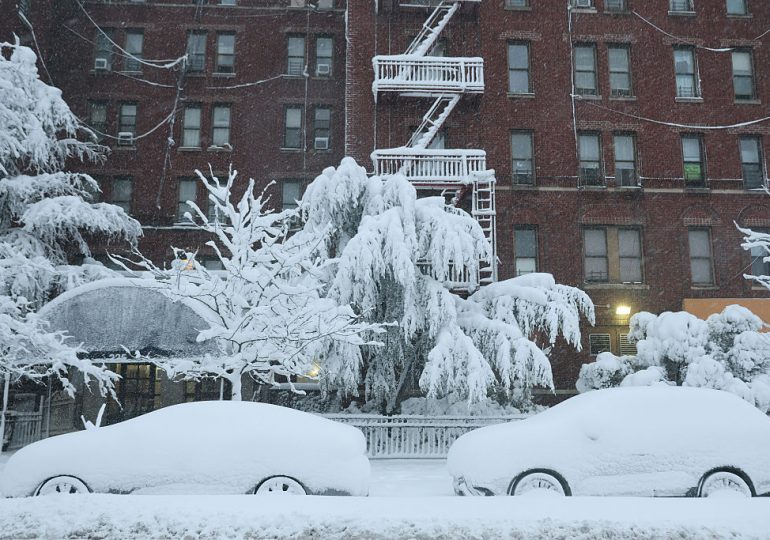
Across the East Coast, local government officials and weather authorities have warned residents of a major blizzard carrying lashing winds and heavy snowfall, with many jurisdictions restricting or limiting travel in light of the storm’s “potentially historic” nature.
[time-brightcove not-tgx=”true”]
Early Monday, CNN Weather and FOX Weather reported the storm intensified into a “bomb cyclone,” a term meteorologists use to describe a rapidly intensifying cyclone, which is a large air mass that rotates around a low pressure area or eye of the storm.
But even before its intensification, forecasters already warned about the East Coast winter storm’s potentially devastating impact. Cody Snell, a meteorologist at the National Weather Service’s Weather Prediction Center, told the Associated Press that while the U.S. is no stranger to nor’easters—storms along North America’s East Coast—with heavy snowfall and widespread impact, “it’s been several years since we saw one of this magnitude across this large of a region in this very populated part of the country.”
More than 65 million people, or almost a fifth of the U.S. population, were covered by alerts relating to the storm on Sunday evening, the Washington Post reported, with about 35 million, or more than 10% of the U.S. population, from Virginia to Maine, issued blizzard warnings.
‘Bombing out’
Meteorologists from AccuWeather earlier forecast that the storm would “bomb out” early Monday.
The winter storm intensified in a process called “bombogenesis,” where a cyclone drops atmospheric pressure in 24 hours, eventually resulting in stronger winds and heavier precipitation—in this case, snow. Bomb cyclones can happen anytime, but they mainly occur during fall and winter when cold air from the Arctic goes down and clashes with warmer air.
But what constitutes “bombogenesis” varies by latitude. According to the National Oceanic and Atmospheric Administration, at the latitude of New York City, the required pressure drop is about 17.8 millibars.
With heavy snowfall and lashing winds, the storm is also expected to fell trees and down power lines. According to poweroutage.us’ data as of 8:30 a.m. ET, over 500,000 Americans don’t have power, most of whom are in Massachusetts and New Jersey.
The show cannot go on
State officials across the East Coast have declared states of emergency in response to the threat.
In New Jersey, Gov. Mikie Sherrill said Sunday that the late February storm was likely to be the “worst” the state has seen since the Blizzard of 1996, the last time when all 21 counties in the state were issued blizzard warnings. At the time, Newark, based on Weather Service reports, logged 28 in. of snow.
New York Gov. Kathy Hochul said in a press conference on Saturday that the National Weather Service issued its first blizzard warning for New York City since 2017—and the first for Long Island since 2022. Hochul warned residents of Long Island on Saturday, a day before snowfall began, that the storm could be “historic” and that the “vulnerability is great,” warning them of possible flooding and urging them to prepare for a “very dangerous situation.”
New York City Mayor Zohran Mamdani, who issued a local state of emergency, said in a press conference on Sunday that New York City has “not faced a storm of this scale in the last decade” and added that, if the storm unfolds as predicted, with snowfall possibly reaching up to 2 feet, the storm will rank among the top 10 snowfall events the city has ever faced.
While the city is no stranger to heavy snowfall events—an immense snowstorm in January, for instance, dumped 11 in. of snow in Central Park—the projected snowfall for New York City for this February storm could compete with previous records. Twenty years ago, in February 2006, a snowstorm covered New York City with 26.9 in. of snow. And 10 years ago, in January 2016, a winter storm buried Central Park under 27.5 in. of snow, making it the heaviest snowstorm since record-keeping began in 1869.
Because of the downpour and related travel restrictions, much of the city has ground to a standstill, with even Broadway cancelling all shows Sunday evening.
Leave a comment