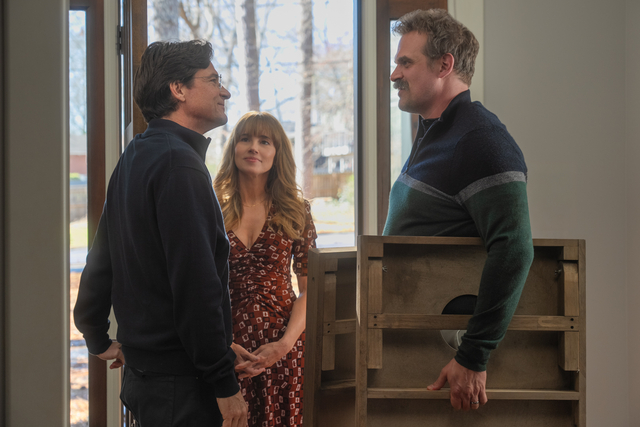
Two very disparate stories intertwine, uncomfortably, in the HBO miniseries DTF St. Louis. In one, a man is found dead at a community pool, surrounded by an empty canned cocktail and a vintage Playgirl. The other traces a friendship between two middle-aged, male coworkers, both of whom are exploring infidelity—one by having an affair with the other’s wife.
The cuckold and the murder victim are the same man: Floyd Smernitch, a gentle sign language interpreter, loving stepdad, and paunchy sad sack played by Stranger Things’ David Harbour. His death gives shape to the plot, which braids together the police investigation with relevant flashbacks. It also places undue emphasis on the least intriguing aspects of the show, wringing another murder mystery out of what could’ve been a nuanced drama of midlife love and friendship.
[time-brightcove not-tgx=”true”]
Within moments of meeting TV weatherman Clark Forrest (Jason Bateman)—a health-conscious alpha who traverses St. Louis on a recumbent bike—Floyd saves him from a flying stop sign as they cover a storm. This is not unusual for our soon-to-be-deceased hero, who regularly risks injury and embarrassment to help people. At group therapy with his troubled stepson, Richard (Arlan Ruf), Floyd bares his soul. “It’s OK, I also got C’s” in school, he tells the boy. He wants to prevent Richard from getting what he calls “grownup C’s,” i.e., an unsatisfying life. Frustrated with his finances, his body, and the widening gulf in his marriage, Floyd is evidently speaking from experience.
Although we’re not initially clear on the order of events, Clark befriends Floyd and starts sleeping with his wife, Carol (Linda Cardellini, TV’s laureate of complicated middle-aged women). Presumably to assuage his guilt, Clark talks his buddy into downloading DTF: St. Louis, an app for married locals looking for discreet hookups. When Floyd’s body is found, the service becomes a crucial tool for two cops investigating the case: Richard Jenkins’ Homer, a veteran detective who leans on lazy assumptions, and young, open-minded Jodie (Wednesday‘s Joy Sunday), who insists on following the evidence wherever it may lead.
Premiering March 1, DTF is a tricky show, one whose apparent inconsistencies might turn out to be deliberate choices. It has an offbeat, sometimes surreal sense of humor. The writing and acting alternate between stylized stiffness and heartwrenching realism. Floyd comes across as a purely kind soul, making his willingness to cheat on his wife seem out of character. Clark and Carol’s authentic selves are, by contrast, buried under layers of artifice. It often feels as though creator Steve Conrad (Patriot) is purposely hiding the perspectives of other key characters. Four episodes into the seven-part season, it’s no easier to predict where all this tenderness and pain might lead than it was at the outset.
As sharp as the interplay between Jenkins and Sunday can be, I can’t muster much curiosity about how Floyd died. More fascinating are the lines that connect each point on the love triangle—the way Clark and Carol guiltily worship Floyd’s goodness, the so-called “dream meetings” where the cheaters engage in dominant/submissive roleplay, the astounding variety and flexibility of human sexuality. The murder is, at best, a distraction from what makes DTF unique; at worst, it’s a crutch supporting three characters whose creator failed to build them a less conventional plot. What if every drama didn’t have to be a crime drama? What if the human heart, with all its competing emotions and desires, were mystery enough?
Leave a comment