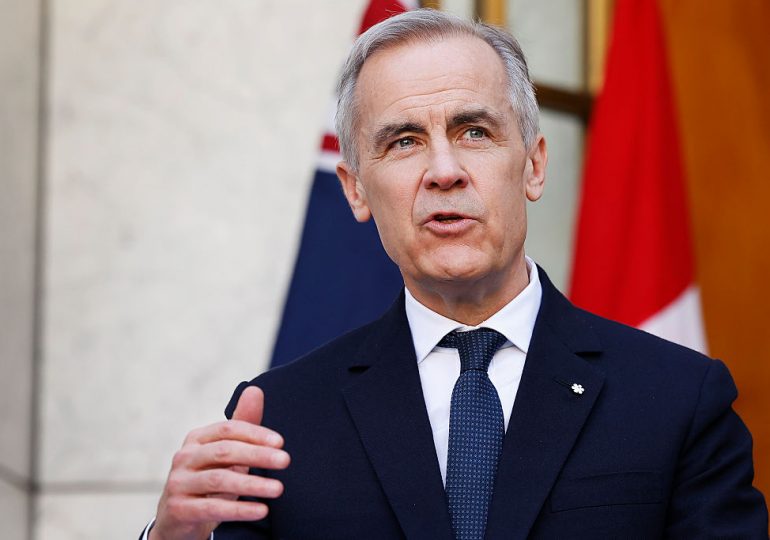
Canadian Prime Minister Mark Carney labeled the widening Iran war a “failure” of the international order, but refused to rule out the possibility of Canada joining the conflict.
“One can never categorically rule out participation. We will stand by our allies,” Carney said when asked whether his country would provide military assistance.
[time-brightcove not-tgx=”true”]
Speaking alongside Australian Prime Minister Anthony Albanese during a joint press conference in Canberra on Thursday morning, local time, the Canadian leader noted a difference between what he described as unconsulted offensive action and his country’s broader alliance commitments.
“There’s a distinction between the offensive actions that were taken and are being taken by the United States and Israel without consultation with Canada and other allies. We’re not party to those actions,” he said. “We will always defend Canadians and we will always stand by and defend our allies when called upon.”
Carney’s remarks echoed a statement he made the day before, whereby he condemned the manner in which the U.S.-Israeli military action that killed Iran’s Supreme Leader Ayatollah Khamenei was launched and faulted Washington for failing to coordinate with allies and international bodies.
“We support efforts to prevent Iran from obtaining a nuclear weapon and to prevent its regime from further threatening international peace and security,” he said. “We do, however, take this position with regret, because the current conflict is another example of the failure of the international order.”
“We condemn the strikes carried out by Iran on civilians and civilian infrastructure across the Middle East, and we implore all parties, including the United States and Israel, to respect the rules of international engagement,” Carney added.
Carney’s latest comments on the “failure” of international order echo statements he made during his address at Davos earlier this year, where he described a “rupture” and said the old world order was “not coming back.”
Albanese has also joined calls for de-escalation, but reaffirmed support for the stated objective of the military campaign.
“The world wants to see a de-escalation and wants to see Iran cease to spread the destinations of its attacks,” he said. “I want to see the possibility of Iran getting a nuclear weapon removed, once and for all… I also want to see a removal of the ongoing threat that has been there for such a long period of time.”
In Europe, meanwhile, Spanish Prime Minister Pedro Sánchez has argued that the strikes undermine international norms.
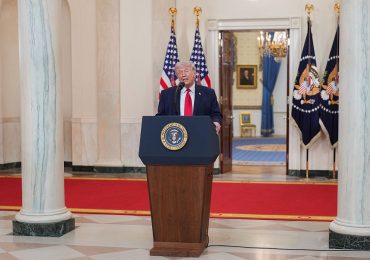
But President Donald Trump defended the military action during a roundtable with business leaders on Wednesday, insisting the strikes were necessary to prevent Iran from acquiring a nuclear weapon.
“If we didn’t hit within two weeks, they would have had a nuclear weapon… When crazy people have nuclear weapons, bad things happen,” he said.
In the same meeting, however, Trump offered a slightly different rationale, repeating his earlier explanation that the military action was taken as a pre-emptive measure.
“I think if we didn’t do it first, they would have done it to Israel and give[n] us a shot, if that was possible,” he said, amid concerns the Trump Administration is struggling to settle on a definitive rationale for the war.
Leave a comment