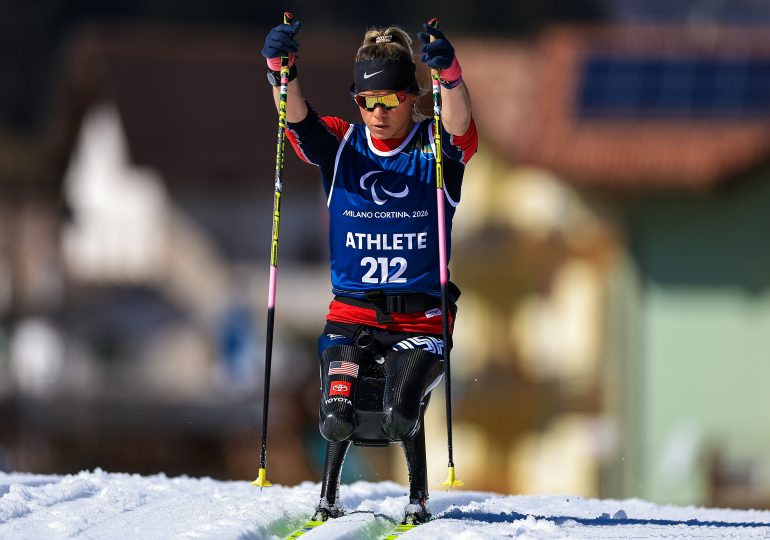
Tuning in to the 2026 Milano-Cortina Paralympic Winter Games, held this year from March 6 to 15, matters more than most people realize. The Winter Paralympics aren’t just about medals; they’re about redefining what’s possible.
Every one of us knows someone—a family member, a friend, a child—living with a disability or a physical difference. When you watch the Paralympics, you’re not just witnessing sport; you’re helping shift perspective. You’re showing little kids that they belong in arenas like this, that they can see themselves in an athlete, on a podium, chasing something big.
[time-brightcove not-tgx=”true”]
It’s also important to learn what the Paralympics truly are. They’re often mistakenly called the “paralyzed Olympics,” but Paralympics comes from the Greek word meaning “parallel” or “alongside.” For the last 50 years, these Games have existed alongside the Olympics—parallel in excellence, intensity, and world-class performance—created for athletes with physical differences competing at the highest level.
So tune in. Follow the athletes. Learn our stories. Because visibility creates belief—and belief can change a life.
This year, I will be competing in para cross-country skiing and para biathlon. In the past seven Paralympic Games I have won 19 medals across summer and winter Games in rowing, cycling, nordic skiing, and biathlon. I have also been alongside my forever partner and soon-to-be husband Aaron Pike, my fellow nordic skiing teammate, for all seven Paralympic Games.
The Paralympics stand on their own merit, a global phenomenon that is neither a secondary event or a consolation prize to the Olympic Games. They are, in their own right, one of the most compelling and inspiring sporting events the world has to offer.
It is an opportunity to witness world-class athletes redefine the boundaries of what is possible, proving that passion, dedication, and innovation can overcome any perceived limitation. If you are not watching, you are missing out on witnessing history being made by athletes who are not just competing at the highest level, but are actively reshaping the narrative around ability and achievement.
This year, the Paralympic Games feature around 665 athletes from around 50 National Paralympic Committees who are set to compete in 79 medal events in six sports: para alpine skiing, para biathlon, para cross-country skiing, para ice hockey, para snowboard, and wheelchair curling.
Paralympic athletes compete at the highest possible level. These are not exhibitions. These are elite competitions governed by strict classifications, razor-thin margins, and the same win-at-all-costs intensity you see in any championship final.
What often goes unrecognized is the sheer complexity behind these events. Classification systems ensure fairness across a wide range of disabilities, requiring detailed medical assessments and sport-specific evaluations. Equipment is customized to the millimeter. Training regimens are as grueling as those of any Olympic gold medalist.
To view these as merely “inspirational stories” is to misunderstand their true significance. Imagine learning to ski competitively on a machine or with equipment that must be custom-built for your body, and then imagine winning gold on it.
When you watch a Paralympian race, you’re seeing sports at its most pure and analytical. It’s not about “overcoming” anything; it’s about getting the absolute maximum performance by perfectly optimizing every single factor: their body, gear, the course, and the timing of training.
When you tune in to the Paralympics, you’re not just seeing speed on snow or power on ice—you’re witnessing resilience in motion. You’re seeing innovation, grit, and heart at the highest level of sport. And I promise you this: once you watch, you won’t see disability the same way again.
Tune in, not out of sympathy, but out of respect. Watch because this is elite competition. Follow because these stories will challenge the way you define ability. Learn because the more you understand the Paralympics, the more you understand possibilities.
When you choose to watch, you’re not just supporting athletes. You’re helping create a world where no child questions whether they belong in it.
When you tune in, you’re not just watching adaptive equipment on snow. You’re watching elite athletes who rebuilt themselves long before they rebuilt their sport. You’re watching speed, strategy, power, and grit at the highest level. And you’re helping change what the world believes ability looks like.
When a person living with disability sees us racing, competing, standing on a podium, it expands their horizon. Representation isn’t symbolic. It’s powerful. When we see it, we can achieve it—and we can build it.
Growing up, I didn’t know any Paralympians or watch them compete because it wasn’t publicized. Paralympic athletes in the 1990s were not in the mainstream media or on billboards, nor did they partner with major brands like we do now. I didn’t know what was possible until I raced in rowing at the London Paralympic Games in 2012 and watched other Paralympians compete.
I’ll never forget cheering on the men’s 5000m track and field wheelchair race at a packed Olympic stadium. Before watching the T54 event, I didn’t know anything about it. Almost 14 years later, I am about to marry Aaron Pike, one of the best athletes in that classification.
Representation matters. For years, Paralympic legends like swimmer Erin Popovich, wheelchair racer Jean Discoll, and shot put, discus, and javelin athlete Joanne Berdan did not get the recognition they deserved. Part of why it took me so long to realize that I can be an athlete is that I never saw what I could become or achieve or the places I could go.
The spirit of the Paralympics is frequently misunderstood. The Paralympics are not about pity, and they are not about lowering the bar of athletic achievement. They are, in their truest essence, about raising it—about asking profound questions regarding the limits of human capability and defining what performance looks like when the boundaries of the body are completely reimagined.
And here’s why this moment matters even more: the Games are coming home. The Los Angeles 2028 Summer Olympics and Los Angeles 2028 Summer Paralympics will be hosted in the United States. Then the 2034 Winter Paralympics will follow in Salt Lake City, Utah.
The child watching today could be the next athlete wearing Team USA across their chest, racing for a podium on home soil. That’s not a dream—that’s a pipeline.
But pipelines only grow when people pay attention. When you tune in, learn, and follow our stories, opportunities grow. Funding grows. Access grows.
My ultimate dream is to see Paralympic sport clubs in cities and states across this country—where every child with a physical difference has equal access to sport, equipment, and coaching, just like our Olympic counterparts who just delivered a record-breaking Winter Games with 12 gold medals.
Watch because the Paralympics is a world-class competition. Learn because understanding builds respect. Show up because visibility builds belief. And belief builds futures.
Leave a comment