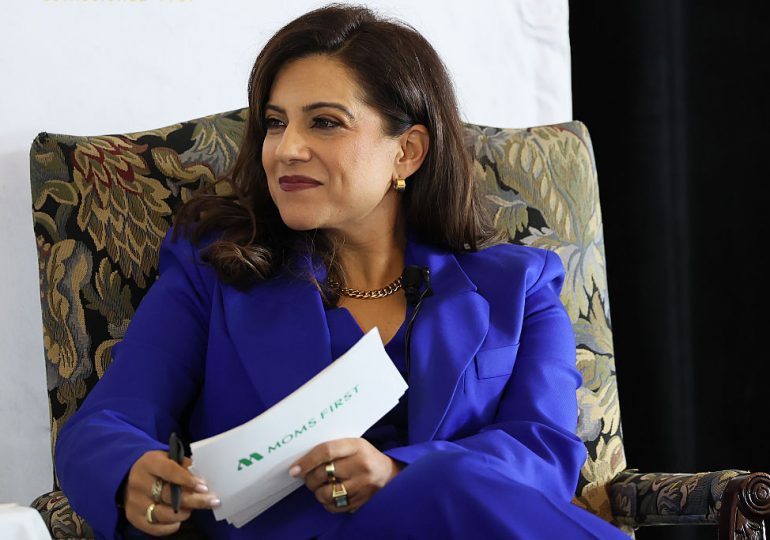
Reshma Saujani has been advocating for women and girls for much of her career. In recognition of that, the founder of Moms First—a nonprofit that advocates for mothers—and Girls Who Code, which works to close the gender gap in coding and technology employment, was named one of TIME’s Women of the Year in February.
[time-brightcove not-tgx=”true”]
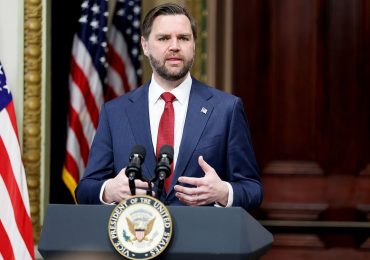
Advocacy for affordable childcare and paid leave are core areas of focus for Moms First and in January, Saujani stood beside Governor Kathy Hochul and New York City Mayor Zohran Mamdani as they announced a $1.7 billion plan to deliver universal care for children under the age of 5. Just over a year before, Saujani had asked President Donald Trump a question about his plans to address childcare affordability onstage during an Economic Club of New York event in a moment that went viral and brought more attention to the issue of childcare costs in the U.S.
Saujani spoke with TIME in February about what AI means for girls and women, speaking truth to power, and why her work is more important than ever.
This interview has been condensed and edited for clarity.
You’ve taken a couple of different twists and turns in your career, but to start off with your congressional campaign in 2010 and your desire to enter into the public servant world, could you tell me about that choice and how that moment brought you to Girls Who Code?
My parents came [to the U.S.] as refugees. I think about this a lot, especially with what’s happening in the country right now. But both my mother and my father were born in Uganda. [My family was there]for two generations, and they were expelled, with 90 days notice. And growing up in a family where everything can be taken away from you in a second shapes you. And it really shaped me. I think it shaped me into wanting to give back to the country that saved my parents’ life. And it shaped my passion for politics and for public service, and I think also for the American dream. When you come to this country with nothing like my parents did, with $12 in their pockets, and you’re taking classes to learn the language, and the Catholic Church has taken you in to feed you and shelter you, you think a lot about, like, how do you get into the middle class? You know, how do you pay for your groceries? How do you pay for your rent? How do you pay for school?
And leading into GirlsWho Code, this idea that this profession can take a girl who just left a homeless shelter in Harlem in the morning, and a girl who’s coming out of the best private school in the Upper East Side—and both of them are equally unprepared for a job for the future—I could create something that could help them, could teach both of them, and you [could] have them both sitting at Facebook. The world could be equal for a millisecond and shifted.
Was there a pivotal moment during your congressional campaign where you realized that this gender gap in tech wasn’t a statistic, but needed a systemic intervention, and was a deeper issue that you felt like you could really have an impact on?
I remember I went to Bishop Taylor’s church in Queensbridge, and he had a handful of computers in the basement of a church. And then I remember going that same week to a school in the Upper East Side and into their new robotics lab or whatever. There were no girls, and really seeing again how all girls, irrespective of race and of socioeconomic status, are being left behind at this moment. Because back then it was 2010, Facebook and Instagram were picking up, and we were feeling technical evolution, and these companies that were built on the backs of women, but we’re all led by men, and it felt like, well, something’s happening, and we’re all going to get left behind.
Girls Who Code started as a response to a very specific gap. If you were founding it today, in the age of AI, what would you do differently, and what would stay the same?
I would do the exact same thing. Prompt coding, or recognizing how to use generative AI as a tool to build something, it’s the same problem, and it’s the same gap, right? Because if you look at the usage of ChatGPT, there’s still a gender gap about the same as there was a coding gap when I started Girls Who Code. When you look at who’s building the video, or the major AI companies, they’re all men, and in this revolution, who’s getting left behind, who’s getting pushed out of the job market? Women, Black women, right? So it’s actually the same thing. And the number one reason why women are not using ChatGPT or any generative AI tool is because they’re afraid that they’re cheating.
So the same kind of cultural archetypes, the same kind of tactics that we used to push women out in the 1980s and ’90s is exactly the same. In the ’80s, it was like Bill Gates sitting in front of his Apple Computer, but it was about power. It was about money, it was about access, and it was about a strategy—a con—because at that time, similarly, guess who was the world’s first programmer—a woman. We pushed them out. Right now—Girls Who Code did this— 40% to 50% of those graduating from are all now women. We changed it. I changed it from 18% when I started Girls Who Code. Now, AI, it’s the hottest thing. More billionaires and millionaires are being created in Silicon Valley today. It’s exactly the same thing and what’s happening? Can’t get hired. Every day, a Girls Who Code student calls me and says, “I did an interview, and instead of getting a job, I got asked on a date,” or “I did an interview and he was on his treadmill.” Women are being pushed out again. History is repeating itself.
In your TED Talk, you talked about teaching girls to be “brave, not perfect.” Where did that idea come from? How do you think perfectionism uniquely holds women back, especially in male-dominated fields?
I think right now we have a major bravery deficit. And I think part of what the problem is people assume that when you act bravely, it feels good. It’s scary. This past year, I gave a commencement speech that someone asked me not to give and got my mic turned off. I’ve been on a series of boards where I had to stand up and speak truth to power. I’ve seen companies that have been our partners for decades cancel their women ERG groups. So I spend a lot of time in my bed crying, if I was honest. Because it’s scary to be one of the few people out there that are speaking, and things get taken from you. Opportunities get taken from you. That’s why I feel so honored to be recognized as a woman of the year in a year where we don’t actually honor women.
What does that conversation look like for you when you speak with students trying to create a Girls Who Code chapter and getting pushback, or who are trying to stand up and are getting pushback?
I think that conversation looks like asking what you need, right now to push back at the university. What can we do? And I’ve been thinking a lot just strategically, what do we do? The Girl Scouts and sororities are constitutionally protected. Do we need statutory protection for girls’ opportunities? It leads back to the work that I am doing for Moms First. Because I think the big lesson is that they can always dismantle pipeline programs, but if you make real structural change, we win.
We’ve thought that the game wasn’t rigged. And that if we just tried hard enough, we were brave enough, we were perfect enough, we were confident enough, we could run anything. And that was just never true. Because the entire system—like American motherhood, for example, it’s set up to make you fail, and that’s a feature, not a bug—that’s the point. And so I think this shifting of consciousness of women into saying, “There’s nothing wrong with you. There’s something wrong with the system. The system is broken.” Once people see that—I always say that there’s nothing scarier than a pissed off mom. And what I’m trying to do is create millions of pissed off moms. And I think the through line in my work is like, I’m just a serial movement builder, and I have been put on this Earth to break down any barrier that stands in the way of women and girls’ progress. And for me, the first decade was really about education and girls, education and opportunity, and shifting that gap, especially in technology, because look where we are today. That’s where all the jobs are. And then it became clear to me, in the pandemic that the shift needed to go towards creating structural change.
I believe that affordable childcare is the linchpin to women’s progress. Once you make childcare affordable, you give women freedom and choice to move in and out of the workforce, in and out of the home, and that frees them.
Moms First reframes caregiving as economic infrastructure. What’s the biggest misconception policymakers still have about unpaid labor, and how do you actually change their minds?
We have always viewed unpaid labor as just the personal work that women do out of the goodness of their heart. Like some countries have social safety nets; we have moms. And so I think that we have spent the past four years through relentless communication, shifting that narrative, and we started with childcare. Childcare isn’t a personal problem, it’s an economic issue, and we were the first to really tie it to this kind of affordability conversation, and to recognize that, families are one bad day away from financial ruin because they’re putting all their money into childcare. So it’s not a personal problem anymore. It is literally an economic problem, because workers can’t work without childcare and businesses don’t work without workers. As simple as that might sound, that needed to actually be said like 100 times for people to be like, oh, yeah, right. So again, I think quantifying and just recognizing, well, who’s doing that work, so when the work day ends at 6 p.m. and a school pickup is at 3:30 p.m. who has to basically do the gymnastics to get there, who’s got to downshift their careers? Who’s going to forego their dreams? Who’s doing that work? Who is it? And so, when I started Moms First, people were like, why don’t you just call it “Parents First”? And I was like, you know, this is why I called it Girls Who Code and not “kids who code.” Because we have to ask ourselves, why aren’t girls coding, right? Why aren’t we putting moms first? Why are moms doing two-thirds of the caregiving work? Why is it? And then, what are the ramifications of that, not just our own sanity, but on the economy?
Leave a comment