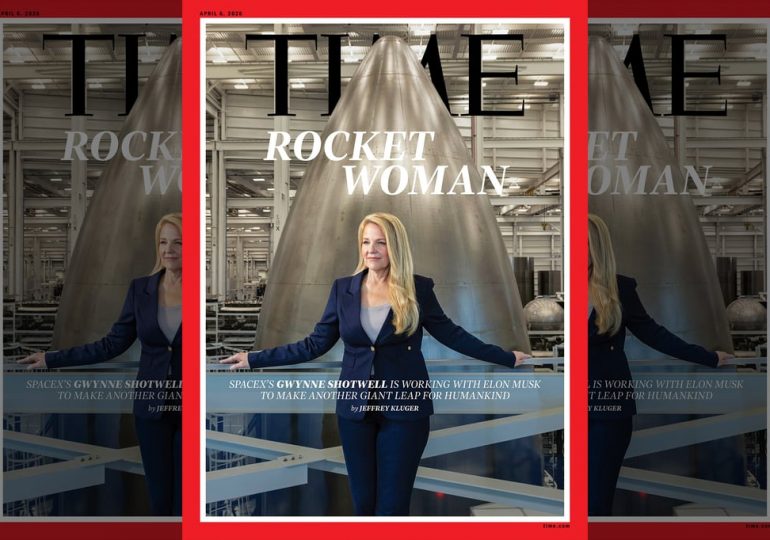
On Feb. 13, SpaceX President and COO Gwynne Shotwell sat down for an interview with TIME, just days after the company merged with xAI, making it the world’s most valuable private company, and as it prepares to go public this year. Below is a lightly edited transcript of the interview conducted by TIME Editor-at-Large Jeffrey Kluger. Read the cover story here.
TIME: Ok, so let’s start with the news. SpaceX just merged with xAI. What role will the new company play in SpaceX’s ongoing operations, and how will that affect your role in turn?
Shotwell: So you know, it’s very early days, and the merger happened incredibly quickly. I haven’t done much on the integration side yet. That will happen over time, but largely it’s going to operate as its own entity as it has been. As far as my role goes, it will morph over time, which is how my role has always gone. I want to be helpful to Elon [Musk], so I can be helpful and add value.
Will there be technological integration with artificial intelligence playing a bigger role now in rocketry R&D?
There is no question. I mean, that was part of the reason for the merger. Elon is such a visionary. But even I was seeing that AI is going to play an increasingly important role at SpaceX, and so why not leverage the best possible AI talent by bringing xAI into the fold?
How did the merger come about? Can you tell us a little bit about being in the room where it happened?
So these are Elon companies. Elon makes these kinds of decisions. As soon as we started talking about it, I was incredibly supportive, it felt like the right move, especially as I was seeing more and more AI being used at the company, it made perfect sense. Now we are even more vertically integrated in a space where we had very little experience, very little talent. I don’t want to say zero talent, because we did have some AI engineers on staff that were working for the last year or year and a half. But really now, with the merger, the thrust of what we can do will just accelerate.
Are there any concrete example you can give of what is being done on this factory floor today or in the drafting labs that will be done differently now that xAI is part of it?
Our adoption will kind of grow over time. As far as factories go, I think the obvious role for AI is in robots, having robots see to issues as hardware is moving through the factory. We do have some robots at SpaceX. We do have some welding robots, but at this point, we still largely build rockets and structures by hand.
The IPO is approaching; that has to affect your strategic thinking. The company all at once has a stock price that will be sensitive to the news cycle and to the statements of the leadership in the company. Are there any shoals that you see you’ll have to navigate as this happens?
I’m not really supposed to talk about the IPO in any way, but I’m actually looking forward to it. It’s a new thing, kind of a new set of methodologies to run companies. So I’m excited about it.
Elon just announced that the company is turning its focus away from Mars for a little while [in favor of the moon].
I wouldn’t say the focus; maybe more energy into the moon. We are not going to lose sight of our Mars vision in any way. But I think, again, the convergence of AI and SpaceX and what we’re doing—data centers in space, mass drivers on the moon, producing AI satellites on the moon. So I guess it’s a sort of shift in focus. But I don’t want people to think that we’re losing sight of Mars. The minute I met Elon, it was about settlements on Mars, it seemed so crazy. Now, it doesn’t seem crazy at all, right?
Tell me a little bit about data centers. Do you envision putting them on the moon or in low Earth orbit or higher?
Putting them around Earth, probably around the moon, and then maybe ultimately, around the sun would be incredible. The gravitational pull on the Moon is much less, about a sixth of what it is on Earth, so if we’re building these satellites on the moon with elements and materials from the moon, it would be much faster and cheaper [to launch them].
So you’d be thinking of actually doing manufacturing on the moon.
Yes, that would not surprise me if we did that.
Do you see this happening before 2030?
I think we will put humans on the surface before 2030, yes.
And HLS [SpaceX’s lunar lander] will be ready by 2028?
That is the plan. That’s the plan. A lot has to go right.
Back in October, [Secretary of Transportation and then-acting NASA Administrator] Sean Duffy opened up the HLS contract, and Blue Origin and Lockheed Martin are now circling or participating. How does that affect what you folks are doing?
I think it’s an inartful…It was an inartful statement by the Secretary. There was no new competition. We won. We won the Artemis III competition. Blue Origin won Artemis V. And there was no new competition. I don’t believe any new money was awarded, so “opening up the contracts,” again, I think it was inartful. We’ve had the benefit of working with NASA on HLS for quite some years, and we’ve learned, NASA’s learned, and I think we all agree on a number of things that would make things go much faster.
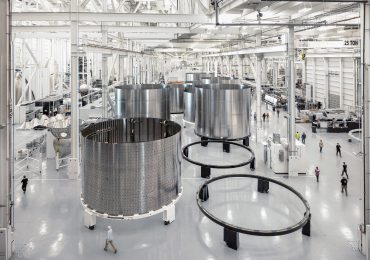
So one of these vehicles that I see here, could one of these be an Artemis…vehicle [that lands astronauts on the moon]?
No, these should be long gone by Artemis. They better have flown by Artemis III.
Starlink currently has a presence in [several] conflict zones, including Ukraine, Iran, and Gaza. How does a company navigate being not just a commercial power but a geopolitical power? And do you see growth in this area for Starlink?
I definitely see growth on the Starlink side, for sure. We are just going to surpass 10 million customers today, Friday the 13th, knocking on wood. So there’s no question that there’s massive growth on the Starlink broadband piece. As far as Starlink in conflict zones, obviously, it’s a shame that there are conflict zones at all. Starlink is kind of guided by the nations that license us; it’s largely up to the nation that licenses us.
For lack of a better word, though, is SpaceX freelancing in these conflict zones?
It’s a commercial endeavor. People purchase the equipment, purchase a service. If we’re not licensed in a country, then we don’t do business there.
Elon is given to making headline-making statements, sometimes intemperate statements. His tenure at DOGE was certainly controversial. How do you handle such public moments? And how will this affect SpaceX’s day to day operation once you go public?
The most important part I think of my job is to keep my now 23,000 employees focused on what they do every day, the great work that they do every day. I feel like we put our heads down, we plow through our very difficult jobs, developing technologies, manufacturing technologies, and then operating technologies. So maybe my best contribution, other than revenue generation, would be keeping everybody focused, not listening to the noise.
And how do you do that? Twenty-three thousand people is a whole lot of people. Can you give me an example of what keeping them focused might involve?
I hold people accountable to what they tell me they’re going to get done in a year, and kind of measure how they’re doing month over month, quarter over quarter. And if people get distracted by noise it’s time to knock them back and get them back on [schedule]. My leadership team has to be the best on the planet. Soon off the planet.
Back to Starlink for a moment. Starlink updated its privacy policy in January with all users automatically opting in to have data used to train AI. Starlink is now privy to a lot of customer information that it wasn’t before. With the merger with xAI, how do you see the two companies working together on this issue?
SpaceX follows the laws and the rules that we’re supposed to follow. If accidentally, there is a misuse of data, we will fix it.
I’m not suggesting that data would be misused, but are you getting any pushback from customers on the automatic opt in as opposed to automatic opt out?
I have not heard any word whatsoever about that process. I’ve not heard one complaint, and people know what my email is, so I get some complaints, I get some customer service issues, and I get them addressed. So, I’ve heard nothing. Not heard of one complaint.
How big is the Starlink constellation now?
We’ve launched 9,500 or so.
How big will it be? What do you see topping out at?
I don’t think we’ll have more than 15 or 20,000 Starlink satellites. But, you know, keep in mind, we have a lot of different technologies. We just recently gave a request for FCC licensing of up to a million AI satellites, I’m surprised that didn’t get more news. I thought for sure that would get a lot of news. I don’t know that we’ll get to a million, but it’s much easier to ask at the beginning and then march towards the goal.
The AI satellites will effectively be a distributed network serving as a data center in space?
Yeah.
You mentioned the orbital traffic problem. A million satellites is a lot of satellites. Are you going to be at one 300-kilometer orbit, or are you going to be all up and down the low Earth orbit, higher Earth orbit band?
We will do what’s necessary to be safe. There’ll be many shells of these AI satellites, some even potentially around the sun. And a million is a lot, but if you think about space, if you have 30,000 satellites in orbit, and you have 30,000 cars on the planet, that’s pretty sparsely populated, right? The problem with space traffic control is when companies or countries don’t tell us where the satellites are going to be. If you’re going to do a maneuver, please let us know so that we can make sure we are out of your way. I’m a communication person, so this is also the job that I can help get done.
SpaceX is the world’s leading launch provider at this point. I think the last number I checked was 595 launches successful launches of the Falcon 9.
I think we’re over 600 now. [Note: The figure is 608 as of this writing.] Last year was our largest launch year for Falcon. Yeah, this year we’ll still launch a lot, but not as much. We launched 165 times last year. This year, maybe 140, 145-ish, yeah. And then we’ll tail off our launches as starship is coming online,
And Starship will also be a freight carrier, a satellite carrier?
It will be, especially for our AI satellites.
Another number I saw was that over 85% of US launches in 2025 were Falcon 9 launches.
Yes.
Is there room for growth or are you going to top out at some point?
We are our largest demand for launchers now. Starlink basically created this incredible demand for Falcon 9, and the AI satellites will do the same for Starship launches. The reason why that is both exciting and important is the more you put something into production, the more consistent the product is, the more consistent the operation, the safer. So having that gigantic demand is incredibly important to us. And then ultimately, I think [Starship] will be moving humans.
What is the maximum number of humans a Starship could carry?
It depends on where you’re going, but I’ve heard up to 300 passengers a vehicle. Right now, we’re not putting 300 people in HLS, of course.
Regarding the moon, the lunar city that Elon envisions, how will that be run and governed? Will it be a top-down system? Will NASA be, ultimately, the supervisor and regulator of this city? Will it be a private industry? A little of both?
It’s a great question, actually, and I don’t know the answer to that question. Elon is not very top-down. So if he were king for a day and decided how the moon was going to be governed, I doubt he would be top-down. He tends to let people do their great work and work pretty independently. I mean, there is a paradigm that exists. He built this city, and five years ago, Starbase did not exist as a chartered city, and now it is, which is, you know, maybe the first step towards doing the same on the moon. Now there still are federal and state laws that you have to follow on Earth. Whereas on the moon, I guess there’s the Outer Space Treaty, which is really the only set of guidelines.
SpaceX has been long connected to the U.S. government through its contracts with both the DOD and with NASA. Do you worry about political volatility causing market volatility that could affect a newly public SpaceX?
I don’t worry about that. And let me tell you why. We have, from the get-go, tailored our products and our services to help fulfill a need in commercial markets, civil markets, military markets, as well as international government and commercial markets. Our products and services serve so many different markets, such a broad base, that an issue in one particular segment, I don’t worry it will impact us dramatically as a business. You know, there’s always ups and downs. It turns out that when commercial is booming, the government doesn’t spend as much. When commercial is not booming, then the government tends to spend more money.
Back to Elon for a moment. What is he like in private? Have you seen him change as a leader or a thinker since the President was inaugurated?
I love working for Elon. I have always loved working for Elon. He’s funny. He’s really quite funny. He gives me the freedom and flexibility to do my job. He’s not super hands on. On the other hand, we’ve worked together for 20, almost 24 years, so I feel like I know where my zone is, and when I get an issue or a topic that I feel like he really is going to care deeply about, I know that’s a thing to go take to him. So I do think he’s changed over the years. I don’t want to say he’s been an easier boss, because he’s quite demanding, but the interactions have been easier. And I don’t mean me with Elon, I just think he’s gotten more comfortable with people. I also think his children, like it was so clear, I’ll never forget once we were in a staff meeting, and maybe it was around his desk. It was a long time ago, and he was talking about how his children were just love bugs. They just want hugs and they want to crawl on you. And it made him so human, and I think that has kind of carried through.
Have you interacted with President Trump at all. Is he good for SpaceX?
I met President Trump during the first Trump administration. I met him at a space meeting. He’s a compelling figure, for sure. I don’t interact with him now and I’ve not met him since. [Note: Shotwell attended a meeting at the White House on March 4, after this interview took place.] The things that are quite good for SpaceX about this particular administration is there’s a manic or relentless focus on trying to clear the path for American industry and American businesses to thrive. And so it’s not necessarily deregulation, but sensible regulation that seems to be prevailing, which is very helpful. The launch industry is an incredibly regulated industry. You have to have environmental approvals. The ATF has to approve, the FCC has to approve, the FAA has to approve. The Department of Defense has to approve. State Department has to approve. Other countries have to approve. Like if we were to add it all up, we probably have to have 40 or 60 approvals or licenses for every launch. So I think any decrease in regulation or streamlining, making things more sensible can only be helpful to us.
You are now one of the most powerful people in both space and AI. What are your long term dreams for space exploration and colonization and the growth of artificial intelligence?
Oh, you meant me personally. Oh, yeah, I never think of myself that way. In fact, I always chuckle with the powerful lists that come out. I would love, in my life, to meet another species, like another, a sentient species. Hopefully it happens in less than thousands of years. Maybe hundreds. Hopefully the work that I’m doing today and the work that we’re doing will help facilitate that. That, to me, is the purpose for doing this. As far as AI goes, I have a very personal [reaction]. [We have] some robots on the ranch that help with the work. I live on a ranch my husband operates, and it’s a lot of work.
How long do you think it will take before we have a functioning infrastructure on the moon, not just bootprints on the moon?
I think Elon has talked about like a million people to sustain a civilization on another heavenly body. If Starship can take 50 to 100 at a time to the moon—if we can’t do it in 10 years, that would be a shame. We will probably have robots to start, you know, helping build this manufacturing capability, and then people go live there. I want to go to the moon. I don’t love camping, right? But I would love to go to the moon.
You’ve been in the space business for 38 years. You have been through multiple presidential administrations, beginning with George H. W. Bush and going up to Trump’s second term. How have you seen space policy change and which administrations have been best for space human exploration?
You know, it’s interesting. I think every president, maybe, with the exception of the last administration—I don’t want to, I don’t want to be political here at all—but I think every administration since I’ve been at SpaceX has had a focus on getting more people into space. Almost every administration, seems to care quite deeply about astronauts and expanding low Earth orbit and hopefully beyond.
You’re a woman atop a company in an aerospace and AI sector in which more than 75% of the leadership is male. Has this posed any unique challenges, any opportunities? How, if at all, do these industries specifically benefit from more female employees and leaders?
You know, I never focus on male-female. It’s just never been a thing for me. I might walk in a room and be the only woman. I might walk in a room and have [other women present]. It’s best to not focus on that part of the work life. I love working with people, and I think I’m good at communicating, and I think that is such an important element.
Have there been ways during your tenure at SpaceX that you’ve been able to model success for girls who are considering STEM education, and for young women, considering entering the aerospace and AI industries?
I hope I have served as a role model. I feel like I’m cheerleader for the underdog. And I’ve heard many times you can’t be it until you see it. Well, hopefully they’re seeing a girl who grew up in the cow town in Northern Illinois could end up helping Elon Musk change the world.
What do you think the industry needs to do to attract more women?
You know, I think women tend to be attracted to careers and industries or fields where they feel like they’re making a positive impact. I think the way to frame the aerospace industry is talking about the future of our planet, the future of life beyond these communities. AI is a very new technology and I think there’s always fear associated with [something new]. So I think, as you know, you get time on this tech, and you see more and more people using it, it will become more familiar.
You’ve been in the aerospace industry since 1988. What are the biggest differences you’ve seen in making this industry more gender neutral, more open to women at higher levels?
So there have been changes, no question. I’m a mechanical engineer. In my undergrad class there were like 9% women. In mechanical engineering now, I think the percentage is much higher. So we’re making strides, but it’s not necessarily fast enough.
Leave a comment