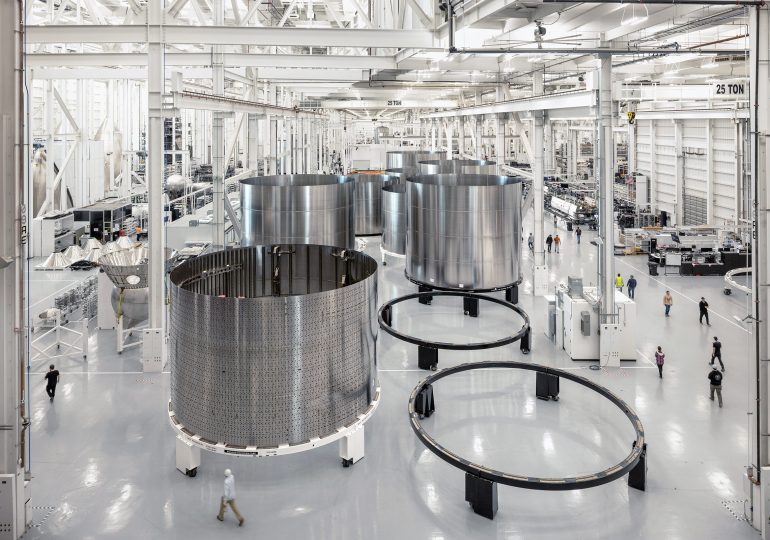
There are 18 Starship spacecraft in various stages of construction arrayed across the 1-million-sq.-ft floor of the SpaceX factory in Starbase, Texas. Some of them are, for now, just stainless-steel barrels measuring nearly 30 ft. across. Others have already been assembled and outfitted with their tapered nosecones, and are ready to be stacked atop a first-stage booster, taking final shape as SpaceX’s 40-story Starship rockets.
Eleven uncrewed Starships have been launched since 2023, some successfully, some not, each of them producing a staggering 16.7 million lb. of thrust from its 33 first-stage engines—more than double the ground-shaking power of the Apollo-era Saturn V. On a recent Friday in February, none of that violence was in evidence, as work proceeded in the gleaming white factory. Some of the welding is done robotically, but mostly these are hand-built—artisanal rockets.
The pristine factory floor in Starbase, Texas. SpaceX rockets are largely built by hand. —Paolo Verzone for TIME
Despite that old-world craftsmanship, they are getting built fast, with a goal of getting launched fast, aiming to meet NASA’s goal of pressing fresh American boot prints on the moon during the mission dubbed Artemis IV in two years’ time. Starship is the newest rocket in the SpaceX lineup, a step up in power from its popular Falcon 9 model. Artemis is NASA’s new lunar program, which will be buying services from SpaceX’s Starship.
“It’s a hard problem and the whole architecture is complex, but we’re gunning for 2028,” says SpaceX president and chief operating officer Gwynne Shotwell, 62, as she stands on a walkway overlooking the factory floor. It’s possible that one of the vehicles under construction here could be the 21st-century equivalent of Apollo 11’s lunar module Eagle, the lander that carried the first humans to the surface of the moon in
1969. But Shotwell is hoping that test flights will proceed so quickly that all of those spacecraft will have been put to use by the time of Artemis IV. “By 2028,” she says, gesturing to the 18 Starships, “these should be long gone. They better have flown by [then].”
When Shotwell says something had better happen, it better. A veteran of nearly 40 years in the aerospace sector, she is one of its top players. Shotwell is second on the SpaceX org chart—behind only CEO and founder Elon Musk—leading what is now the world’s most valuable private company. On Feb. 2, SpaceX announced that it merged with xAI, Musk’s artificial intelligence company. The combined operation is worth a reported $1.25 trillion, a valuation that will be tested when the privately held company (whose investors include TIME co-chair and owner Marc Benioff) begins selling stock. The initial public offering is rumored to be set for the second quarter of 2026.
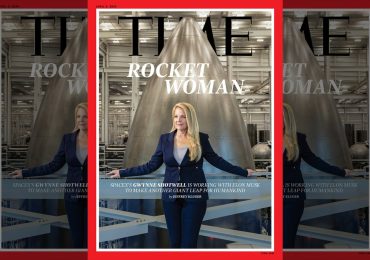
—Photograph by Paolo Verzone for TIMERocket Woman: SpaceX’s Gwynne Shotwell
Read the full transcript of Shotwell’s interview with TIME
“I’m not supposed to talk about the IPO in any way,” says Shotwell, “but I’m looking forward to it. It’s a new thing—a new set of methodologies to run companies—so I’m excited about it.”
It also means Shotwell will occupy an even bigger position in an even larger operation, one that has plans not just to dominate the aerospace sector, but also to settle other worlds and reroute the course of human history.
Starship could be the machine that helps make that happen. The goal of having these 18 rockets out the door in two years is actually a slow pace of launch for SpaceX. Since the first successful flight of the company’s workhorse Falcon 9 rocket in 2010, the vehicle has flown more than 600 times, including 165 launches in 2025 alone.
Assuming Starship proves its flightworthiness, it will have a lot of work to do in addition to taking astronauts to the moon. Its enormous dimensions allow it to carry 50 or more satellites to orbit—a big plus as SpaceX seeks to expand its Starlink internet constellation from its current 9,400 satellites to 20,000. On Feb. 13, Starlink passed the 10 million-customer mark, with its reach expanding beyond the commercial sector and into conflict zones around the world, including Ukraine, Gaza, and Iran. As artificial intelligence expands, the company sees a place for a similar constellation of satellites serving as data centers in space. SpaceX envisions linking the satellites by laser, giving them the power to process information as a single distributed brain.
“We just recently gave a request for FCC licensing for up to a million AI satellites,” says Shotwell. “I’m surprised that didn’t get more news. I don’t know if we’ll get to a million, but it’s much easier to ask at the beginning and then march toward that goal.”
SpaceX’s FCC application made a number of arguments for its proposed mega-constellation. Energy efficiency and carbon reduction were a big part of the pitch, as terrestrial data centers gulp enormous amounts of power and millions of gallons of coolant water. Placing AI satellites in orbits that keep them constantly charged by solar panels and constantly cooled by the infinite heat sink of space mitigates this problem.
Ultimately, Shotwell envisions the satellites being made on the moon. “The convergence of AI and SpaceX and what we’re doing—data centers in space, mass drivers on the moon, producing AI satellites on the moon,” she says. “I would be disappointed if we didn’t have a settlement on the moon and [are] building a manufacturing facility on the moon within 10 years. Hopefully half that.”
Getting a million satellites into orbit before that point would be a heavy lift, literally, but in an interview on the Cheeky Pint podcast, posted to X, Musk suggested launching Starship with the regularity of airplanes taking off from airports, reaching 10,000 launches per year.
Starship could not only accommodate 50 or more satellites, it could also seat a hundred or more passengers—a critical capability in Musk’s long-term vision of making humanity a multi-world species. Since the founding of SpaceX in 2002, Musk has made colonizing Mars a long-term goal.
“When I came to the company as a new employee,” says William Gerstenmaier, SpaceX’s vice president of build and flight reliability, “the first discussion was about how we go to Mars; it wasn’t about how you fill out your time card.” But in a Feb. 8 post, Musk announced a change. “SpaceX has already shifted focus to building a self-growing city on the Moon, as we can potentially achieve that in less than 10 years,” he wrote, “whereas Mars would take 20+ years.”
Musk explains the workings of the Starship spacecraft to President Trump before a launch in 2024. Starship has flown 11 times in the past three years —Brandon Bell—Pool/AP
Shotwell will get a lot less than 20 years—or even 10—to stick the planned Artemis IV moon landing. In 2021, NASA selected the company to build Artemis’ so-called human landing system (HLS)—the vehicle that will set down on the moon with two astronauts aboard, while two others station-keep in the Orion mother ship, orbiting above. NASA cut the company a $2.9 billion check to get the job done. Blue Origin, the rocket company owned by Amazon founder Jeff Bezos and one of the losers in the initial HLS bidding, was given a fat consolation prize in 2023, when NASA issued it a second, $3.4 billion contract to build its own HLS for a later moon landing, Artemis V.
Artemis I, an uncrewed flight round the moon to test NASA’s Orion capsule, flew in 2022. After that, the plan had been to fly Artemis II on a crewed trip around the moon—a mission that is scheduled to launch in April—and then land on the moon with Artemis III in 2028. SpaceX proposes using a specialized Starship as the HLS, but production is behind schedule and the clock is ticking. On Feb. 26, the Aerospace Safety Advisory Panel (ASAP), a government watchdog group, issued a report questioning not just whether Starship will be ready for a lunar landing by 2028, but whether it is the right ship for the job at all.
The Apollo lunar module stood 23 ft. tall and had a splayed, four-legged stance that gave it a low, sure-footed center of gravity. The Starship lander, by contrast, stands 171 ft. tall, requiring an onboard elevator rather than a ladder to get the astronauts down to the ground. Blue Origin’s proposed HLS is more of a child of the Apollo era, standing just 52 ft. tall—less than a third of the height of Starship.
The day after the ASAP report came out, NASA announced it was shuffling its flight schedule—and potentially its HLS provider—to keep Artemis III in low Earth orbit to practice rendezvousing and docking between the Orion capsule and either or both of the SpaceX and Blue Origin landers. Only then will Artemis IV get the chance to press its footpads into the lunar soil, in 2028. If SpaceX is feeling pressure from either the calendar or Blue Origin, it doesn’t show in Shotwell’s demeanor.
“A lot has to go right,” she concedes. “Each of us, the company together, are thinking, ‘Are there things we can do to go faster?’ We’ve had the benefit of working with NASA on the HLS for quite some years.”
At the same time Blue Origin is looking to take a bite out of SpaceX’s portfolio, Musk, Shotwell, and the rest of the leadership team are expanding it. The IPO and the xAI merger, Shotwell believes, are not just business plays; they’re part of the natural maturation of the overall enterprise.
“These are Elon companies,” she says. “Elon makes these kinds of decisions, and as soon as we started talking about [the merger] I was incredibly supportive, especially as I was seeing more and more AI being used at the company. It made perfect sense. It’s a force multiplier.”
Elon Musk’s detractors may scoff at his plans to build a city on the moon, but he’s already proved his chops by building one on Earth. In 2014, SpaceX began acquiring parcels of land in the town of Boca Chica—at the toe of Texas on the Gulf of Mexico—ultimately securing a 1.5-sq.-mi. plot on which to build a rocket factory, high bays, employee housing, and more. Musk dubbed the little enclave Starbase—a moniker that soon became more than just a nickname. In May 2025, polls opened for the 500 Starbase residents to vote on whether to incorporate their little village into a city. The results weren’t even close, with incorporation winning 212-6.
SpaceX headquarters in Starbase, Texas, on Feb. 13 —Paolo Verzone for TIME
The factory and corporate offices form the center of the city, and Musk’s aesthetic is evident throughout. “He picked the color palette [of the factory],” says Shotwell. “It’s clean and it looks organized too.” The city also includes a mini supermarket and a restaurant known as the Astropub. A neon sign reading Occupy Mars is on the pub’s back wall. Musk changed the name of Weems Street, a road that runs through the town, to Memes Street.
The city may be new, but the relationship between Musk and Shotwell, its most important players, is a long-standing one. Shotwell studied mechanical engineering at Northwestern University, receiving both a bachelor’s and a master’s degree there, and in 1988 took a job at the Aerospace Corp. in its El Segundo, Calif., offices, working on integrating private-sector resources with military and other government operations. In 1998 she left that position and joined Microcosm, a rocket company in El Segundo. Four years later, she met Musk through a colleague who had left Microcosm to join SpaceX. They were introduced in the SpaceX offices, and Shotwell was immediately impressed by Musk—but less so by how his company was organized.
“I shook his hand and blurted out that he needed to hire an in-house business developer (he had someone contracted to do this at the time),” she wrote in an email to TIME. “When I got back to the office I got a call from his assistant asking me to come interview for the new VP of business development job.”
Shotwell was unsure about leaving Microcosm. “After the interview and offer, I dithered for a few weeks as I was being a huge idiot,” she wrote. “I was driving in LA on the freeway in massive traffic one afternoon and I realized I was being said idiot so I called him and said I would take the job and sorry I was being such a ‘f—ing idiot.’ He laughed and was happy I called.”
They have been colleagues and friends since. “I love working for Elon,” Shotwell says. “He’s really quite funny. He has said many times that he would like to die on Mars, just not on impact. He also refers to Mars as a fixer-upper planet.” But Musk colors outside the lines too. Back in October, when Transportation Secretary and then acting NASA administrator Sean Duffy announced he was going to “open up” the HLS contract, inviting in competitors like Blue Origin in light of SpaceX’s slow progress developing the ship, Musk lashed out on X.
“Sean Dummy is trying to kill NASA,” he posted. “The person responsible for America’s space program can’t have a 2 digit IQ.”
(Shotwell agrees Duffy got out over his skis, if with more tact. “It was an inartful statement by the secretary,” she says now. “I don’t believe any new money was awarded. So ‘opening up the contract’ again—I think it was inartful.”)
Then, too, there was Musk’s tumultuous tenure as the head of the Department of Government Efficiency, or DOGE, and his subsequent falling-out with President Trump, during which he trolled Trump on X about the disgraced and deceased Jeffrey Epstein. The value of Tesla, Musk’s publicly held car company, took a pounding, with share prices falling 36% from January to April 2025.
All of that was problematic enough during SpaceX’s long tenure as a private company, but when the company goes public, it, like Tesla, will have a stock price that is sensitive to news cycles and any noise Musk may make. Shotwell sees it as her responsibility to insulate her workforce from such distractions.
“The most important part of my job is to keep my now-23,000 employees focused on the great work they do every day,” she says. “I feel like we put our heads down, we plow through our very difficult jobs. Maybe my best contribution, other than revenue generation, would be keeping everybody focused, not listening to the noise.”
Not all noise is bad, of course. In some cases it can be good—even heroic—news. That’s the case with Starlink’s role in global conflict and disaster zones, particularly in Ukraine. During the early days of the war, the government in Kyiv asked SpaceX about providing internet service for hospitals, schools, energy grids, and military operations, filling connectivity holes caused by destruction of ground-based servers. The appeal was urgent—and personal.
“The government reached out to Elon and asked, ‘Can you help?’” says Mike Nicolls, vice president for Starlink engineering at SpaceX. “Elon said yes, and within hours we had mobilized.”
The job was harder than simply boxing up Starlink terminals and shipping them east. “This was early days of Starlink, so we didn’t have software that worked everywhere,” says Nicolls. “We had terminals in Spain and Starlink employees drove across Europe with a truck full of them. They stopped at the Tesla factory in Berlin and unpacked hundreds of kits in the parking lot, and did a software upgrade. They then drove into Ukraine and handed them over to the citizens.” Up to 160,000 Starlink terminals are now operating in Ukraine, according to MIT Technology Review.
Local residents use internet from the Starlink network, set up by Ukrainian army after the liberation of Kherson, on Nov. 13, 2022. —Bulent Kilic—AFP/Getty Images
Then there’s Iran. In January, Musk lifted subscription fees on 50,000 Starlink customers in the country. As the Wall Street Journal and others reported, the U.S. State Department smuggled 6,000 Starlink terminals into the country to aid anti-regime activists. (SpaceX declined to elaborate on Starlink’s role, if any, in the U.S.-Iran war.) The constellation has also been used in Gaza to aid humanitarian efforts, as well as in Venezuela, where outages occurred after U.S. strikes to capture former President Nicolás Maduro.
Shotwell aims to keep clear of geo-political debate—seeing to it that SpaceX obeys the laws and regulations of countries in which Starlink is licensed to operate, and sidestepping blame in places it’s forbidden but is being used anyway. The terminals are portable, affordable, and easy to obtain, and only a naive regime would be shocked to find that they were being used by opposing forces.
“People purchase the equipment, they purchase the service,” Shotwell says. “If we’re not licensed in a country, we don’t do business in that country. We don’t sell terminals in Iran; we follow the regulations of the places we do have business.” Ultimately, with thousands of satellites beaming service around the world, anyone can tap in.
By tapping in, however, customers are also opting in to a new Starlink policy. In January, SpaceX announced that Starlink users automatically agree to have their personal data used by SpaceX to train its AI systems. With online privacy a growing concern for many, the move seemed out of touch with consumer preferences, but Shotwell says she’s received no pushback.
“I’ve not heard one complaint,” she says. “And actually people know what my email is, so I get some complaints. I get some customer-service issues, and I get them addressed. If accidentally there is a misuse of data, we will fix it.”
As Musk oversees SpaceX’s über-dreams about cities on the moon and million-satellite constellations, it’s up to Shotwell to manage quarter-to-quarter, year-over-year growth, and in some respects the company almost seems to have gotten too big. SpaceX’s 165 launches last year represented a whopping 85% of all U.S. orbital flights in that period. The company is so dominant a force in the market there is just not much room left for expansion—at least domestically. One solution is to look inward, to Starlink. The constellation now represents nearly 63% of the 14,900 active satellites orbiting Earth. It’s growing so large so fast that SpaceX is in a sprint just to loft its own satellites, eating the cost of launches but making up the expense in the revenue earned by an expanding customer base.
“We are our largest demand for launchers,” says Shotwell. “Starlink basically created this incredible demand for Falcon 9. And the AI satellites will do the same for Starship launches.”
A SpaceX Falcon 9 rocket lifts off in Florida in September—one of 165 Falcon 9 launches last year. —Manuel Mazzanti—NurPhoto/Getty Images
Space seems like an endless void ripe for managing our increasing data, but a hoped-for constellation of 20,000 Starlinks and a future constellation of a million AI satellites could make it exceedingly crowded. The orbital lanes in and around the 300-or-so-mile altitude at which Starlinks fly are already seeing too much traffic. According to NASA’s Orbital Debris Program Office, more than 25,000 objects larger than 10 cm—or 4 in.—are currently orbiting Earth, most of them active or no longer operative satellites. But that’s only a tiny fraction of the problem. There are 500,000 objects measuring 1 to 10 cm, and 100 million in the 1-mm range. Those tiny objects matter. Traveling at 4.85 miles per second, even a fleck of paint could do measurable damage to a satellite or crewed spacecraft.
Shotwell insists that the problem may be less severe than it seems since space is mostly, well, space. “Having 30,000 satellites in orbit is like having 30,000 cars on the planet,” she says. “It’s pretty sparsely populated.” What’s more, Starlinks don’t all fly at exactly the same altitude, instead circling the Earth in different “shells” that keep the traffic down on any one orbital highway.
Not everyone buys the cars analogy. “Satellites orbit the Earth in 90 minutes, depending on altitude,” says Aaron Boley, professor of astronomy at the University of British Columbia. “This means they sweep out tremendous volumes for their size. Satellites cannot stop, go, and make large turns like a car, either. Altogether, the collision potential on orbit is a serious concern.”
Managing the politics of spaceflight is as much a part of SpaceX’s business as managing the engineering. The company made no friends among environmentalists with its inaugural 2023 launch of the Starship rocket, which ended with an explosion shortly after liftoff. The U.S. Fish and Wildlife Service was unsparing in its review of the environmental damage caused by the liftoff and the accident, writing, “Impacts from the launch include numerous large concrete chunks, stainless steel sheets, metal and other objects hurled thousands of feet away along with a plume cloud of pulverized concrete.”
Five environmental groups filed suit against the Federal Aviation Administration for failure to evaluate SpaceX’s launch protocols, and the company has since followed stricter guidelines, including light and noise mitigation to protect wildlife, rapid cleanup of debris, and year-round monitoring of local flora and fauna. Regular launches from Starbase have proceeded apace, and in December 2025, the U.S. Air Force, which controls the Cape Canaveral Space Force Station in Florida, cleared SpaceX to develop one of the pads there for future Starship launches as well. Winning such clearances from multiple agencies and stakeholders is a big part of SpaceX’s—and Shotwell’s—job.
“The launch industry is an incredibly regulated industry,” Shotwell says. “You have to have environmental approvals. The ATF has to approve, the FCC has to approve. The FAA has to approve. The Department of Defense has to approve. The State Department has to approve. If we were to add it all up, we probably have to have 40 or 50 approvals or licenses every time we launch.”
Addressing that perceived regulatory burden is something Shotwell appreciates about the current Administration. “I met President Trump during the first Trump Administration,” she says. “He’s a compelling figure for sure. I don’t interact with him and I’ve not met him since. The things that are quite good for SpaceX about this Administration is that there’s a manic or relentless focus on trying to clear the path for American industry to thrive. It’s not necessarily deregulation, but sensible regulation, which is very helpful.” (On March 4, after Shotwell’s remarks to TIME, she attended a White House meeting with Trump and the leaders of six other AI giants to discuss the problem of higher electric rates hitting consumers as a result of the strain data centers place on the grid.)
Ruth Porat, chief investment officer of Alphabet Inc., left, and Gwynne Shotwell, chief operating officer of SpaceX, during a roundtable on a ratepayer protection pledge in the Indian Treaty Room of the Eisenhower Executive Office Building at the White House in Washington, DC, US, on Wednesday, March 4, 2026. —Bonnie Cash—UPI/Bloomberg/Getty Images
Since she began at SpaceX in 2002, Shotwell has worked under four Presidents, and she feels only one has failed to support the enterprise of space travel. “I think every President, maybe with the exception of the last Administration—I don’t want to be political here—but I think every Administration since I’ve been at SpaceX has had a focus on getting more people into space,” she says. The first crewed SpaceX mission did launch during the first Trump Administration, in May 2020. But 13 of the total 20 crewed flights the Falcon 9 has flown occurred during the Administration of former President Joe Biden.
For now, Shotwell is focused less on the history of space exploration and more on its future—and her own role in shaping that future. At the dawn of the space age, when the old Soviet Union launched the beach-ball-size Sputnik satellite, space was a man’s game—with men at the drafting tables and men at the flight consoles and men in the cockpits. Women, for the most part, were excluded from the enterprise. Some of that has not changed much. Shotwell’s undergraduate mechanical-engineering class, she says, was just 9% female. As of 2022, according to the American Society of Mechanical Engineers, women made up just 17.3% of people working in the field. But that number can grow, and Shotwell does think she can help.
“I feel like I’m a cheerleader for the underdog, and I hope I have served as a role model,” she says. “Hopefully they’re seeing that a girl who grew up in a cow town in northern Illinois could help Elon Musk change the world. We’re making strides, but not fast enough.”
Like all but a tiny handful of the human population of 8.3 billion, Shot-well will spend her life earthbound, even as she helps others leave the planet. That might not be what she would wish.
“I don’t love camping, but I am dying to go to the moon,” she says and then laughs. “That’s probably a bad word. But I want to do flips on the moon. I want to look back at the Earth and see [the view] available to astronauts.”
She won’t behold that view, but she will, perhaps, have a longer, larger vision. From the tiny Texas city of Starbase—pop. 500—she will help expand humanity’s footprint out into the solar system. □
Leave a comment