One afternoon this week just off the Senate floor, Lindsey Graham told me his vision of victory in Iran. Graham, one of the most outspoken supporters of the war launched last month by the U.S. and Israel, said victory would mean Iran was stripped of both its nuclear ambitions and missile programs, and was no longer “the largest state sponsor of terrorism.”
A few steps away, I asked his fellow Republican, Senator Tommy Tuberville of Alabama, the same question: what does winning the war with Iran look like? “Instead of a dictator, let them have a democracy,” he said. Others found the question baffling. “I have no idea what winning the war would look like,” Senator Tammy Duckworth, an Iraq War veteran and Illinois Democrat, told me. “I don’t know why we’re even at war with Iran.”
Between those answers lies the problem confronting Washington: the U.S. is fighting a war without a shared definition of victory. TIME posed the question to more than two dozen lawmakers this week. The exercise laid bare startling disagreements over the main objectives of a spiraling conflict that’s costing the U.S. tens of billions of dollars and destabilized energy markets. Some in Congress described a narrow, achievable objective. Others outlined sweeping, almost utopian outcomes. The scattershot answers sounded at times like descriptions of entirely different wars.
Republicans largely framed victory in terms of military and strategic outcomes—though not always the same ones. Answers varied in emphasizing the elimination of Iran’s nuclear capabilities, crippling its ability to project force, or toppling the regime altogether. Many Democrats, by contrast, questioned whether the war had any coherent objective at all, while some suggested the way in which Trump began the war—without authorization from Congress—made victory impossible.
The partisan divide is not absolute. Some Democrats outlined their own hopeful visions for a postwar Iran, while some Republicans took no interest in assessing the conflict that way. “Winning means having an exit strategy and getting the f—k out,” Rep. Nancy Mace, a South Carolina Republican, told me.
Administration officials insist the mission is clear and has been a resounding success, pointing to degraded Iranian military capabilities and leadership losses. But despite those tactical gains, even members of Congress who have been briefed by the White House on the conflict don’t feel confident on how it is supposed to end.
“The fact that people have to ask the question,” Senator Chris Van Hollen told TIME, “just reveals what we’ve been saying—they have no end game.”
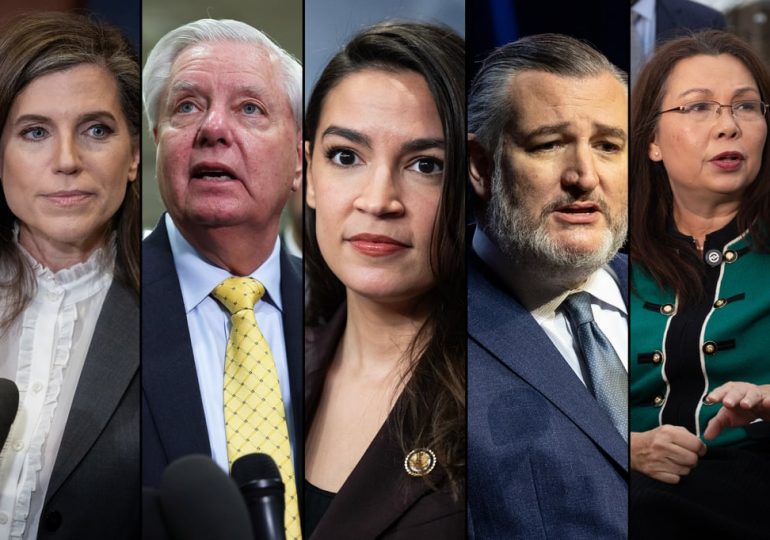
Here’s how 27 members of Congress answered:
Regime change
For some lawmakers, particularly Republicans, victory is inseparable from the fall of Iran’s ruling system. This perspective aligns with Trump’s statements soon after coordinating the initial strikes with Israel, in which he urged Iranians to “take over” their government. While Trump’s language has shifted, these lawmakers still view regime change as the central objective of the mission instead of a byproduct.
“The collapse of the regime and no longer having Iran led by Islamist radicals who want to murder Americans.” – Sen. Ted Cruz (R-TX)
“Well, getting the right regime change and obviously giving the country back to their people, instead of a dictator, let them have a democracy.” – Sen. Tommy Tuberville (R-AL)
“For me, it’s the Persian people getting their country back. Hard stop. Iran and the regime are the number one funder and exporter of terror around the world. We literally have Hezbollah terrorists here on U.S. oil. We know that. And quite frankly, the Persian people should have their country back. Anybody that gets them in the way of the Strait is going to pay the price.” – Rep. Andy Ogles (R-TN)
Neutralizing Iran as a threat
For many Republicans and a handful of Democrats, the most concrete definition of victory centers on neutralizing Iran’s capacity to threaten the United States and its allies, particularly through nuclear weapons and missile programs. Their answers largely mirror the Administration’s stated military objectives, though they stop short of saying wholesale regime change was essential to calling the operation a success.
“That they can no longer project power as the largest state sponsor of terrorism, they don’t have a nuclear breakout capability, or an illicit missile program that’s funding terrorism.” – Sen. Lindsey Graham (R-SC)
“Winning looks like what President Trump says was the ultimate goal, which is that Iran can never have a nuclear weapon, and that they cannot have the ballistic missiles and drones to protect a nuclear weapon. That is the stated goal at the beginning. Once that goal is achieved, I think that’s a win.” – Sen. Cynthia Lummis (R-WY)
“I think there are clearly identified missions—making sure they never have a nuclear weapon, taking on their ballistic missile capability—I think we’re way ahead of schedule and all that.” – Sen. Eric Schmitt (R-MO)
“That they’re no longer a terrorist threat, that they don’t have nukes and that they don’t have the ability to missile launch, and that we’ve reached a negotiated settlement. I mean, I don’t think you can just destroy and not have a settlement. That’s what I think winning looks like.” – Sen. Shelley Moore Capito (R-WV)
“Incapacitating Iran’s leadership, specifically killing or capturing those who have the means and desire to fulfill their promise to bring death to America. Winning includes dismantling, destroying, incapacitating as much as we can their nuclear ambitions and winning means having an open Strait of Hormuz.” – Rep. Nick LaLota (R-NY)
“The radical Muslim Imams and Mullahs can no longer project power through the region and hold the world economically hostage with their bidding and the Persian people have the ability for self determination. That’s the secondary goal. The first thing is these guys, they have to not be able to fund these terrorist proxies with their ballistic missiles. They cannot have that and obviously they cannot have nuclear weapons at any time.” – Rep. Derrick Van Orden (R-WI)
“First of all, I think the Administration went in recklessly, and I’m skeptical of the capacity for the war to achieve in the long term realistic goals that I would have—which is 1) an Iran that protects the human rights of its citizens; 2) a truly nuclear-free Iran for as far as the eye can see; and 3) an Iran that’s no longer funding proxies in the region, or has the capabilities of attacking our allies in the region. That is obviously a worthwhile goal if we reach it. I am not confident that this war has a path forward that results in a stable Iran, a more stable region and the human rights of the Iranian people preserved and a nuclear program that could not advance.” – Rep. Sarah McBride (D-DE)
Can’t win a war without clear goals
Among Democrats, the most consistent response was that victory cannot be defined at all under the current circumstances because the Trump Administration has not clearly articulated its goals and Congress has not voted to authorize what is clearly an ongoing war.
“Well, it’s a hypothetical question, because we already won it, right? In order to determine what victory means, we would have to know what the objective of the war was. And Donald Trump has never specified an objective. He’s talked about regime change. He’s talked about nuclear weapons. Some of my colleagues believe that this was foretold in the book of Revelation, and this is part of the Rapture, where followers will be taken up into heaven while there are a thousand years of Tribulation down below—who knows what the objective is, it changes every day.” – Rep. Jaime Raskin (D-MD)
“This is Trump’s war of choice. We are not winning. We are less safe, so we should just stop this war. And the fact that people have to ask the question just reveals what we’ve been saying—they have no end game. They have no plan. They have no definition of success, and that’s because Trump’s already, sadly, put the country at greater risk.” – Sen. Chris Van Hollen (D-MD)
“I have no idea what winning the war would look like because I don’t know why we’re even at war with Iran… You know, if Pete Hegseth had spent 30 minutes awake in his officer basic course, he would know that every operation order ends with an end state. What’s the end state? I don’t know… It’s not up to me to find it for them. They need to come to me and say this is what we define. And then I’ll decide whether or not that’s appropriate.” – Sen. Tammy Duckworth (D-IL)
“It’s incredibly hard for this administration to find what winning looks like when you have a President that got into a conflict without any kind of strategic goal, without a plan, without a timeline, without an exit strategy. So how do they define what’s winning and how do you extract yourself from a conflict when the enemy also gets a vote?…That’s the big question that the President has yet to answer.” – Sen. Mark Kelly (D-AZ)
“I think that’s a question that really is about why did Donald Trump get into this war, and what is his stated reasons and off-ramp. I mean, this is ridiculous. This is not a video game like he seems to think it is. This has real consequences and right now the American public is paying.” – Sen. Cory Booker (D-NJ)
No more war spending:
For some lawmakers, success in the war is less about geopolitical outcomes than about the financial toll on the American taxpayer.
“To me, winning would be bringing our troops home and stop spending $2 billion a day dropping bombs in Iran. We claim to not have enough money for health care for folks here in America. That would be winning for me. Obviously, the President and the Administration have shifting and different definitions of winning, but to me, that would be winning.” – Rep. James Walkinshaw (D-VA)
“I’m not a foreign policy expert. I will be more interested in where the money is being spent. That’s what my focus is going to be on Iran. Where have we spent the money, how much more is it going to cost. That’s the lens that I’m looking at… Obviously we want the Strait of Hormuz reopened. I don’t know how to answer that question, but we’re certainly looking at the price tag of [gas] from my lens.” – Rep. James Comer (R-KY)
Just end it:
A number of lawmakers rejected the idea that victory is achievable at all. Some referenced the long and costly wars in Iraq and Afghanistan, where overwhelming military force failed to produce clear or lasting political outcomes.
“Winning means having an exit strategy and getting the f—k out.” – Rep. Nancy Mace (R-SC)
“I don’t think there’s any winning in a conflict that was ill conceived and impulsively started to begin.” – Rep. Alexandria Ocasio-Cortez (D-NY)
“I think we should stop killing people. I believe it’s unjust. I feel it’s illegal. And the harm that we are causing is not being justified in any kind of way.” – Rep. Ilhan Omar (D-MN)
“Well, look, I didn’t want this war in Iran, and the American people don’t want this war. So I think that this has just been a disaster writ large. Having been on the ground in both Afghanistan and Iraq, I can tell you that there is no real winning when it comes to war, especially when Trump didn’t ask for the American people’s approval when it comes to this.” – Sen. Andy Kim (D-NJ)
Reopening the Strait of Hormuz:
One Senator suggested that the U.S. can’t declare victory if it hasn’t fixed a problem made by the war itself. For four weeks, Iran’s blockade of the Strait of Hormuz has upended global energy markets and rattled the global economy.
“So the President on Tuesday said that the war had been won, but I don’t think you can call a war won as long as the Strait of Hormuz is closed, which it is. And so until, in my view, until the Strait of Hormuz is open in some way, the war is not won.” – Sen. Mazie Hirono (D-HI)
Regional peace:
At least one lawmaker embraced perhaps the most aspirational definition of success.
“Peace in the Middle East. How’s that? It would be a great outcome if we can get people to live together there.” – Rep. Dan Newhouse (R-WA)
A better life for Iranians
The sole Iranian American member of Congress said she worried what the end of the war would look like for the Iranian people.
“My hope is that there will be an off ramp that isn’t disastrous for Iranian people who have been suffering for decades already under this regime. And I think my concern based on Trump’s recent rhetoric is that they will ultimately just work to make a deal with someone that potentially is even more hard line than the previous Ayatollahs.” – Rep. Yassamin Ansari (D-AZ), the only Iranian American member of Congress, whose parents fled the country
No comment:
And then there were those who declined to engage with the question at all—an answer that, in its own way, reflects the uncertainty around a war whose objectives remain unsettled.
“I don’t have any comment on that.” – Sen. John Boozman (R-AR)
“I don’t have anything for you right now.” – Sen. Rand Paul (R-KY)
“I don’t have anything for you.” – Sen. John Kennedy (R-LA)
Leave a comment