Donald Trump appears to be shifting toward deescalation on the Iran war, and his Administration has said it has been in talks with a “top person” other than the Middle Eastern country’s newly-installed Supreme Leader to try to find a way out of the conflict.
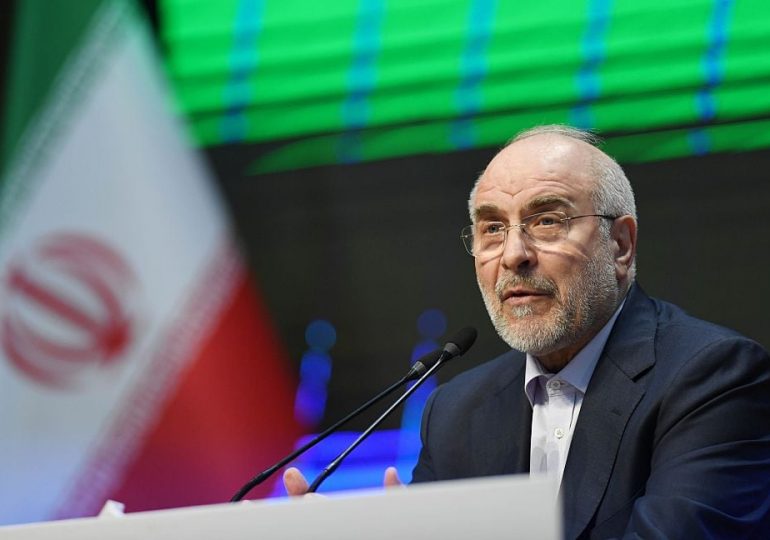
That figure appears to be, at least according to the U.S. side, Mohammed-Baqer Qalibaf, the Speaker of Iran’s parliament.
Politico reported Monday that the Trump Administration was “quietly weighing Iran’s parliament speaker as a potential partner—and even a future leader,” according to two unnamed officials. One of the Administration officials told the outlet that Qalibaf was a “hot option” but said that the choice was not final as they still have to “test” him and other prospects: “We can’t rush into it.”
Trump has publicly rejected the appointment of Mojtaba Khamenei, son of the slain Ayatollah Ali Khamenei, as Iran’s Supreme Leader, and the U.S. President has insisted that he influence who leads Iran.
As his Administration is trying to negotiate with Iran to end the conflict, which the U.S. started with Israel on Feb. 28, Trump has suggested that his envoys, Steve Witkoff and Jared Kushner, are dealing with “very solid” figures in Tehran. While Trump has not named who was allegedly negotiating on behalf of Iran, he claimed the U.S. and Iran were aligned on many issues amid ongoing talks. “We are dealing with a man who I believe is the most respected,” Trump said, adding that it was “not the Supreme Leader” and that his Administration has not heard from Mojtaba Khamenei at all.
An unnamed Israeli official told Axios that Witkoff and Kushner were in touch with Qalibaf, and another unnamed source told the Jerusalem Post that Qalibaf led the talks. But Qalibaf himself has denied holding negotiations with Washington.
“No negotiations have been held with the US,” Qalibaf posted on X on Monday, “and fakenews is used to manipulate the financial and oil markets and escape the quagmire in which the US and Israel are trapped.”
TIME reached out to the White House for comment.
Here’s what to know about the key Iranian figure.
Revolutionary Guard veteran
Born in 1961, Qalibaf, a grocer’s son, grew up near Mashhad in Iran’s northeast. During the Islamic Revolution, he entered activism. Iranian state-owned Press TV reported in 2024 that Qalibaf, as a teenager with his classmates, founded the Islamic Students’ Association, which eventually became a national organization.
At 18, Qalibaf joined the Islamic Revolutionary Guard Corps (IRGC), then a nascent group that operated alongside the Iranian armed forces but which has since become one of the country’s most feared and influential institutions. Amid the Iran-Iraq war led by Iraqi dictator Saddam Hussein in the 1980s, Qalibaf swiftly rose through the ranks, becoming a brigade and division commander after about three years. He played a crucial role in the 1982 recapturing of the Iranian city of Khorramshahr from Hussein’s forces, a victory still celebrated annually in the country. By 1997, Qalibaf was selected to become Commander of the IRGC’s Aerospace Force.
While remaining active in the IRGC, Qalibaf sought to improve his educational background. He earned a bachelor’s degree in political geography from the University of Tehran. He also obtained a master’s in human geography and a doctorate in political geography from the Islamic Azad University and Tarbiat Modares University, according to The Hill..
Former police chief
In 2000, against the backdrop of a pro-democracy student uprising, then-Supreme Leader Khamenei appointed Qalibaf to serve as chief of the national police. Qalibaf was among the several IRGC commanders who wrote a letter to then-President Mohammad Khatami and threatened potential military intervention if instability related to the protests continued.
According to BBC Persian, Qalibaf’s tenure as police chief saw violent crackdowns on some protesters and journalists, though the reputation of the police force also reportedly improved.
Tehran mayor with failed presidential bids
Qalibaf, a conservative, has unsuccessfully vied for the Iranian presidency multiple times. He ran in 2005, 2013, and 2024. He also ran briefly in 2017—before withdrawing in favor of Ebrahim Raisi.
But despite coming in fourth in the 2005 presidential election, his public profile improved, contributing to his election as mayor of capital Tehran later the same year, after Mahmoud Ahmadinejad, the city’s former mayor, won the presidential election. As mayor, Qalibaf earned a reputation for pushing infrastructure development in the capital, but his popularity took a hit from road-traffic problems and corruption scandals. Qalibaf would remain in the position until 2017.
Close to the Khameneis
Qalibaf was elected as Speaker of the Iranian parliament in 2020, reportedly owing to his loyalty to then-Supreme Leader Khamenei. Qalibaf replaced Ali Larijani, a close associate of Khamenei who had become a senior security official after his speakership stint. Larijani was killed in military strikes on Iran last week, and the New York Times reported Qalibaf is filling in for Larijani, now managing strategic decision-making.
Qalibaf himself has long been seen as a protégé of Khamenei and a confidant of his son Mojtaba, pledging allegiance to the younger Khamenei when he ascended to Supreme Leader.
Peer of powerful figures
Qalibaf was also a close friend of Qasem Soleimani—one of Iran’s most powerful figures, whom the first Trump Administration assassinated in 2020. Soleimani led Iran’s elite Quds Force, the IRGC’s foreign arm that backs proxy militias throughout the Middle East.
Historian Arash Azizi wrote in his 2020 book, The Shadow Commander: Soleimani, the U.S., and Iran’s Global Ambitions, that “during the war years, the commanders who had distinguished themselves most had a regional base and a talent for organizing the men of their provinces for the national war effort. Three such men became close comrades and helped build a web of influence that strengthened their respective positions:” Soleimani; famed Iranian army commander Ahmad Kazemi, who died in 2006; and Qalibaf.
Leave a comment