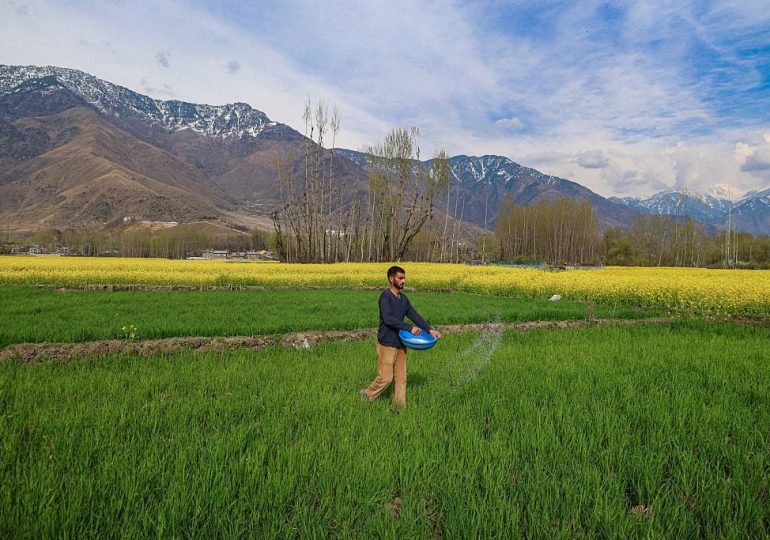
A Kashmiri farmer sprinkles fertilizer near a mustard field outside Srinagar in India-administered-Kashmir, on March 22, 2026. The war in the Gulf has disrupted global fertilizer supplies with the de-facto closure of the Strait of Hormuz. —Firdous Nazir–NurPhoto via Getty Images
Wars have a way of revealing the world’s hidden architecture. We notice the narrow straits, the fragile chokepoints, the invisible bargains that keep daily life intact only when they begin to fail. Today, the Strait of Hormuz is one such place.
Most people know Hormuz as an energy artery, the passage through which a fifth of the world’s oil and gas move. But that description is too narrow. Hormuz is also a corridor for food, fertilizer, and the raw materials required to grow food elsewhere. When transit is disrupted, the shock does not stop at the pump. It hits grain markets, shipping rates, insurance premiums, and, before long, the dinner tables of families far from the Gulf.
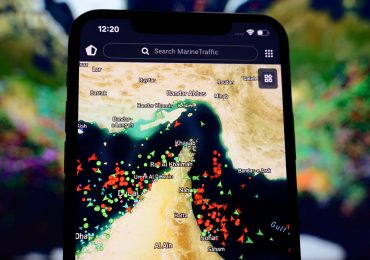
The ongoing war involving Iran, Israel, and the United States—and in which Iran has struck at Gulf Arab countries—has already shown how briskly a military crisis can become an economic one. The restriction of maritime traffic through Hormuz has driven up oil prices as high as $119 barrel and gas prices to over $4 per gallon on an average in the U.S. The prospect of liquefied natural gas (LNG) shortages looms over the Asian countries that purchase almost all Persian Gulf LNG exports, with fertilizer plants pausing operations in Bangladesh, schools closing in Pakistan, and India and Japan turning to coal as much as possible.
The danger runs deeper. Gulf countries, Iraq, and Iran sit at a strategic crossroads of fertilizer exports and food imports. An estimated one-third of the world’s seaborne fertilizer trade passes through the Strait. A prolonged disruption would not simply squeeze trade. As much of the world gears up for planting season, it would deepen food insecurity, especially across poorer, import-dependent countries that are, as ever, always the first to feel the pain when global supply chains fracture.
Hormuz and the coming global food crisis
The World Food Program recently estimated that around 45 million people could fall into life-threatening food insecurity if the conflict does not end by the summer and if oil prices stay above $100 a barrel—a projection based on an analysis of just 53 countries. No country will be entirely able to shield itself from the spiking costs of growing food and transporting it, along with other necessities, around the world.
Many of the world’s agricultural powerhouses rely on imported fertilizer, including the U.S., India, Brazil and Australia. Even countries that produce much of their own fertilizer will face challenges as food prices rise, among them China, still one of the largest wheat importers. Smaller producers will have even less flexibility in managing the problem. Sri Lanka, for instance, is heavily dependent on imported fertilizer, and an attempted government ban on synthetic fertilizer in 2021 illustrated the consequences of abruptly severing those imports: the country experienced a food security crisis as rice yields fell and imports spiked. Sri Lanka’s agricultural sector has yet to fully recover and remains vulnerable to new shortages.
While rising fertilizer and energy prices may take time to reflected in food prices, countries that depend on imported staples such as wheat—Egypt, for instance—have reason for concern in the year ahead. The consequences will ultimately be most severe where needs are already most acute, in countries like Sudan, where the United Nations repeatedly documented famine in 2024 and 2025 and continues to warn of the threat of mass starvation.
The Black Sea lesson for the Gulf crisis
There is a way forward to prevent this grave danger to global food security. The United Nations and Turkey brokered the Black Sea Grain Initiative in July 2022, five months into Russia’s war in Ukraine. The deal made no attempt to resolve the underlying political conflict. Instead, it focused on something narrower—and, for that reason, more achievable: carving out a workable arrangement to protect the movement of essential goods through a conflict zone. It relied less on grand visions and mutual trust than on limited, overlapping interest. It was built not on lofty declarations, but on monitoring, transparency, and painstaking diplomacy.
The Black Sea Grain Initiative offers a lesson for Hormuz. Even in the midst of war, diplomacy can still make room for necessity. What is needed now is some form of Hormuz Transit Initiative: a political commitment, not a sweeping peace settlement, to ensure the safe passage of food, fertilizer, and related raw materials through the Strait, and to protect the ports that handle them. Such an arrangement would be modest by design. It would not ask the parties to resolve their larger dispute. It would ask them only to recognize a shared interest in preventing a wider calamity, one that would push tens of millions toward acute hunger.
That shared interest is real. Gulf leaders, like many others, have understandable concerns about anything that could implicitly formalize Iran’s control of the strait. But continued fertilizer exports matter for them both economically and strategically, given their critical importance to many countries with which Gulf capitals have forged close ties over recent years. For Iran, food imports are not abstract bargaining chips but a domestic necessity. For countries across Africa and Asia, continued flows of fertilizer and its key ingredients through Hormuz can mean the difference between price pressure and outright crisis. For consumers and farmers in Europe and America, the costs of disruption would not remain distant for long.
This is why focusing on food, raw materials and especially fertilizer may present an opening that energy politics does not. Iran may regard restricted oil transit as a source of leverage in wartime. Food security is different. It is harder to weaponize without risking blowback at home and abroad. A narrower arrangement may therefore prove more politically attainable than a broader deal encompassing all trade.
Such an initiative would require a credible institutional anchor. The United Nations has taken a welcome step by announcing a task force to address maritime trade disruption, with a particular focus on fertilizer shipments. To succeed, the initiative would need a discreet but capable team: specialists in maritime trade, sanctions, regional politics, mediation, and humanitarian diplomacy. Their task would be to consult promptly with all relevant parties, test the political ground, and develop an operational mechanism that shipping companies, insurers, and governments can trust. World leaders should throw their weight behind such an initiative.
In the Black Sea, confidence was built through information sharing and monitoring, not through illusions and expectations of good will. The same principle should guide any arrangement over the Strait of Hormuz. A workable mechanism would track vessel movements, document incidents, and provide the kind of reassurance that would allow commercial ships to move without becoming targets or pawns.
None of this would solve the wider war. By far the best outcome would be for the two sides to negotiate a ceasefire that includes the full opening of the Strait of Hormuz. Sadly, such a deal seems some way off. In the meantime, diplomacy need not be comprehensive to be meaningful. Sometimes its most urgent task is simply to keep one disaster from cascading into another: to pursue an agreement that is realistic, limited, and urgent and serves the interests of all parties while protecting those with no say in this conflict at all. Reopening the Strait for food and fertilizer shipments would send an immediate signal to markets, ease pressure on vulnerable populations, and remind all parties that even now, a narrow channel for reason exists.
In times of war, peace often begins not with resolution but with restraint. In a conflict whose already considerable toll could still mount if critical infrastructure continues to be targeted, an understanding on the Strait of Hormuz would help check the momentum toward more destructive consequences.
Leave a comment