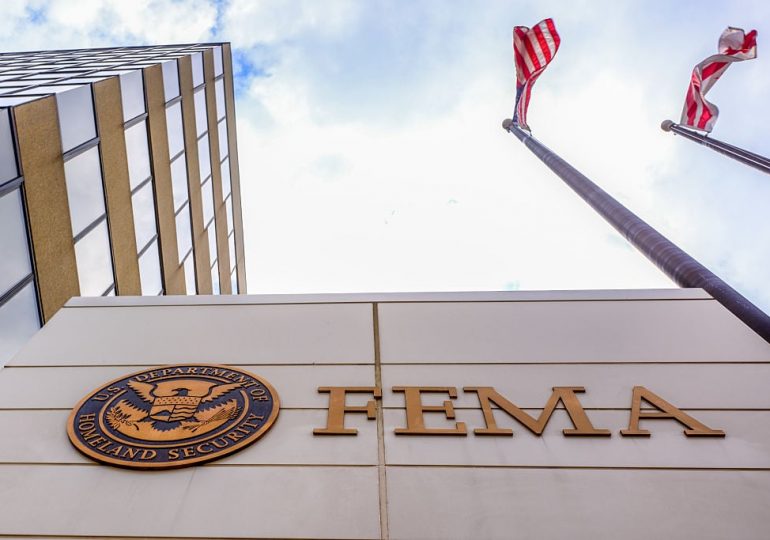
A sign marks the location of the Federal Emergency Management Agency (FEMA) headquarters building in Washington, D.C., on March 30, 2026. —J. David Ake—Getty Images
Transportation Security Administration (TSA) agents began receiving their paychecks this week, but thousands of staffers at other agencies are still being impacted by the ongoing partial government shutdown.
President Donald Trump issued a presidential memorandum last week that directed Homeland Security Secretary Markwayne Mullin and Office of Management and Budget Director Russell Vought to use existing funds to pay TSA officers. The Department of Homeland Security (DHS) told TIME that most agency staffers began receiving retroactive paychecks on Monday.
Trump’s order came as TSA officers had been working without wages during the DHS shutdown, leading to understaffing at airports and hours-long security lines. The shutdown, which began on Feb. 14 amid a standoff over immigration enforcement, is now the longest in U.S. history. Since Monday, wait times to get through security have seemed to be improving at some airports.
But several other agencies within DHS still haven’t received funding as the partial shutdown drags on, and officials have reported impacts both on staffers and the services they provide—including programs aimed at protecting Americans from terrorism and proactively countering the threat of cyber attacks on U.S. infrastructure.
Senate and House Republicans said earlier this week that they had reached a deal to fund most of the department, excluding immigration enforcement agencies, through September. But while the Senate sent an appropriations measure to the House on Thursday, the lower chamber didn’t take up the legislation that day. That means the shutdown is set to last at least through Monday, when the House will reconvene for a pro forma session during its ongoing two-week spring recess, though the shutdown could stretch on even longer.
Trump said in a Truth Social post on Thursday that he plans to “soon sign an order to pay ALL of the incredible employees at the Department of Homeland Security” amid the ongoing shutdown. He didn’t specify when this would happen, how long his Administration would be able to pay staffers, or where it would draw the funding from.
Here are the other agencies that are being impacted by the DHS shutdown.
Federal Emergency Management Agency (FEMA)
FEMA, the country’s leading agency for disaster response and recovery, falls under the purview of DHS, and so has not been receiving funding during the ongoing shutdown. Testifying before the House Committee on Homeland Security on March 25, Victoria Barton, associate administrator for FEMA’s Office of External Affairs, said that more than 4,000 agency staffers are not receiving wages—and that, for many of them, this is their third shutdown in less than a year.
“Staff are under significant financial and emotional strain, trying to serve their communities with fewer resources,” Barton told the committee.
FEMA’s disaster relief fund, which is the main source of federal funding allocated for disaster response and recovery efforts, is “rapidly depleting,” Barton warned. As of March 3, the balance of the account had fallen to $4 billion, according to a fact sheet released by the Senate Committee on Appropriations. FEMA typically keeps about $3 billion of reserve funds in the account for future emergencies and disasters, leaving only $1 billion available for existing disaster response until the agency is funded again.
“If this shutdown continues, and the disaster relief fund is depleted, FEMA will be unable to fund much of the disaster recovery efforts,” Barton said.
“This is not just rhetoric,” she continued. “These impacts are having dire rippling effects for thousands of Americans and communities across the United States. Disaster survivors waiting for assistance may face increased uncertainty and hardship. Local officials working to rebuild after hurricanes or floods may be unable to access federal support. And FEMA staff, many of whom have served through multiple disasters, are now struggling to pay their bills and support their families while also continuing to serve the public.”
Barton also said that the shutdown is preventing FEMA staffers from providing support to “critical programs that protect communities from targeted violence and terrorism.”
“This means organizations like Temple Israel in Michigan, which recently experienced a violent attack, cannot receive the support they need to protect their congregants and staff,” Barton said. On March 12, a suspect armed with a rifle drove his car into the Michigan synagogue. None of the students or staff members in the place of worship were wounded, but a security guard was injured in the attack. The suspect died from a self-inflicted gunshot wound. The special agent in charge of the FBI’s Detroit field office called the incident a “targeted act of violence against the Jewish community,” and said the suspect was inspired by the Iran-backed militant group Hezbollah.
Barton said that FEMA has had to postpone most of its training courses because of the shutdown, including anti-terrorism preparedness courses. FEMA has also said that it has not been able to hold emergency management trainings for first responders, such as wildland firefighters, during the shutdown.
“The reality is this: with hurricane season approaching, each day of this shutdown increases the risk that a catastrophic disaster could occur while FEMA’s capacity to respond and support recovery is diminished,” Barton said.
Cybersecurity and Infrastructure Security Agency (CISA)
CISA, which detects and responds to threats to the country’s cyber and physical infrastructure, is also being impacted by the ongoing shutdown, since it falls under the purview of DHS. CISA Acting Director Nick Andersen told the House Committee on Homeland Security on March 25 that roughly 60% of agency staffers have been furloughed or are “otherwise unable to work.”
“The remaining personnel are carrying out mission essential functions without pay while facing increasing pressure from nation-state and criminal actors targeting our nation’s critical infrastructure,” Andersen told the committee. “This is not a sustainable model. This shutdown affects morale, stability, and the overall well-being of our people.”
Andersen said that CISA’s functions are “largely limited to protecting life and property, responding to imminent threats, maintaining our 24/7 operations center, and sharing critical vulnerability and incident information at a reduced capacity.” While those are important operations, Andersen said that “they are not sufficient to get ahead of the threat,” adding that many proactive tasks meant to decrease the risk to the nation’s infrastructure have been scaled back or halted amid the shutdown. CISA has had to stop, for instance, assessments intended to identify vulnerabilities in the nation’s infrastructure, according to the Senate Committee on Appropriations.
“The result is simple: risk is accumulating across the system,” Andersen said, adding that that can “create openings for our adversaries.”
Andersen also warned that the agency is feeling these impacts just months before several large-scale events—such as the FIFA World Cup and America250—are set to take place, and that each of those events “require heightened preparedness.”
“Every day the shutdown continues, we’re not just standing still; we’re falling behind,” Andersen said.
Coast Guard
Vice Commandant of the U.S. Coast Guard, Admiral Thomas Allan, told the House Committee on Homeland Security on March 25 that the shutdown is causing an “unacceptable financial strain” on staffers.
“Our dedicated civilian employees have already missed several paychecks, leaving them without resources to support their family,” he told the panel. While the Coast Guard’s military members are being paid during the shutdown, the New York Times reported, Allan said that they “and their families are operating under grim uncertainty of whether they will receive their next paycheck.”
“Our deployed crews conducting critical national security missions are accumulating thousands of dollars in expenses with no way to be reimbursed,” Allan continued. “These realities erode the sacred trust our men and women have in the nation they serve. The work our crews perform every day is dangerous. Any distraction puts our crews at risk.”
Allan added that the shutdown is “eroding mission readiness”—for instance, the Coast Guard had to halt many of its preparations for the FIFA World Cup and America250 because of limited resources during the shutdown.
The Coast Guard has also been unable to issue credentials and documentation for merchant mariners and commercial vessels amid the shutdown, according to the Senate Committee on Appropriations.
“Every day the shutdown drags on moves us closer to a tipping point,” Allan told the House Committee on Homeland Security. “And we know through experience it will take us about two and a half days to recover from every day we are in a shutdown. If the shutdown ended today [March 25], we wouldn’t catch up until July 3rd.”
Immigration and Customs Enforcement (ICE) and Customs and Border Protection (CBP)
Law enforcement officers at ICE and CBP have continued to receive their wages during the shutdown; the agencies are using funds from Trump’s “Big Beautiful Bill” to pay officers during the lapse in appropriations. Certain staffers who are not officers but work closely with them are also receiving their paychecks, such as forensic support technicians, the Times reported.
But the two agencies also have civilian employees—such as mission support specialists and clerks—who are not being paid during the shutdown, according to the Times.
Leave a comment