
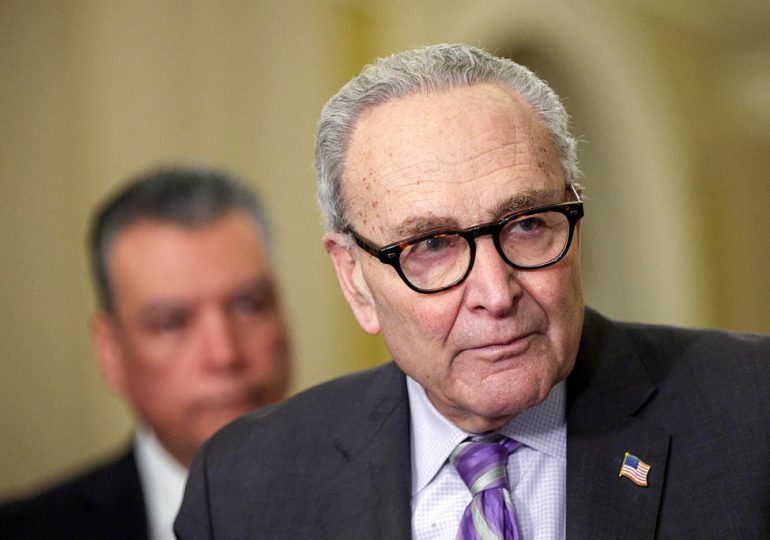
Senate Minority Leader Sen. Chuck Schumer is finding some of his preferred candidates in key Senate races are struggling in their Democratic primaries. —Alex Wong—Getty Images
This article is part of The D.C. Brief, TIME’s politics newsletter. Sign up here to get stories like this sent to your inbox.
Chuck Schumer might have to swallow the bitter pill of backing his haters.
As this year’s Senate map appears to be shifting more in Democrats’ favor, some of the Senate Minority Leader’s preferred candidates are struggling in their primaries. In key states like Maine, Iowa, Michigan, and Minnesota, Democrats may ultimately settle on nominees explicitly running to remove Schumer from leadership. The pragmatic Schumer is making clear that he won’t let his ego override his desire to see Democrats regain control of the chamber, according to conversations with a half dozen party insiders. That means Schumer is prepared to root for—and, if needed, put serious money behind—candidates who have made trashing him part of their messaging.
The savvy New York Democrat has been fairly open with donors in private sessions about his preferred candidates—people in some cases he recruited personally and promised ample resources from the party’s official campaign arm, the Democratic Senatorial Campaign Committee. But Schumer’s roster has faced some unexpected pushback, some of it tied to frustrations with his tenure as party leader dating back to 2017.
To his supporters, he is a New York scrapper. To his detractors, he’s a meddling symbol of Washington’s gerontocracy who has been in power way too long. National polls show there are roughly twice as many in the latter camp; Schumer’s dismal favorable rating has him a more toxic figure than Trump. Even candidates who aren’t calling for Schumer’s replacement are far from wrapping their arms around the party boss.
With sincere indifference to his own fading popularity, Schumer and his orbit are readying for the general election in November, with or without his favored picks on the ballots.
“The DSCC has one goal: to win a Senate majority,” committee spokesperson Maeve Coyle said in a statement to TIME. “We expanded the map and created a path to do that with all-star candidates, a winning message, and stronger campaigns that will power Democrats to victory and continue our long record of overperforming the national environment.”
Put in blunter terms: by any means necessary.
In a way, it’s a lesson learned from another highly polarizing figure who told candidates to say whatever they wanted about her as long as they got to Washington to fight on her side: former House Speaker Nancy Pelosi. She led the House Democrats for two decades.
Senate Democrats in Washington started the year with a pep in their step. They had recruited a tested Governor to challenge Sen. Susan Collins in Maine. A pragmatist wonk was in the mix to replace retiring Sen. Gary Peters in Michigan. A charismatic and centrist paralympian gold medalist was a favorite to be their nominee for the open Iowa seat. A moderate lesbian stepped up to replace a fellow Democrat in Minnesota.
But in each of those four races, things aren’t lining up with Schumer’s initial blueprint. His allies note that the hustle has not stopped despite agita from less-favored candidates calling for new leadership. The eventual nominees may need money his party’s official campaign arm controls. In conversations with party strategists across the political spectrum, all expect the checkbooks will open once the primaries pass.
Unlike the Republican drama on the other side of the aisle, where President Donald Trump is complicating should-be-easy re-election bids with his meddling, Democrats say the open criticism of Schumer matters less than winning. Schumer’s legacy, they predict, could be as the Leader who guided Democrats back to running the Senate for the last two years of Trump’s time in power.
Democrats from the start were facing a tough map this year to retake a majority. They’d have to hold all of their current seats—Georgia, New Hampshire, and Michigan being the biggest worries—and pick up four more seats. That raw math put places like Alaska, Maine, North Carolina, and Ohio at the fore of their push. All were top priorities for Schumer.
It was entirely doable, Democratic strategists told me then. It still is today, they maintain. But the harsh truth is the party machinery cannot stage-manage the in-state primaries from afar. It’s gotten to the point where major players—including those close to Schumer—are acknowledging that the safer, more-electable candidates might not be able to compete with the base’s affection for more ideological fighters.
Platner vs. Mills in Maine
The biggest schism in the party is arguably playing out in Maine, where Sen. Susan Collins, a perpetual target for Democrats, is seeking a fifth term. Schumer landed his dream recruit in Gov. Janet Mills, now 78 and potentially the oldest first-term Senator in history. Progressives, including Sen. Elizabeth Warren, had other ideas and are backing Graham Platner, a 41-year-old harbormaster who served three tours as a Marine in Iraq and one in Afghanistan. Platner vs. Mills has emerged as an emotional, high-stakes proxy fight that we’re going to see a lot in this column.
Platner has landed himself in trouble for social-media crassness and a tattoo on his chest of a symbol of Hitler’s paramilitary police that was responsible for the systematic murders of millions of Jews and others in Europe during World War II. (Platner has since tattooed over his original ink.)
His skeptics—including Mills, whose first negative ad includes an image of the Nazi-linked tattoo—say polls showing Platner ahead were taken before Mills started her ad campaign, and note that polling in Maine is notoriously tough. (Collins won by 9 points six years ago despite every single poll leading into Election Day showing her down between 1 and 12 points.)
Even so, Platner is acting like the June 9 primary has already been decided. His team is telling donors—and potential donors—that he is pivoting now, rather than waste these next two months focused on Mills, Axios scooped. Washington Democrats who still have deep issues with Platner might have deeper lust for a majority. Plus, the unions are urging Schumer to drop his backing of Mills, or at least be open to Platner, according to one labor official privy to the talks.
Platner has been far from circumspect about his views on Schumer: “The next Leader needs to be one of vision and also somebody who is willing to fight,” he told Politico. “And I am not seeing either of those things coming out of the current Democratic Leadership in the Senate.”
Michigan, Iowa and Minnesota
In Michigan, it’s not much more welcoming for Schumer, where he and his allies seem to be tamping down their promotion of Rep. Haley Stevens, a 42-year-old technocrat who works with the moderate New Deal Democrats. It is a three-way race that has seen Schumer quietly signal that he would be OK with 39-year-old state Senator Mallory McMorrow but has yet to reach the same level of confidence when it comes to former public health official Abdul El-Sayed, a 41-year-old progressive, according to a person who has sat in these fundraisers. Polling there is a mixed bag but McMorrow seems to be threading the needle between Stevens and El-Sayed and could prevail in a state that last time elected Trump to the White House and a Democrat to the other Senate seat on the same ballot.
McMorrow has made no secret of her desire for Democrats to try something new and is running with—you guessed it—backing from progressives in Washington. “Chuck Schumer has dedicated his life to public service and fought a lot of really great fights, and it can be time to step back. And those things are not mutually exclusive,” she said.
Iowa was not on an initial list of targets but came online last summer when Sen. Joni Ernst announced she was retiring. That put another three-time-Trump state in play for Democrats. Schumer allies quietly worked to winnow the field and deliver the nomination to Josh Turek, a 46-year-old Gold Medalist in wheelchair basketball. But state Senator Zach Wahls is still on the ballots and spoiling for a fight. In fact, Wahls is enjoying durable polling; much like Maine, it’s not clear opposition research on Wahl’s social media posts have moved the needle against the 34-year-old activist. He and Turek fought to a draw last quarter on fundraising but VoteVets, a veterans super PAC, is now on the scene with ads for Turek, who did not serve but he was born with spina bifida after his father was exposed to Agent Orange in Vietnam.
Wahls, too, is no fan of Schumer: “I think it is clear as day that it is time for him to step down and make way for a new generation of leaders.”
In Minnesota, the debate is more about what kind of Democrat will fill the seat being vacated by Sen. Tina Smith than if a Democrat will prevail. Neither national party nor their partner super PACs expect Republicans to be able to flip the seat this year. But the Democratic primary has put Rep. Angie Craig on a collision course with Lieutenant Governor Peggy Flanagan in a pretty clear microcosm of the Democrats’ perpetual identity crisis. It’s taken as gospel these days that Craig was Schumer’s recruit, a hard-nosed mom and St. Jude Medical administrator. It’s also taken with the same truth that Flanagan—who, you’ll sense a pattern here, has picked up endorsements from the likes of Warren and Bernie Sanders—is not likely to back Schumer’s bid to hold the Leader title.
Even as anti-Schumer Democrats gain ground in so many key states, the hyper-competitive Schumer is keeping his eye on the larger scoreboard, understanding that which party controls the Senate will ultimately decide how this year is written about in the history books.
A Democratic Senate could stymie Trump’s legislative agenda for his final two years in office, launch aggressive oversight of his first six, and rebalance Washington—especially if there is a Supreme Court vacancy.
If it’s a choice between a bruised ego or a roadblock for Trump, Schumer is not going to waste his time giving it a second thought.
Make sense of what matters in Washington. Sign up for the D.C. Brief newsletter.
Leave a comment