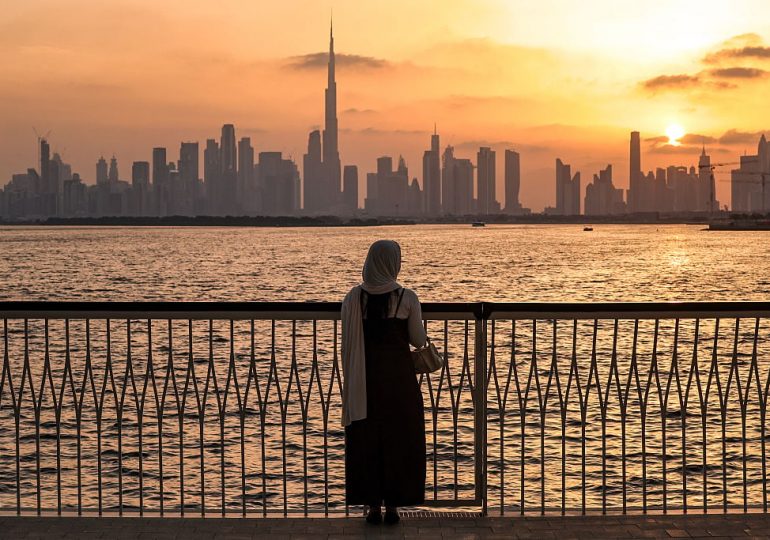
A woman looks at the Dubai skyline from Creek Harbour, Dubai on April 3, 2026. —FADEL SENNA–AFP via Getty Images
The images from Dubai on the night of Feb. 28, the first night of the war in the Gulf, were almost surreal in their juxtaposition: missiles streaking across the sky above Palm Jumeirah, intercepted in flashes of light, while in the beach clubs below, some residents stood frozen by their windows, cocktails in hand, watching the pyrotechnics. By morning, smoke was rising from the Burj Al Arab, the billowing, sail-shaped hotel that is to Dubai what the Eiffel Tower is to Paris, and from Dubai International Airport, one of the world’s busiest.
The war Dubai had spent four decades doing everything in its power to avoid had arrived, and had struck its most iconic addresses. Iran’s assault on the Gulf Arab states—more than 500 missiles and more than 2,000 drones—fired at civilian infrastructure and military installations in the United Arab Emirates alone since that first night was an act of retaliation, a military strategy, and a message to the United States.
The attack on Dubai, specifically, can also be seen as a direct assault on an idea. The glitziest of the seven emirates that make up the UAE, Dubai had for years sold the world a proposition: that in one of the most volatile regions on earth, it was a place apart, built on the soft power of attraction. Iran had struck at that proposition with a demonstration of raw, hard power.
What Dubai built
Is the Dubai dream broken? I would argue that it is not. To understand whether Dubai will survive this war and thrive again requires understanding what was built, and what was damaged. Dubai is the most deliberately constructed soft power city in modern history: a place that converted economic abundance into cultural and reputational attraction at a pace no previous city has matched. Iran’s missiles certainly damaged that construction, but they did not destroy it. What distinguishes Dubai from every city that has faced this test before is that it possesses both kinds of power—the soft power of attraction and the hard power of money—in extraordinary quantity. The combination, deployed by rulers who have spent four decades proving they know how to use it, changes the recovery calculus entirely.
The political scientist Joseph Nye, who introduced the concept of soft power, defined “the ability to affect others to obtain the outcomes one wants through attraction and persuasion rather than coercion or payment.” He argued that the most resilient states are those that combine both forms of power—what he called “smart power.” Dubai is that kind of city. Its soft power is real and layered: the cultural infrastructure of Art Dubai and the Museum of the Future, the Michelin-starred restaurants, the opera house, the galleries of Alserkal Avenue, the world-class sporting events and literary festivals. Dubai has the ecosystem of a cosmopolitan capital. You can argue, and many do, about how much of it is authentically Emirati. You can’t deny that it is real.
There is less debate about its economic and commercial attractions: zero personal income tax, a Golden Visa system that offers a 10-year residency to investors and skilled professionals, and a regulatory framework engineered to say yes where others say wait. Iran’s missiles struck a city armored with all of it. That matters enormously for what comes next.
It would be dishonest to minimize the damage. The strikes on Dubai’s most recognizable landmarks were not incidental. As Cinzia Bianco, a Persian Gulf expert at the European Council on Foreign Relations, put it: “This is Dubai’s ultimate nightmare as its very essence depended on being a safe oasis in a troubled region.” The financial district emptied. Goldman Sachs, Citi, and Standard Chartered ordered staff to work from home. The iconic ICD Brookfield tower in the Dubai International Finance Center— home to BlackRock, JPMorgan, and Bank of America — stood largely empty for days. The Dubai Financial Market benchmark fell 16%, wiping out around $120 billion from UAE listed stocks. Hotel bookings collapsed by 60% within 48 hours of the first strikes. The US State Department raised its travel advisory for the UAE to Level 3.
Jim Krane, an energy policy and geopolitics expert at Rice University’s Baker Institute, captured the structural danger in an interview with CNBC: “Dubai’s economic model is based on expatriate residents providing the brains, brawn, and investment capital. You need stability and security to bring in smart foreigners.” The reputational damage is the deepest wound, and the one that will take longest to heal. The Wall Street Journal described the strikes as having “punctured the notion that towering skyscrapers, financial clout and the embrace of luxury and diversity in the Persian Gulf can act as impenetrable shields against the region’s turmoil.”
And yet. And yet.
The physical damage, while alarming in its symbolism, is of a categorically different order from what has broken—and failed to break—great cities before. History of great cities and wars is instructive here. Tokyo was firebombed into ash. Berlin was almost entirely destroyed by air strikes. London endured 57 consecutive nights of bombing during the Blitz and emerged battered but unbowed. Bombs, history insists, do not kill great cities. Measured against what those cities absorbed and survived, Dubai has suffered barely a scratch.
Even Kuwait, with which comparisons are inevitably drawn, endured far worse at Saddam Hussein’s hands: seven months of occupation, more than 600 oil wells torched, its institutions looted and dismantled. And yet Kuwait City recovered, and quickly. Here is the remarkable part: Kuwait came back on the strength of a single asset, oil. It had no meaningful cultural economy, no serious aspiration to serve as the world’s crossroads, no magnetic proposition for global talent beyond its hydrocarbon revenues. In soft power terms, it was barely armed.
Why Dubai will thrive
Dubai has considerably more financial firepower than Kuwait, along with everything Kuwait never had and never tried to build. What should we expect of the most elaborately constructed cosmopolitan hub of the modern era? The answer lies in Dubai’s soft power of attraction, its hard power of money, and in understanding what the missiles did and did not destroy.
Dubai’s rulers possess resources that no war-damaged city in history has had. The evidence of their deployment is already visible: within weeks of the first strikes, Sheikh Hamdan bin Mohammed approved an economic package of one billion dirhams—roughly $272 million—to stabilize the hospitality and tourism sectors. Emirates airline was flying to 125 of its usual destinations within days of restarting operations. We don’t yet have an assessment of the physical damage wrought by Iran’s missiles, but rebuilding is unlikely to be a major drain on Dubai’s coffers. At the start of the year, its sovereign wealth fund had assets of $430 billion under management.
Dubai’s soft power is more durable than the headlines suggest. Zero income tax: intact. The Golden Visa system: intact. The regulatory framework, the free zones, the geographic centrality—a third of the world’s population within four hours’ flight—all intact. Art Dubai, the Museum of the Future, Alserkal Avenue: intact. The cosmopolitan ambition that draws artists, musicians, chefs, and writers from across the Global South to a city that funds and welcomes them: intact. Most of what made Dubai magnetic on Feb. 27, the day before this war began, remains magnetic, or will quickly become so again.
Western commentary has consistently underestimated a dimension of Dubai’s soft power. The city’s gravitational pull operates differently, and more powerfully, for the billions in the Global South than for the few Western expatriates who fled at the first missile alert. The World Bank estimates that remittances from the UAE to India, Pakistan, and the Philippines alone reached $47.5 billion in 2024. That figure is the cold arithmetic of economic gravity. After a Bangladeshi driver was killed by missile debris, his brother described the idea of returning to Dubai— especially as the conflict continued—as “unbearable” but added, “But Dubai is the only place we know how to earn.”
For these communities—and for the African tech founders, the South Asian engineers, the Egyptian entrepreneurs who have made Dubai their base—the alternative looks nothing like it does from London or New York. Western cities are expensive and increasingly hostile to outsiders. The great cities of East Asia—Tokyo, Seoul, Shanghai—present formidable barriers of language, taxation, and visa regulation. The competition in the wider Gulf suffered identical anxieties during the same strikes and offers less soft power to compensate. As the Lebanese tech founder Mirna Mneimne, who divides her time between Beirut and Dubai, told Rest of World: “I have lived most of my life in a war zone. Dubai was and still is the safest place I have ever lived in.”
Intellectual honesty requires acknowledging the one variable that neither hard nor soft power can fully resolve. Justin Alexander, director of Khalij Economics, frames the key uncertainty thus: “If there’s a comprehensive peace agreement or a recognition that the cost of the war was so high that it will never be repeated, I’d expect Dubai’s economy to rebound strongly.” But, he told the Arabian Business Gulf Insight, an inconclusive ending—a ceasefire that leaves the threat latent and the possibility of resumption alive—would be more damaging than a longer war that ends decisively.
Great cities have always recovered from hard power assault on their soft power foundations. But they recover over time, and time requires peace—or at minimum the confident absence of resumed hostilities. Dubai’s double arsenal is formidable. It works over time. The timetable—two years, five years—will depend in equal measure on what Dubai’s rulers do and on circumstances beyond their control. The current ceasefire is fragile. The uncertainty is real, and it would be foolish to paper over it.
Iran did not choose its targets randomly. It struck the airport because that is Dubai’s circulatory system—the infrastructure through which its cosmopolitan proposition flows. It struck the Burj Al Arab because it is Dubai’s calling card to the world, the image that has decorated a thousand magazine covers and a million Instagram posts. It struck the financial district because that is where Dubai’s proposition converts into global capital. In targeting the symbols of Dubai’s soft power, Iran confirmed their significance.
And the global response confirmed it further. The anxious commentary, the breathless headlines asking whether the Dubai dream is over, the analysts debating the fate of the safe-haven brand are a measure of what was built. A city nobody valued would generate no such alarm. The attention is itself evidence of the soft power accumulated. You do not mourn the loss of something that did not matter.
Great cities endure because they have accumulated — or, in Dubai’s remarkable case, deliberately constructed — the reserves of attraction that outlast the damage of any particular conflict. Dubai will abide.
Leave a comment