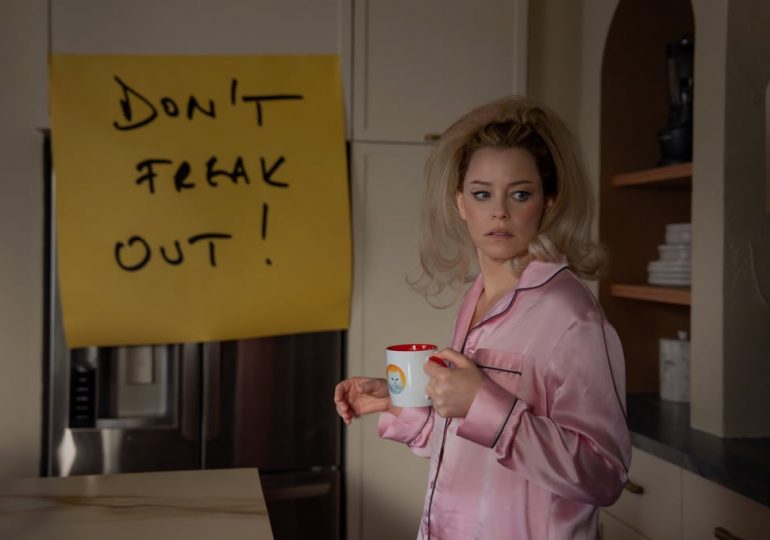
Elizabeth Banks —Courtesy of Peacock
Warning: This post contains spoilers for The Miniature Wife.
“What drives a man to such generosity and compassion towards science and yet such selfish heartlessness towards his wife?” ponders a character in the new Peacock show The Miniature Wife, starring Elizabeth Banks and Matthew McFadyen. The line could easily be the thesis statement of Manuel Gonzales’ short story “The Miniature Wife,” on which the series is based. The 2013 story follows a brilliant scientist who tests his miniaturization technology on his wife, who is understandably incensed to be shrunk and thus uses tiny household implements to pay her husband back. But that’s pretty much where her story begins and ends. We don’t get a sense of her personality or desires. We don’t even know her name.
This proved ripe inspiration for the screenwriting duo Jennifer Ames and Steve Turner, who previously worked together on shows like Boardwalk Empire and Goliath.
“What really got me interested was that [Gonzales has] written it only from the husband’s perspective. The wife that he miniaturizes has no name. He knows nothing about her [even though they’re] married,” says Ames.
Here, The Miniature Wife showrunners break down what happens in the series.
The miniature wife’s “too muchness”
When Banks was cast as the titular miniature wife, Ames and Turner knew they had to write a character worthy of the actor. They came up with Lindy Littlejohn, an author who won the Pulitzer Prize with her autofiction debut several decades earlier and hasn’t really done much since. She and her husband, scientist Les Littlejohn (McFadyen), have an agreement that they take turns chasing career success. It just so happens that Lindy reached the pinnacle of her field early in their relationship while Les has been toiling away for the past twenty years at a miniaturization formula that has the potential to change agriculture and food systems.
“I do think they have this very competitive edge with each other which fuels drive and ambition and support, but that can get away from you very quickly,” Ames says. “They want their partner to do well, but maybe not better than them. I see that in a lot of couples as a drive, but it could run you right off the road and into a tree.”
What Lindy lacks in creative fulfillment and literary output, she makes up for in the too muchness of her personality. When we meet her, she’s a dissatisfied writing professor having an affair with her husband’s colleague, Richard (O-T Fagbenel, wonderfully playing against type as a bumbling, needy nerd), and passing off her students’ work as her own. Though she’ll later have to shout to be heard in her miniaturized form, before that Lindy’s loudness is a clear overcompensation for her scant personal and professional life.
“Who hasn’t felt small in a relationship?” asks Ames. “As confident and strong as she may appear, there is an insecurity or what she would think of as a weakness.”
Elizabeth Banks
The square–cubed law
The series takes place around the holidays, and Les and Lindy are at a precipice in their relationship. They’ve been seeing a couples therapist, and ultimately decide to recommit to one another by renewing their vows on their anniversary, New Years Eve. But after a rich tech investor, Hilton (Ronny Chieng), wants to fund Les’ miniaturization technology (and, we later find out, use it for privatized military operations, because of course), requiring Les to work through the New Year and blow off their vow renewal, they have a massive fight in which Les accidentally-but-on purpose miniaturizes Lindy.
“The quantum physics of it turned out to have a very interesting metaphor in the square–cubed law because as you get smaller you get stronger,” Turner says. “That’s how ants can pick up things [so much larger than them]. This woman has to get smaller in order to find her strength again, which was such a fun metaphor to play with.”
Control as a love language
There’s an abuse allegory in The Miniature Wife for those who care to see it. Though Ames and Turner see Lindy and Les as “soulmates” and they do reconcile, Les’ behavior is illustrative of coercive control. In episode 2, Les locks Lindy in the dollhouse “for her own protection” and in episode 7 Les angrily almost flushes Lindy down the toilet. Lindy gives as good as she gets, bringing in elements from the original short story in which she goes full Home Alone on Les, a movie which Ames says was an inspiration, along with War of the Roses, Big, and Romancing the Stone.
It’s revealed that Les shrunk Lindy on purpose, wanting to bring her down to size. “She was going to leave me,” Les justifies. “It was an accident.” How many times have those words left an abuser’s mouth?
“Control is his love language,” Richard says of Les at one point, which is echoed by Ames in our interview: “I feel like they might have stumbled upon a love language. There is this understanding that they’re going to have to take a look at what that balance actually is.”
Ultimately, Ames and Turner “do believe, foundationally, that their relationship was built on love, [but] they need a big emotional reset. There’s your miniaturization!” says Ames. “We do like to say that miniaturization might be better than couples therapy.”
Matthew McFadyen and Elizabeth Banks
Reclaiming The Miniature Wife
That’s a hypothesis that is supported by the experiment that is The Miniature Wife. Lindy and Les end the season as they began it: plagued with issues, to be sure, but a united front. Les succeeded in miniaturizing Lindy and himself and making them big again without exploding them in the process, so now it’s Lindy’s turn again, right? And she has the perfect idea for a follow up autofiction: The Miniature Wife, claiming back the narrative from Gonzales’ unnamed character.
“It’s something that we thought of very early on and that we were writing towards,” says Ames. “If we are lucky enough to get a second season, what if she had the ammunition from this experience to write about that. Then what?”
Leave a comment