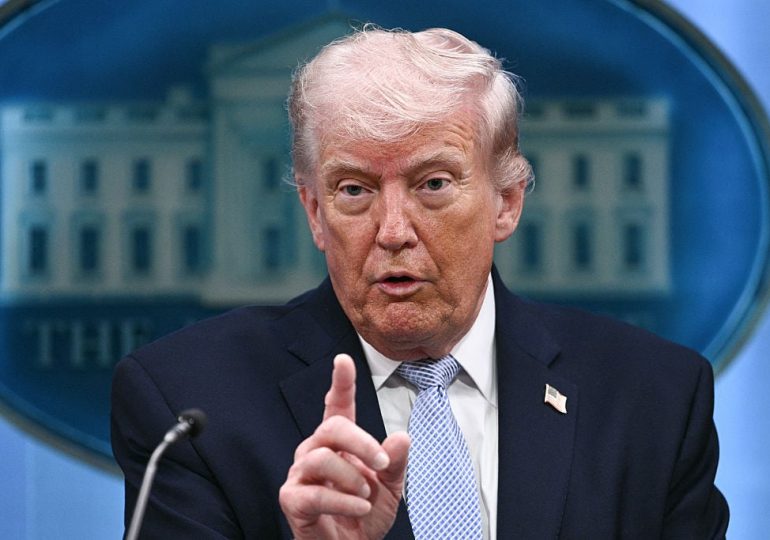
U.S. President Donald Trump speaks about the conflict in Iran in the Press Briefing Room of the White House on April 6, 2026. —Brendan Smialowski—Getty Images
President Donald Trump warned of attacks that would be “bigger, better, and stronger than anyone has ever seen before” if Iran does not comply with what he described as the “real agreement” tied to the cease-fire.
“All U.S. ships, aircraft, and military personnel, with additional ammunition, weaponry, and anything else that is appropriate and necessary for the lethal prosecution and destruction of an already substantially degraded enemy will remain in place in, and around, Iran, until such time as the real agreement reached is fully complied with,” he said.
Trump argued that “contrary” to other rhetoric, “it was agreed, a long time ago” there would be “no nuclear weapons” and the Strait of Hormuz would be “open and safe.” In the meantime, he added, the U.S. military “is loading up and resting, looking forward, actually, to its next conquest.”
While the exact details of the “real agreement” have not been made public, Iranian parliament speaker Mohammad Bagher Ghalibaf said Wednesday that Iran’s right to enrich uranium is a key element of its own 10-point proposal.
Trump previously described a 10-point proposal from Iran as a “workable basis in which to negotiate,” though it remains unclear which exact version he was referencing.
Mohammad Eslami, head of Iran’s Atomic Energy Organization, reportedly said Thursday that protecting Tehran’s right to enrich uranium is “necessary” for any cease-fire discussions.
White House press secretary Karoline Leavitt described enrichment as a “red line that the President is not going to back away from.”
It will no doubt be a core focus when U.S. negotiators, led by Vice President J.D. Vance and including Trump’s son in law Jared Kushner and Middle East envoy Steve Witkoff, meet with Iranian officials in Islamabad, Pakistan, on Saturday.
The latest warning from the U.S. President comes as the fragile two-week cease-fire, reached shortly before Trump’s deadline on April 7, comes under threat amid tension over the Strait of Hormuz and concerns over Israel’s strikes against the Hezbollah militant group in Lebanon.
Strait of Hormuz disagreements central to instability
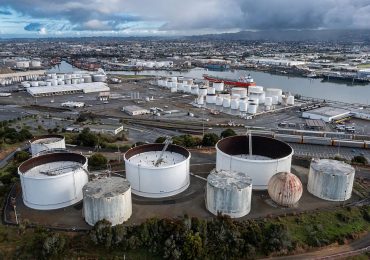
Disagreements over the Strait of Hormuz, the vital passage between the Persian Gulf and the Gulf of Oman through which roughly a fifth of global oil supply flows, remain a major obstacle.
Under Iran’s proposal, Tehran would maintain control over the Strait, which it has used as a bargaining chip during the conflict to disrupt energy markets and pressure the U.S. and its allies.
The White House on Wednesday disputed reports that Iran had closed the Strait just hours into the cease-fire in response to Israel’s strikes against Hezbollah. But Leavitt also insisted that any Iranian threat to naval navigation would be “completely unacceptable.”
She reiterated Trump’s “expectation and demand that the Strait of Hormuz is reopened immediately, quickly, and safely.”
Trump previously suggested that the U.S. and Iran should jointly charge tolls for passage through the Strait. During Wednesday’s briefing, Leavitt said it was an idea the President has “floated,” but that he ultimately wants the sea route open “without any limitations, like tolls or otherwise.”
On Thursday morning, Iranian state media published a chart suggesting that the Islamic Revolutionary Guard Corps had deployed sea mines in the Strait during the war, and that safe passage would require coordination with the IRGC to “avoid possible collisions with naval mines.”
The effective closure of the Strait has driven up energy prices and unsettled global markets, with volatility expected to continue as unrestricted navigation remains uncertain.
Israeli strikes in Lebanon continue as death toll rises
Israel on Wednesday carried out its heaviest strikes in southern Lebanon since the Iran war began. The IDF said it targeted more than 100 of what it referred to as Hezbollah command centres and military sites.
Lebanon’s Health Minister said Thursday morning that the death toll from the strikes on Wednesday has climbed to 203 people, with over 1,000 injured.
Iranian President Masoud Pezeshkian argued Israel’s attacks on Lebanon are a “blatant violation of the initial cease-fire agreement.”
“This is a dangerous sign of deception and lack of commitment to potential agreements. The continuation of these actions will render negotiations meaningless,” he said, signaling a potential rupture.
However, there continues to be a dispute as to whether or not Lebanon was included in the U.S.-Iran cease-fire.
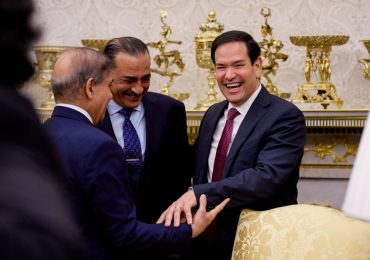
Pakistan’s Prime Minister Shehbaz Sharif and Iranian officials have indicated Lebanon was factored into the agreement, but the U.S. and Israel say otherwise.
“Lebanon is not part of the cease-fire. That has been relayed to all parties involved in the cease-fire,” Leavitt said.
Vice President J.D. Vance said the U.S. never agreed that the cease-fire would cover Lebanon and he thinks it was a “legitimate misunderstanding” of the Iranian officials who thought it did.
Iran’s Deputy Foreign Minister Saeed Khatibzadeh has maintained that Israel’s strikes on Lebanon constitute a “grave violation” of the cease-fire.
He told the BBC that Iran will “provide security for safe passage” through the Strait of Hormuz, but said reopening would only come “after the United States actually withdraws this aggression,” referring to Israel’s operations in Lebanon.
Ghalibaf has also insisted that Lebanon forms “an inseparable part of the cease-fire.”
The continued escalation has drawn criticism among European leadership.
Kaja Kallas, the European Union’s foreign policy chief, said Thursday: “Hezbollah dragged Lebanon into the war, but Israel’s right to defend itself does not justify inflicting such massive destruction. Israeli actions are putting the U.S.-Iran ceasefire under severe strain.”
Leaders from Germany, Canada, the U.K., France, Italy, Spain, Denmark, the Netherlands, the European Union, and Japan have also indicated support for the cease-fire to include Lebanon.
Leave a comment