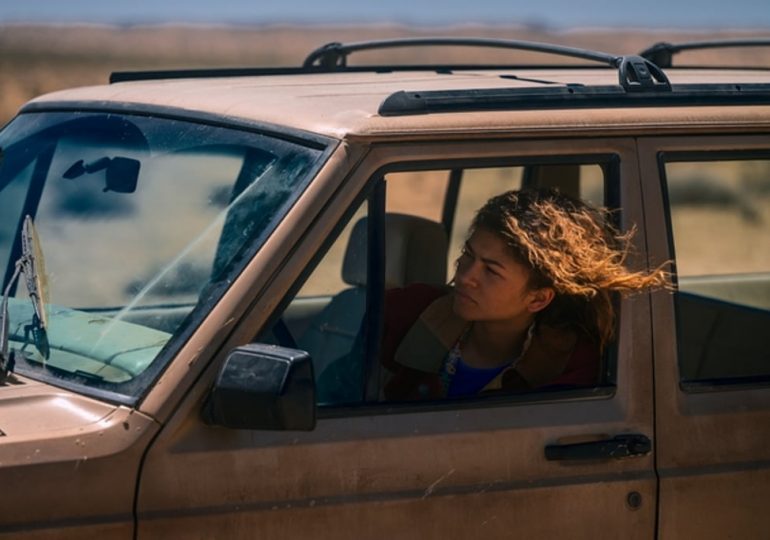
Zendaya in Euphoria Season 3 —Patrick Wymore—HBO
Telling stories that appeal to teenagers does not require a worldview arrested in adolescence. In fact, if you can’t filter the hormone-soaked mess of youth through the sieve of experience, you probably aren’t offering the next generation anything that hasn’t already occurred to them. I am convinced that this is the core problem with the work of Sam Levinson, the 41-year-old creator of such self-consciously edgy spectacles of Gen Z sex, drugs, violence, glamour, and angst as Assassination Nation, The Idol, and most successfully Euphoria. On April 12, the latter teen drama will return to HBO for its third and presumably final season, more than four years after the Season 2 finale, reuniting a cast that now includes some of Hollywood’s biggest stars under 30. A time jump reintroduces the characters five years later, as they try on roles in the show’s surreal approximation of the adult world—a premise that might exceed Levinson’s capacity for maturity.
Considering that a full college education’s worth of time has passed since we last saw Euphoria’s menagerie of Southern California high schoolers, a brief summary might be helpful. The series is narrated by Zendaya’s Rue Bennett, a depressive drug addict who exists at an emotional remove from her classmates, with the exception of new girl in town Jules (Hunter Schafer), an introspective, trans artist who might be Rue’s one true love. A mean-girl clique is led by ambitious alpha Maddy (Alexa Demie); her minion Cassie (Sydney Sweeney) has a bad reputation and poorly regulated emotions. There was drama in Season 2 around Maddy’s on-again, off-again boyfriend, Nate (Jacob Elordi)—an arrogant, abusive, all-around terrible jock—hooking up with Cassie. The season’s final few episodes featured an explosive, Hamlet-lite metafictional high school play by Cassie’s reserved younger sister, Lexi (Maude Apatow), that forced everyone to confront the monsters they’d become. That same night, Rue’s dealer friend Fezco (the late Angus Cloud) lost his surrogate brother Ashtray (Javon Walton) in a harrowing SWAT team raid. In other law enforcement news, Nate’s dad, Cal (Eric Dane, who filmed the new season before dying of ALS in February), was arrested after years of sex crimes.
The cast of Euphoria Season 2’s play-within-a-show takes a bow —Eddy Chen—HBO
You’d think that these events would have prompted some serious introspection on the part of the characters, but as we revisit them in the first few episodes of Season 3, it’s clear everyone has reverted to their factory settings. The difference is that, as they fan out on separate quests, each storyline comes slathered in the tropes of its own familiar genre. Maddy and Lexi are essentially in Industry, if said industry were entertainment. (Lexi’s job on a prime-time soap with a girlbossy showrunner played by Sharon Stone threatens to burden us with the TV version of the shallow music-business satire we had to endure in The Idol.) Nate and Cassie are engaged, living the kind of kitschy, midcentury, upper-middle-class, Barbie-and-Ken suburban nightmare that masquerades as a dream come true. She is, predictably, a tradwife in training, dressing up in sexy-puppy costumes to make poolside social media content that she hopes will finance the lavish wedding she’s been planning. He has followed Cal into real-estate development. “I am in the real world, making deals,” Nate proclaims to Cassie, in dialogue that could have been scripted by AI. What he doesn’t say is that he’s out of his depth and burning money.
Rue inhabits the most distinctive and, in some ways, surprising genre of all: a widescreen western, complete with expansive desert exteriors and a Hans Zimmer score that immediately calls to mind the work of Ennio Morricone. Especially compared to the murk, dinge, and gutter glitter of past seasons, it feels like the dawn of a new day. Rue is not exactly going straight and choosing life, though. A few years after graduation, Laurie (Martha Kelly), the monotone teacher turned dealer to whom she owed $10,000 at the end of Season 2 called in that loan, with exorbitant interest, forcing her to become a drug mule. Levinson treats us, in the premiere, to a long sequence in which Rue and her old buddy Faye (Chloe Cherry) choke down powder-filled balloons dipped in K-Y Jelly and suffer graphic gastrointestinal consequences. A quick study, Rue soon levels up to high-octane border crossings; one portentous scene has her jalopy teetering atop the infamous wall that separates the U.S. and Mexico. Euphoria doesn’t usually traffic in such explicit political symbolism. But, true to the show’s fixation on inner turmoil, the obstacle ultimately says more about Rue’s liminal existence than it does about immigration.
Sydney Sweeney in Euphoria Season 3 —Patrick Wymore—HBO
So does a subsequent scene in which she’s briefly taken in by a family of xenophobic, fundamentalist Texas homesteaders and finds herself drawn to their isolated, godly, technology-free lifestyle. (Their open hatred of immigrants doesn’t seem to bother her much.) Once again, Rue is out of step with her peers. As they chase conventional success through conventional means—hard work, marriage, macho posturing, TikTok—she sets off on a path to spiritual fulfillment, parsing the Bible’s anti-gay content with her sponsor, Ali (Colman Domingo). “War ain’t the time for butt sex,” he says, by way of explaining why it might’ve cautioned early believers against homosexuality. She starts digging into the Good Book herself, via audiobook. It seems she’s really searching for freedom and purpose; hence the wide-open-spaces, go-west-young-woman motif. None of this can happen while she’s literally indentured to Laurie.
Levinson, who has written every episode of the series and directed almost as many, has said the season honors Cloud, who died of an accidental overdose in 2023, and meditates on the third of Alcoholics Anonymous’ 12 steps: “Made a decision to turn our will and our lives over to the care of God as we understood Him.” I have no reason to doubt the sincerity of his tribute. (Nor do I have reason to doubt the disturbing behind-the-scenes reports from some of his sets, which he has disputed.) Rue’s foray into religion is certainly a literal enough manifestation of the theme, and the emptiness of her former classmates’ pursuits creates an explicit contrast.
Zendaya in Euphoria Season 3 —Patrick Wymore—HBO
Yet in the three episodes HBO provided for review—episodes whose technical elements can be stunning and manipulation of genre conventions canny—Levinson does nothing to deepen his antihero’s search for meaning. Instead, there are platitudes about money and power recycled from gangster movies and tableaux of debauched ennui that recall the songs his Idol collaborator the Weeknd wrote when he was younger than Euphoria’s characters are now. The women almost all do some form of sex work, allowing the show to imply its anticapitalist cliché that all wage labor is prostitution and drool over T&A, too. In a first season that emerged at a more progressive moment for pop culture, it took an equal-opportunity approach to exploitation. Now that sexism is in again, its default to the hetero male gaze is unmistakable. “I’m basically a dude,” says Rue, who is queer, at one point, encapsulating how Levinson seems to think about the sole woman in the show who isn’t constantly objectified. In fairness, rapacious male characters like Nate and Cal are cast in an even more negative, gender-essentialist light. But so little is communicated through either set of stereotypes that they constitute repetition more than critique.
Euphoria has always been uneven. At its best, though, it embodied teenage fluidity. Levinson got that the selves we build at that age can oscillate between extreme possibilities—an Ivy-bound class president can moonlight as a coke dealer but still sleep cozily in their parents’ McMansion—and are co-created with the people and pop-cultural talismans that mean the most to us. He counterbalanced the cynicism of bored kids consciously restaging three generations’ worth of angsty teen dramas with the genuinely moving storyline of Rue and Jules searching for purity in a relationship that grows out of new kinds of identity. But the Jules we meet, belatedly, in Season 3 lacks the interiority and self-possession she once had. Formerly suspended between My So-Called Life and Drugstore Cowboy, spinning towards oblivion but tethered to school, family, and Jules (or longing for her), Rue has now embarked upon a generic gangster come-up. God might be her conscience and co-pilot, but it’s hard to shake the suspicion that He’s there as a lofty placeholder for insight into adulthood Levinson just doesn’t have.
Leave a comment