
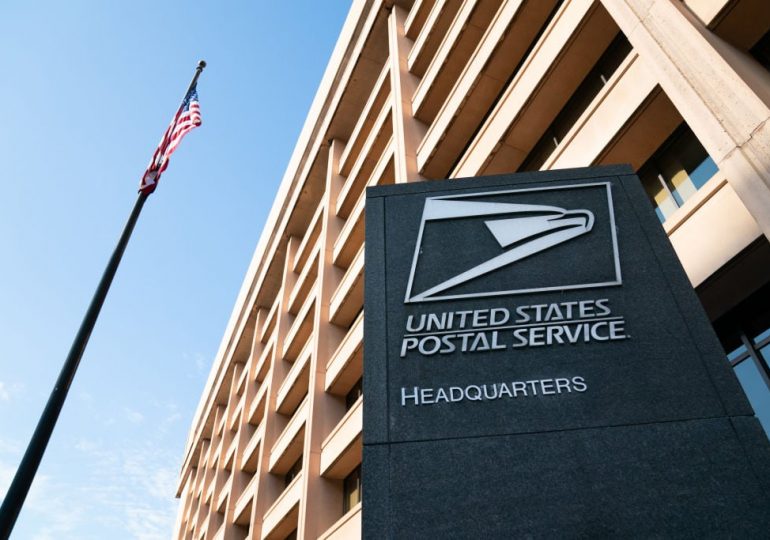
An American flag flies above signage outside U.S. Postal Service headquarters in Washington, D.C., on Aug. 17, 2020. —Erin Scott—Bloomberg/Getty Images
The U.S. Postal Service announced on Thursday that it’s pausing its payments to a federal pension plan and moving to increase stamp prices in the midst of its “severe financial crisis.”
USPS said that it has informed federal budget officials of its plan to temporarily halt its employer contributions for the defined benefit portion of the Federal Employees Retirement System (FERS). That same day, the Postal Service also said it filed notice with regulators to raise postage rates, including increasing the price of a First-Class Mail Forever stamp by 4 cents.
The agency attributed both changes to the financial challenges it’s currently facing. Last month, Postmaster General David Steiner said that, if no significant changes are made, USPS is set to run out of cash in 2027.
Here’s what to know about the Postal Service’s announced changes and its ongoing financial crisis.
What changes is USPS making to its pension contributions?
The Postal Service said it will be temporarily suspending its employer contributions for the defined benefit portion of FERS, a retirement plan for USPS workers and other federal government staffers, “to conserve cash and preserve liquidity due to its ongoing, severe financial crisis.” A defined benefit plan is a retirement plan that provides fixed, monthly payments to an employee once they retire, the amount of which are determined by a formula based on various factors, including the employee’s salary and the number of years they worked.
“There will not be any immediate detrimental impact to our current or future retirees if normal FERS cost payments are temporarily withheld,” Postal Service Chief Financial Officer Luke Grossmann said in a statement. “The risk to the Postal Service and the American public from insufficient liquidity for postal operations dramatically outweighs any longer-term risk to the pension funds from not making the currently due payments.”
The change, effective Friday, will allow the agency to save approximately $2.5 billion in this current fiscal year, the Postal Service said. USPS said that it will continue transmitting employees’ contributions to FERS and sending employer automatic and matching contributions, as well as employee contributions, to the Thrift Savings Plan, another government retirement plan for federal employees.
The president of the National Association of Letter Carriers, Brian Renfroe, said in a statement on Thursday that the Postal Service’s decision “is necessitated” by the agency’s financial challenges “and is a direct result of continued inaction by Congress to fix the legislative constraints that inhibit the Postal Service’s ability to invest in its infrastructure and modernize to meet the needs of its employees and the American people.”
What changes is USPS making to postage rates?
The proposed postage rate changes, which still have to be approved by regulators, would raise mailing services product prices by about 4.8%. That means the price of First-Class Mail Forever stamps would increase from 78 cents to 82 cents, and international postcards from $1.70 to $1.75, among other proposed rate increases.
The new rates would go into effect on July 12, according to USPS.
The Postal Service said that the additional-ounce price for single-piece letters will continue to be 29 cents.
“In the midst of the severe financial crisis facing the Postal Service and continued rising operational costs, the Postal Service is using all available tools, including available regulatory pricing authority, to ensure we can continue to fulfill our universal service obligation and serve the American public,” USPS said in a statement.
“The Postal Service generally receives no tax dollars for operating expenses and relies on the sale of postage, products and services to fund its operations,” it continued. “Notwithstanding the adjustment, the Postal Service’s mailing prices remain among the most affordable in the world.”
Steiner previously indicated that USPS was eying an even larger jump in prices, telling lawmakers in a written statement last month that the agency was considering raising the price of a First-Class Forever stamp to as high as 95 cents, a 17-cent increase from the current price. He noted, though, that that price would still be much lower than stamp prices found in many other nations.
Why is USPS in a financial crisis?
Steiner outlined the severity of the Postal Service’s financial woes in his written statement that was shared ahead of him testifying before members of Congress in March.
“I am not sure that the American public is aware that the Postal Service is at a critical juncture,” he said. “I know that I wasn’t aware of the extent of it before I took on this role, but at our current run rate and if we continue to pay our required obligations in the same manner as we have done in recent years, then we will be out of cash in less than 12 months. So, less than a year from now the Postal Service will be unable to deliver the mail if we maintain the status quo.”
Steiner said the Postal Service’s financial struggles stem from “the drastic reduction in the use of mail.”
“From the historic peak volume of 213 billion pieces per year in 2006 to 109 billion pieces today, we have lost over 104 billion pieces per year in our system,” he said. “For perspective, if all of that lost volume was paid at the current price of a stamp, which is 78 cents, that’s about 81 billion dollars. No company could weather that much revenue loss. For comparison, if UPS or FedEx lost that much revenue, they could not survive.”
The agency has been experiencing financial challenges for years. Steiner said that, since USPS reached its peak mail volume in 2006, the agency “was thrown overboard and instead of tossing us a life jacket, we were thrown an anchor.” The Postal Service has been able to continue delivering mail and packages because it has borrowed funds from the U.S. Treasury, and has suspended some pension payment obligations in the past.
But Steiner said in his statement that the agency is not permitted, under federal law, to borrow any more money.
“We cannot borrow more than $15 billion, and we reached that limit years ago,” Steiner said.
“In order to ensure our survival beyond next year, we need to increase our borrowing capacity so that we don’t run out of cash,” he said. “The failure to do this could lead to the end of the Postal Service as we know it now.”
Leave a comment