
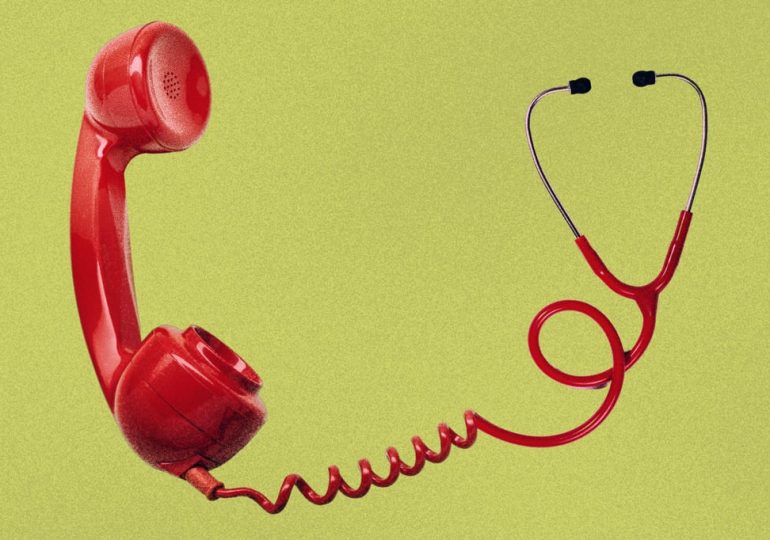
—Photo-Illustration by TIME (Source Images: the_burtons, Peter Stark—Getty Images)
Earlier this year, Olivia Mannion had one thing on her to-do list: schedule a six-month follow-up scan. She’s been in remission from Stage IV Hodgkin lymphoma for nearly four years, and while MRIs are always nerve-wracking, booking one was supposed to be the easy part.
What followed instead: 12 phone calls, 16 MyChart messages, a day off of work, and a call to her therapist—not because of her cancer, but because of the scheduling chaos surrounding it. At one point, she sent a message through the patient portal apologizing for being a pest. “All I was trying to do was advocate for myself,” says Mannion, 29, who lives in Saratoga Springs, N.Y. “And I truly felt like I was being an inconvenience to the system.”
Not long ago, calling your doctor meant actually talking to your doctor. Someone answered the phone, and if you needed a call back, you usually got one that day. While that scenario hasn’t entirely disappeared, it’s become unrecognizable for many patients. They call and reach an automated system that can’t understand them, or they send portal messages that go unanswered for days. “‘I just wanted you to hear my voice,’” Mannion wrote to her care team through the portal after weeks of messaging back and forth. “‘I want you to hear me as a person.’”
Mannion’s experience isn’t unusual. “What we’re seeing is the culmination of a number of still-ongoing changes in our health care delivery system,” says Dr. Gary Price, president of the Physicians Foundation, a nonprofit focused on physician well-being and health care system improvement. “It’s very real—and it’s getting worse.”
Why reaching your doctor has become so hard
Dr. Scott Titus, an internal medicine physician at a busy private practice in Annapolis, Md., says Monday mornings often bring a surge of activity at his clinic and many others like it. Before the phone lines even open, dozens of messages might be waiting. Once calls begin coming in, demand quickly spikes. “You can easily have 25 to 30 people trying to reach you all at once,” he says. “It peaks, and it’s very difficult to staff.”
Tara Gentry, a front-office manager at a family practice in Lexington, Ky., sees the same pressures from the other side of the desk. Doctors, she says, are managing large patient loads, and the demand for care often exceeds the time they have in a day. While they’re seeing scheduled patients, messages are coming in from every direction—phone calls, portal requests, questions from staff, even patients who walk in unscheduled. “There’s a lot on their plates,” she says. “We haven’t forgotten about people—we’re working on it.”
Juliana Parker, a registered nurse and founder of Nurse Corps Triage, an after-hours triage service for ob-gyn practices, has a front-row seat to just how overwhelming that volume has become. Her service handles calls at odd hours so that ob-gyns—many of whom work full days in the office and then spend nights on call delivering babies—can get some rest. She keeps track: Of every 1,000 calls her clients receive after hours, she handles 670 without contacting a doctor. “Sometimes they might get 14 calls a night,” she says of the physicians she works with. “Doctors will work all day, and then spend their weekends returning messages because there’s so much incoming.”
Read More: 8 Ways to Shorten Your Wait for a Doctor’s Appointment
While patients wait, physicians are often squeezing in phone calls and portal responses wherever they can—between appointments or late at night, for example. Parker says nurses keep an eye on the hallway between exam rooms, waiting for a doctor to step out so they can catch them for 30 seconds with an urgent question.
The problem isn’t just volume. It’s structure. Stephanie Broussard, director of social work at Thyme Care, a company that provides clinical support to cancer patients, says that in most practices today, a verbal or written message from a patient travels through multiple layers before it ever reaches a physician. “I don’t think it’s that doctors don’t want to talk to their patients,” she says. “They want to be available. But in a fee-for-service world where they’re asked to see so many patients a day and maneuver so quickly, it can be very difficult for them to get on the phone.”
Triage nurses, nurse navigators, medical assistants, and physician’s assistants all serve as filters—not to obstruct patients, but because the demand on any individual doctor’s time so vastly exceeds what’s available. “Providers understand that their patients want to get to them,” Broussard adds. “There are multilayers of support to try to triage, route, and answer questions earlier on, so the things that actually need to be escalated to the provider get there.”
Primary care in particular is under growing strain, Price says. More physicians are now employed by large hospital systems, a shift that’s added layers of staff, systems, and scheduling between patients and their doctors. And less than 5% of total U.S. health care spending—across insurers, government programs, and out-of-pocket costs—goes to primary care, even though it plays a key role in preventing costly complications. Plus, a growing physician shortage means doctors are responsible for more patients, with less time and control over their schedules.
Titus’ practice, meanwhile, recently implemented an AI-powered phone triage system—they named it Aimee—to manage the bottleneck of incoming calls. The tool handles routine requests like scheduling appointments and routing calls to the right department so staff are free to handle more complex or urgent matters. “We’re not trying to replace humans,” he says. “We want technology to carve out the tasks that are repetitive and automatable, and let the humans do what they do best.” It works well when the technology is thoughtfully implemented, Titus has found. But for many patients, automated phone systems can still feel frustrating or confusing—especially when they’re trying to reach a real person.
The cost of not getting through
When patients can’t reach their care team, the consequences range from frustrating to dangerous. Broussard describes what she sees most often: patients who turn to Google or AI chatbots for answers that should come from a clinician. “AI is a great asset,” she says, “but it’s best when paired with clinical judgment. It doesn’t create space for the nuances—your predispositions, your other conditions—that could impact what the best course of action would be for you.” She worries most about patients who, unable to reach anyone, simply wait. “People don’t want to be a bother,” she says. “So they sit and wait until symptoms are too severe—when it could have been something appropriately managed at the office level—and they end up in the ER.”
For Mannion, the patient in remission, the cost was as emotional as it was logistical. Having to spend weeks fighting through a scheduling maze on top of scanxiety was, she says, “a weight on my shoulders.” When she finally saw her provider, he apologized for the weeks of back-and-forth she’d had to endure.
“It really takes the empathy and the humanity out of health care,” Mannion says. “This is my provider’s job, and that is just one part of who that person is. But for me, this is my entire life.”
What you can do
Patients aren’t helpless. By better understanding the complex system they’re navigating, they can approach it strategically. Here’s what experts and experienced patients recommend.
Ask a crucial question at your first appointment
Catherine Hicks, 50, has lived with cerebral palsy, rheumatoid arthritis, and epilepsy since childhood, so she knows firsthand how frustrating navigating health care can be. She’s found that the single most useful thing you can do happens at your very first appointment with a new doctor: Ask them directly how to reach them in an urgent situation. But choosing the right words is critical.
“Don’t ask what the best way is to reach them,” she says. “Ask what the most expedited way is.” The distinction is significant—“best” might get you punted to a general voicemail, while “expedited” signals that you’re asking specifically about urgency. Some doctors, when asked this way, have given Hicks their cell phone number. Others have told her which staff member to ask for, or which hours the portal is most reliably checked. Whatever the answer, you want it before you’re in a crisis, not during one.
Leave a message that grabs their attention
A surprising amount of patient frustration is self-inflicted, Parker says—not because patients are doing anything wrong, but because they don’t realize how their messages land on the other end. Calling to say “Hi, it’s Mary, can you call me back?” creates too much work for office staff. A triage nurse receiving that message has to figure out which Mary called, call back just to find out what she needs, and then potentially call back again with an answer—doubling or tripling the number of interactions. “If you give very specific information,” Parker says, “it makes it so much easier, because I can go and talk to the doctor before I even call you back and hopefully get your solution taken care of in one call.”
That means providing your full name, date of birth, and callback number first in your voicemail. Then, state your symptoms—not your self-diagnosis. Don’t call and say, “I have a UTI,” Parker cautions. Describe exactly what you’re experiencing and how long it’s been going on, because those details determine how urgently your message gets escalated.
Caitlin Donovan, senior director of the Patient Advocate Foundation, has navigated the health care system both professionally and personally—including recently helping her aging father change neurologists because of chronic communication failures. She stresses that doctors are trained as scientists and respond to data. “Think about not just ‘I have a problem,’ but here’s the problem, here’s how it’s affecting me, here’s how often it’s happening, here’s how critical it is,” she says. “You’re giving them the information they need to triage you properly.”
And don’t be vague about what you want from the communication. If you’re calling to find out whether you should come in, say that explicitly.
Use the portal strategically
The patient portal is best suited for questions that can wait 24 to 48 hours, Titus says. For anything you’d describe as urgent, a phone call is still the more reliable channel—because calls can be triaged in real time in a way that portal messages often can’t. Broussard recommends starting with the portal for non-urgent questions, then following up by phone if you haven’t heard back within a reasonable window, or sooner if things are escalating.
Read More: 8 Phrases That Will Instantly Get Your Doctor’s Attention
Hicks adds a particularly useful trick: If you’ve sent a portal message about something important, call the office and let them know. “I’ve had them say, ‘Oh, wait a minute, I can have a look at that right now,’” she says. That double-tap—portal message plus phone flag—can dramatically speed up response time.
One caution from Titus that most patients don’t think about: Check your spam filter. Doctors’ offices often call back from numbers patients don’t recognize, and if your phone is set to silence unknown callers, you may be inadvertently blocking the response you’ve been waiting for.
Be willing to work with the whole team
One of the most common sources of patient frustration, Broussard says, is insisting on speaking only to the physician when a nurse practitioner, physician assistant (PA), or triage nurse could answer the question just as well—and far more quickly. “The days of always expecting to talk to your physician for answers unfortunately don’t exist as much anymore,” she says. “We’re moving to an interdisciplinary approach, and that may mean the person giving you your answers is a PA, or a triage nurse relaying guidance from the doctor.”
Building relationships with the broader care team, not just the physician, can make a meaningful difference in how quickly you get what you need.
Know when and how to escalate
If you’ve left a message and haven’t heard back within 24 hours, it’s reasonable to call again, Donovan says. The key is how you do it. Using clinical language—not aggressively, but in a way that signals you understand your situation—can shift how seriously you’re taken. When Donovan called her ob-gyn’s office about an unusual symptom and was told by the receptionist to “go to urgent care if you think something’s wrong,” she pushed back—not on the advice itself, but on being asked to make that call on her own, without a clinician’s input. “I said, ‘I feel like you’re asking me to self-diagnose,’” she recalls. The response was immediate—she was connected to a PA within minutes and soon got an appointment scheduled. Similarly, knowing who the office manager is, and being willing to ask for them when things have gone sideways, gives you an escalation path beyond just calling and getting nowhere.
Don’t stress about being a bother
Perhaps the most important thing, Broussard says, is to remind yourself that you’re not being a burden by calling. The triage lines, portal, and patient navigators exist because practices want to hear from you before symptoms become serious. “You matter,” she says, “and it’s important that you advocate for yourself and see that you’re worthy of the time and attention.”
Read More: 10 Symptoms ER Doctors Say to Never Ignore
Mannion puts it more bluntly. After nearly four years of navigating cancer care—and fighting just to get a routine scan on the calendar—she’s arrived at a clear-eyed conclusion about what it takes to survive the system. “It’s better to be persistent and perceived as a pest than to be dead,” she says. She thinks often about people who are less assertive than she is, or less comfortable with technology. “Patients can slip through the cracks,” she says. “You need to advocate for yourself as best you can.”
Leave a comment