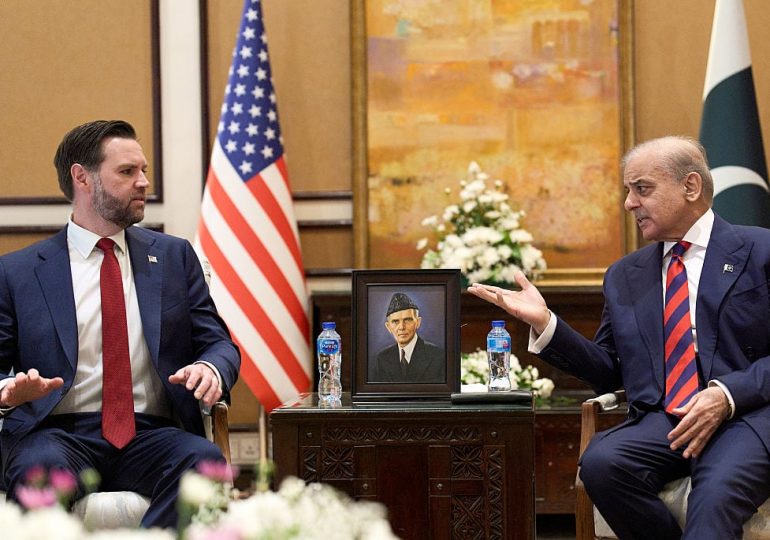
U.S. Vice President JD Vance meets with Pakistan’s Prime Minister Shehbaz Sharif during their meeting at Islamabad, Pakistan on April 11, 2026. —Jacquelyn Martin—Pool/Getty Images
The cocoon of Islamabad’s fanciest hotel was not enough to coax the United States and Iran into a historic peace agreement this weekend, but the progress made offered hope that dialogue was not over.
It was the highest level meeting between the two sides since the 1979 revolution in Iran, with talks running through the night.
The setting was a small purpose-built capital not used to high-stakes global diplomacy. Even many Pakistanis said it was surreal that world peace was to be decided in sleepy Islamabad. Yet, Pakistan, by having good ties with both Tehran and Washington, and playing no part in the war, was able to bring the two adversaries together.
On offer from the United States was a grand bargain: the lifting of sanctions on Iran, bringing the country fully into the international community, even a partnership. Washington wanted to test if the Iranian command, after seeing the destruction from six weeks of war and the killing of its Supreme Leader, would now bend to its will, experts said.
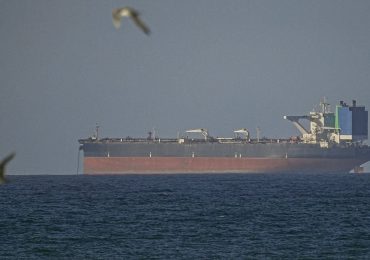
Yet Iran believed that it made gains from the conflict, including its hold over the Strait of Hormuz, which gave it leverage over the global economy. Tehran was not ready for what it would view as surrender.
Pakistani officials were working frantically to salvage the talks, with the Iranian side remaining behind to confer with Pakistani mediators for some hours after U.S. Vice President JD Vance left with the U.S. delegation.
For Washington, the deal breaker was nuclear weapons. Iran’s concern was more fundamental: the country’s Parliament Speaker Mohammad-Baqer Qalibaf said that the U.S. side “ultimately failed to gain the trust of the Iranian delegation in this round of negotiations.” Iran was bombed twice in the midst of talks with the United States over the last year. Tehran wanted assurance that the war would really be over this time, that the bombing would not restart once they made concessions.
“We will not for a moment cease our efforts to consolidate the achievements of the forty days of Iran’s national defense,” Qalibaf said in a post on X.
A weary Vance said the U.S. had made the “best, final offer” as he left Islamabad. President Donald Trump told Fox News on Sunday that it was a “really good meeting” – except for one issue: “they want to have nuclear weapons. It’s not going to happen.”
A U.S. official told TIME that Iran did not agree to several “red lines” set by the Trump Administration, including an end to all uranium enrichment, the dismantling of all major enrichment facilities, and the removal of Iran’s stockpile of highly enriched uranium from the country.
The official said Iranian negotiators also did not agree to end funding for allied militant groups across the region, and to fully open the Strait of Hormuz without charging a toll for passage.
Kamran Bokhari, senior resident fellow at the Middle East Policy Council, a think tank in Washington, said that U.S. demands on nuclear matters left no face-saving for the Iranian side, which viewed the nuclear program as a matter of pride. He saw the departure of the U.S. team as a “classic walk-out move,” from Trump’s negotiating playbook.
“The Iranians can’t look like they’ve capitulated,” said Bokhari. “The credibility of the regime at home and overseas is at stake.”
Pakistan’s powerful army chief Asim Munir has been key to his country’s role as mediator. Munir has built a rapport with Donald Trump, who has described him as “his favorite field marshal.” But Munir also knows the leadership of Iran’s Revolutionary Guards, since he served as head of military intelligence a decade ago, said Muhammad Saeed, a retired three-star Pakistani general.
Saeed said that Pakistan would continue to pass messages between the U.S. and Iran, with the possibility of Iran coming back with a counter-offer once they conferred with the rest of the leadership at home, and look to set up another meeting.
“Nobody from the two sides has said that they are done with this process and that it is dead,” said Saeed.
The ceasefire, for now, remained in place. But Trump’s announcement on Sunday of a naval blockade of the Strait of Hormuz – to stop Iranian use of the waterway – could reignite the conflict, with the Revolutionary Guards warning that “any miscalculated move will trap the enemy in the deadly whirlpools in the Strait.”
Iran’s semi-official Fars News Agency quoted an Iranian official saying that the U.S. was making “excessive demands” on the Strait of Hormuz.
“It seems that the United States is seeking to achieve through negotiations what it did not achieve during the 40-day war,” the official told Fars.
Trump has floated the idea of joint U.S.-Iranian administration of the Strait. Tehran rejected the idea, which surfaced in the talks, saying that it was in the territorial waters of Iran and Oman, and those two countries should manage it.
But even the fact that the two sides sat face-to-face, with Pakistani officials also in the room as mediators, was a breakthrough. Technical negotiations also took place separately. The last negotiation had been indirect talks.
The venue was the sprawling Serena Hotel, an oasis within what is already a bubble provided by Islamabad, a leafy city of broad boulevards that feels detached from the rest of Pakistan, an often chaotic country of 240 million people.
The hotel is a retreat loved by Islamabad’s expatriate community, with a sushi restaurant, banquet halls, lawns, and a rooftop pool that is a spot for bikini-clad sunbathing on the weekends.
Iran’s spokesman Esmaeil Baqaei said that it was obvious that after a war, and years of mutual suspicion, a single negotiating session was never going to resolve all their differences. He said there was agreement on a range of issues, with two or three sticking points. Texts were exchanged between the two sides, he said.
Iran’s ambassador to Pakistan, Reza Amiri Moghadam, said that the talks were held in a dignified and calm atmosphere.
“The Islamabad Talks laid the foundation for a diplomatic process that, if trust and will are strengthened, can create a sustainable framework for the interests of all parties,” he said.
The conflict had added complications to the U.S.-Iran agenda: the Strait of Hormuz, Israel’s bombing of Lebanon, and Iran’s demand for reparations.
Sina Toossi, senior non-resident fellow at the Center for International Policy, a research and advocacy group in Washington, said that both sides had incentives to continue negotiating.
“The costs of renewed war are high for both,” said Toossi. “At the same time, political dynamics in Washington and Tehran, and the tendency toward maximalist positioning, could easily pull things back toward confrontation.”
Leave a comment