
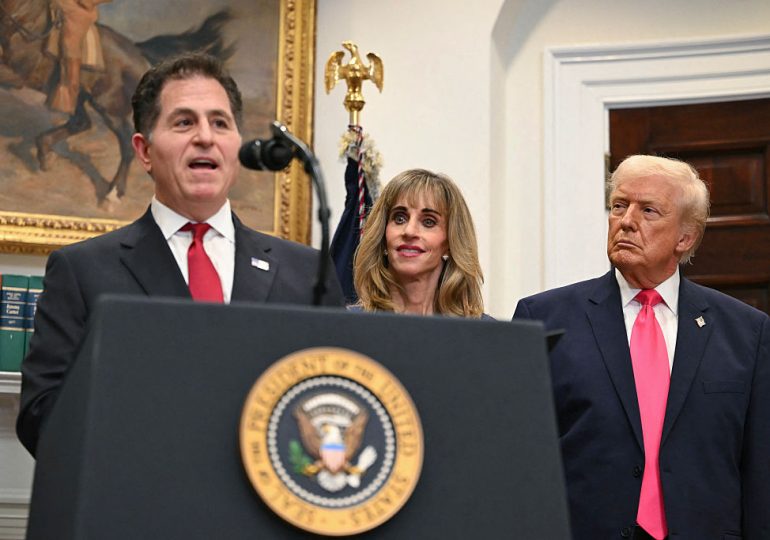
At the White House this week, tech CEO Michael Dell and his wife, Susan, announced a $6.25 billion gift to support one of the President’s signature initiatives: a new tax-advantaged savings vehicle known as the “Trump Account.” The program creates an investment account for every newborn, seeded through a $1,000 federal deposit, with the stated goal of helping all Americans begin building assets from day one.
[time-brightcove not-tgx=”true”]
It is easy to see the surface-level appeal of Trump Accounts. After months of federal policies that have squeezed working families—from tighter SNAP eligibility to higher health-care premiums—any effort to help parents save for their children is a welcome shift. And the instinct behind the program is sound: well-designed, automatic savings can influence family behavior. A study of Oklahoma’s SEED OK experiment found that newborns who were randomly assigned to receive $1,000 in a 529 College Savings Plan saw their parents report higher expectations for their children’s education and engage more in long-term planning. Trump Accounts are not designed exclusively for education, but the study offers hope that well-designed savings policies can change how families plan for their children’s future.
But while the White House frames the Trump Accounts as a way to “give every newborn child a head start toward lifelong financial security and the American Dream,” the reality is far less even-handed. The program may be open to every child, but its benefits will flow overwhelmingly to families with the means to contribute thousands of dollars a year. What could have been a leveling tool instead risks becoming a widening wedge between the haves and the have-nots.
You don’t have to take our word for it; the White House’s own numbers make this plain. In its analysis, the Council of Economic Advisers modeled how much a child’s account would grow under different contribution patterns. For a family living paycheck-to-paycheck that is unable to add anything beyond the government’s $1,000 seed deposit, the balance reaches just $5,839 by age 18. That’s better than nothing, but hardly transformative.
For wealthier families, the picture looks entirely different. Those able to make the maximum contributions of an inflation-adjusted $5,000 per year will see the same account swell to $303,757 by age 18. Two children, two seemingly identical programs, and two very different financial futures.
And the disparities don’t stop there. Because Trump Accounts are structured like tax-advantaged retirement plans, the families who contribute the most also receive the largest tax breaks. A child whose family can’t save beyond the initial $1,000 sees only modest tax benefits by age 18. A child whose parents can make the maximum contributions receives tax relief on an entirely different scale. In short: the richer the parents, the bigger the tax subsidy.
But it doesn’t have to work this way. We already have models for building children’s assets in ways that narrow gaps rather than widen them—approaches designed to give kids without family wealth the foothold that some savings can provide.
The basic idea of the Trump Accounts echoes a previous proposal from Senator Cory Booker known as “Baby Bonds.” That plan would also give every child a $1,000 deposit at birth, but would add up to $2,000 a year in federal contributions, with the largest amounts going to the families with the least. By the time those children reach adulthood, they would have a meaningful nest egg to put toward education or buying a first home. The law’s framers estimate that it could create an account balance of $46,215 for the poorest 18-year olds in the country, significantly more than the Trump Accounts would provide. It’s the same premise—build assets early—but would level the playing field rather than tilt it further.
The Trump Accounts, as enacted, do not achieve any significant field-leveling promise. The only income-targeted element comes not from the federal design but from private philanthropy. The Dells’ gift will be directed to children in ZIP codes with median household incomes below $150,000—an effort to focus resources where they can do the most good. Their contribution underscores a simple point: when support is targeted to families with the least, the impact is far greater.
But while these accounts are far from perfect, they are a start. Both parties are now talking more seriously about helping the next generation build wealth, and there is broad public support for the idea that every young person should begin adulthood with some savings to their name. To help level the playing field for the next generation, low-income families who don’t have the disposable income to invest should receive more seed funding upfront and additional support over time.
Here’s the north star: A children’s savings program ought to lift up those without a financial head start, not reinforce advantage. And if we get this right, the next generation—no matter their circumstance—will enter adulthood with the foundation for a brighter economic future.
Leave a comment