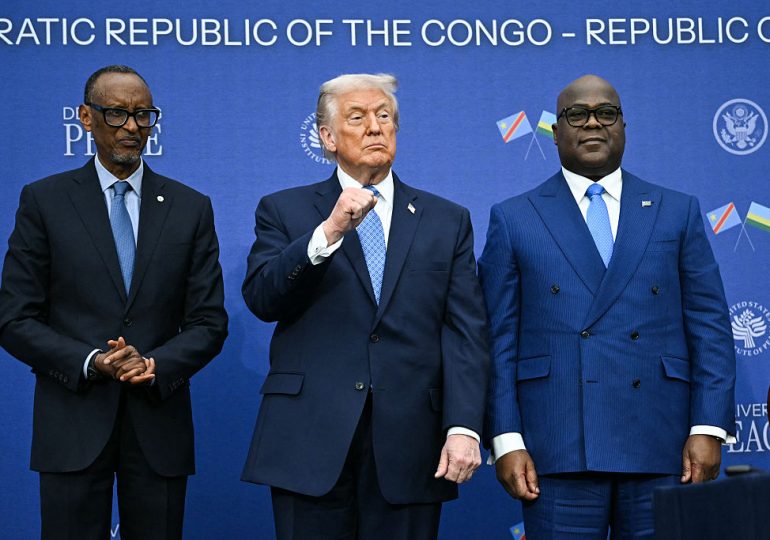
Last week, U.S. President Donald Trump hailed a “historic” peace deal between the Democratic Republic of Congo and Rwanda. Yet there was no public handshake at the summit in Washington between DRC President Félix Tshisekedi and Rwanda’s Paul Kagame, and the violence has continued ever since President Trump began mediating the conflict in April.
[time-brightcove not-tgx=”true”]
The two nations have often been at odds over the past 30 years, but the conflict sharply escalated in January after Rwanda-backed M23 rebels seized large parts of mineral-rich eastern DRC in an offensive that has killed thousands and displaced hundreds of thousands more.
Given the grim reality of the conflict, President Trump’s mediation efforts should be welcomed. But if President Trump wants to truly realize his vision for regional peace and prosperity, he must now build on the summit with sustained high-level engagement and increase pressure on both nations to abide by their commitments.
The task is urgent. M23 has launched several new offensives in the last two weeks, making significant advances for the first time since March. The surge in fighting is unsurprising. The previous months, M23 was waging smaller offensives to set conditions to take key positions in the eastern DRC that it is now capitalizing on, while the Congolese military was conducting an airstrike campaign against M23-held areas. Both sides had heavily reinforced the front lines with thousands of new forces and increasingly advanced materiel.
The Washington Accords—the DRC-Rwanda peace deal—alone will not change this reality. It hardly addresses the role of militias, particularly the M23, who are involved in the vast majority of the fighting. That issue is being discussed in the parallel Qatar-led Doha peace process. While the DRC and M23 signed a framework agreement on Nov. 15 as a prerequisite to the Washington Accords, it is non-binding and both sides have already violated the cease-fire.
Rwanda continues to provide covert support to M23, while publicly denying it backs the rebels. M23 itself likely sees no reason to agree to a political settlement or disarmament, especially while it faces no external military threat to its control and is busy building an extensive parallel state. The Congolese government does not face a direct military threat from M23, enabling the government to repeatedly issue hardline demands in the talks that it does not have the military leverage to enforce as it conducts airstrikes and equips rival militias.
All of this undermines the entire U.S.-backed peace framework. That is why President Trump should increase efforts to hold Rwanda and the DRC to account, and break this familiar pattern.
Read More: How Rwanda and DR Congo Can Forge a Lasting Peace
The U.S. can start with threatening to withhold investment and consider sanctioning Rwandan officials unless Kigali cuts support for M23 and pushes it to negotiate in good faith. Rwanda should immediately pressure M23 to halt its ongoing offensives in South Kivu, which violate the Qatari-brokered ceasefire. Kigali forced M23 to withdraw from Walikale town in North Kivu in April as part of peace efforts and, according to a U.N. Security Council report, Rwanda exercises command and control over the group and provides vital military hardware. President Trump should also demand that Rwanda stop supporting M23 efforts to build a parallel state and pursue genuine negotiations toward some form of reintegration into the DRC.
President Trump must apply equal pressure on the DRC and Congolese officials fueling rival militia groups. The DRC must be more willing to make realistic compromises, especially regarding some form of M23 integration into the state, cut its support for armed groups in the eastern DRC who regularly attack M23 and threaten Kinyarwanda speakers, and stop violating the cease-fire with air attacks on populated areas. The U.S. could also condition certain investments on much-needed governance reforms.
For these efforts to be successful, President Trump should ensure that there is more frequent and more high-level engagement in the peace process. President Trump’s Africa adviser, Massad Boulos, has made commendable effort in shepherding the peace process to where it is today. However, Boulos is overstretched, with a mandate covering the entire continent and limited institutional clout. Greater involvement from Secretary of State Marco Rubio and President Trump himself will help re-energize the peace process.
The risk is that these efforts stall. Another outbreak of violence a day after the peace deal was signed in Washington was hardly reassuring. Only through a more comprehensive and rigorous framework can President Trump’s vision of peace and prosperity in the region be realized.
Leave a comment