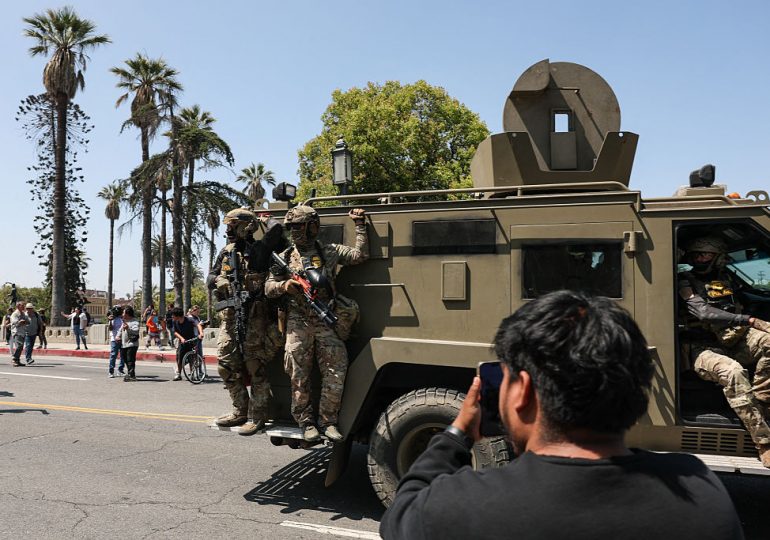
On July 7, 2025, armored vehicles rolled into MacArthur Park, in Los Angeles, where children were at summer camp. National Guard troops deployed alongside federal agents on horseback, looked like soldiers in a war zone. Community health workers providing routine medical services scattered in fear. Mayor Karen Bass, who confronted the agents at the scene, called it “a city under siege.”
[time-brightcove not-tgx=”true”]
MacArthur Park was just the most visible spectacle in a months-long campaign. Throughout the summer, ICE raids swept through Home Depot parking lots, car washes, bus stops, and farms across Los Angeles County, targeting people who looked like they could be undocumented immigrants. Appearance alone was used to warrant probable cause.
In September, the Supreme Court formally cleared the way for agents to profile people based on their race.
All of this sparked massive fear, so people stopped going to work. Businesses shuttered. Parents kept their children home, afraid to let them board school buses or walk familiar streets. By October 14, the economic and social disruption was severe enough that the Los Angeles County Board of Supervisors declared a state of emergency. The predominantly immigrant neighborhoods, many inhabited by U.S. citizens, were asking, once again, “Why do I get the feeling I don’t belong here?”
Eighty-two years earlier, during a different crisis, the same city asked the same question.
The Zoot Suit Riots
In June 1943, military servicemen prowled the streets of Los Angeles for multiple nights, hunting down Mexican American youths in the infamous “Zoot Suit Riots.” The unofficial campaign targeted kids wearing zoot suits: extravagant outfits with broad-shouldered jackets tapering to thin waists and baggy pants that draped elegantly at their ankles. These weren’t just clothes. They were declarations of identity as Americans, crafted by minority communities claiming the belonging they’d been promised.
Born in the late 1930s from African American, Latino, Filipino, and other communities, the zoot suit was designed for looking sharp when you came from nothing. Those who wore them were called “Pachucos,” young men and women who adopted not just the style but an entire identity, speaking their own slang, “caló,” and embodying urban cool in a way that threatened the established order. But the trend wasn’t foreign. It was as American as jazz itself, and like jazz, it was treated as dangerous precisely because it came from communities the establishment wanted to keep invisible.
In wartime Los Angeles, with Pearl Harbor still fresh in people’s minds, and 120,000 Japanese Americans banished to internment camps, paranoia ran deep. The press whipped up hysteria about “zoot suit gangs.” When servicemen attacked, young men were savagely beaten, some stripped of their zoot suits and left naked and unconscious on the street. Instead of arresting the attackers, the police often arrested the victims.
The message was clear: you don’t belong here.
But many of the young men and women who were arrest arrested came from families who had been in Los Angeles for generations, some since before California became part of the United States. They weren’t immigrants. It was the border that moved, suddenly making them foreigners in their ancestral homeland. The riots weren’t just about fashion or even assimilation. They were about America abandoning its founding principle, that all people are created equal, with rights that can’t be taken away. In practice, though, that equality kept requiring proof, and the proof kept changing depending on who was asking.
Belonging in America
I grew up in suburban Texas in the 1980s and ’90s, where I learned, as if through a toxic poison in the air, that to be Mexican was something to be ashamed of. Or at least something to deflect with jokes.
I remember in second grade when someone asked me, “Your last name is Alvarado? What are you, like, Mexican?”
Without thinking, I felt a pang of shame and quickly shot back, “No, actually, my family is from Spain.”
It was a lie. To the extent that I found a social circle in a predominantly white, suburban Texas community, it was mostly among outsiders. The pissed off punk rockers, the hopelessly antisocial geeks, and the kids doing drugs. I eventually dropped out of high school, but found my way back through community college, discovered filmmaking, and for the first time in my life started making good grades. Good enough to receive a Hispanic scholarship award. At the ceremony, when I was 21, I met the writer, director, and actor Luis Valdez for the first time.
From Valdez’s early days on the picket lines in the 1960s with Cesar Chavez and Dolores Huerta his theater group El Teatro Campensino (the Workers’ Theater) challenged the narrative that farmworkers were foreign laborers rather than indigenous peoples working their ancestors’ land. He made a career of saying: We belong here, and there’s no shame in being Mexican American. But it was in 1979 that Valdez crystallized this argument when his production “Zoot Suit” became the first Chicano play to reach Broadway.
The play, which dramatized the Zoot Suit Riots, had broken box office records at the Mark Taper Forum in Los Angeles in 1978 before heading off to Broadway. Valdez would go on to write and direct “La Bamba,” the 1987 blockbuster that brought Latino stories to mainstream Hollywood.
At that scholarship award ceremony, Valdez spoke about Teatro Campesino, about farmworkers’ dignity, about making theater a weapon for humanity. But what struck me most was simply seeing him there: a Mexican American artist who had made it, proving that it was possible to be proud of who you are and to know you belong in the grand American experiment like everyone else.
In some ways, that night launched my 15-year documentary career. I’ve directed films about luminaries in science, technology, and health, but have recently decided to take a more personal inward journey into questions of identity and belonging in America. Now that I’m finishing my documentary on Valdez’s life, I can’t escape how history is repeating itself. I also can’t escape what he taught me about seeing that history clearly.
The conventional national narrative treats Mexican Americans as immigrants who must earn belonging. But many Chicanos trace their lineage to indigenous peoples who survived Spanish colonization, often carrying mixed indigenous, Spanish, and other ancestries, a testament to survival and cultural fusion. Think about the implications. We call ourselves a “nation of immigrants” while treating people with some of the deepest roots as perpetual foreigners. How do you “immigrate” to a land that was your ancestors’?
In 1943, zoot suiters were beaten in the streets for daring to unapologetically occupy the same space as white Americans. In 2025, families who had peacefully integrated into American society were forced into hiding. Both times, with the same message: you don’t belong. But Valdez understood that the Pachuco in his zoot suit was the American experiment working exactly as promised. People creating culture, claiming dignity, refusing shame.
The question facing our country is not really about documents or borders. It is, and has always been, about whether America would honor its own promise.
The Pachucos belonged in 1943. The families in MacArthur Park belong in 2025. But America keeps treating belonging as something they must earn rather than something they already possess, and in that gap between promise and practice, the nation betrays not just them, but itself.
Leave a comment